
Wohnwand Wood
-
Wall Unit CLIF - Living Room Furniture Set - San Remo Oak / Anthracite GreyRegular price $529.99Unit price / perRegular priceSale price $529.99
-
Wall Unit VISTE - Living Room Furniture Set - Scandi / Truffle / White GlossRegular price $719.99Unit price / perRegular priceSale price $719.99

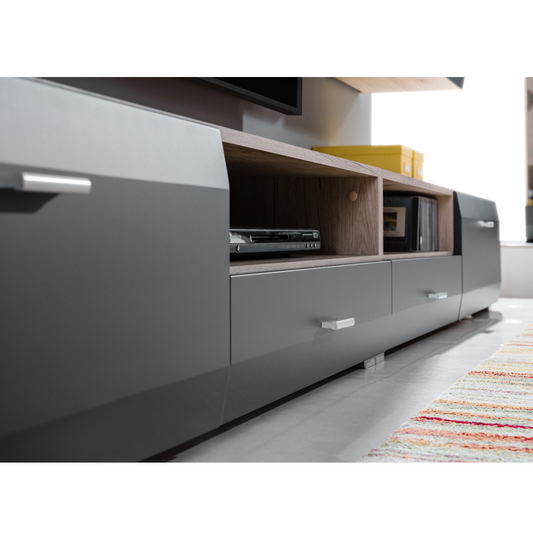

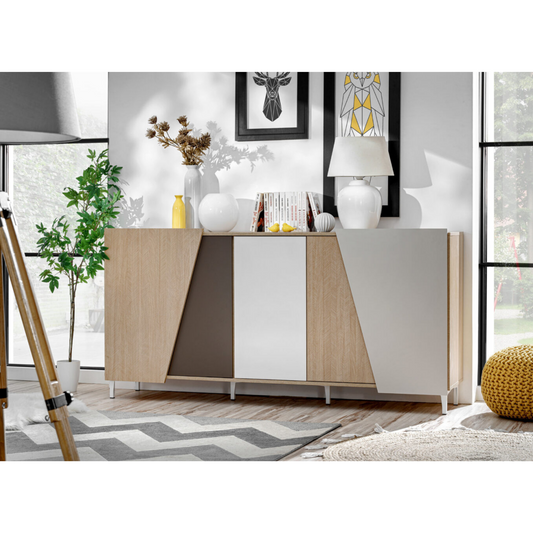
Awooden entertainment center(or wall unit) refers to a modular or free-standing cabinet and shelving system designed for the living room. Its carcass and fronts are constructed from engineered wood materials such as melamine-facedparticle board,MDF(medium-density fiberboard), orsolid wood. These furniture sets typically consist of multiple elements, including display cabinets, wall-mounted cabinets, floating shelves, and TV media consoles (lowboards). They serve to provide structured storage for media equipment, books, and everyday household items.
Technical Fundamentals and Material Selection
When assembling awall unit, the substrate material dictates the overall stability, weight, and assembly techniques required during installation. The industry distinguishes between three primary categories for furniture construction:
- Melamine-Faced Particle Board:The standard choice for cabinet carcasses. Wood chips are compressed with synthetic resin under heat and high pressure. The typical thickness for entertainment centers ranges from 19/32 in to 7/8 in (15 mm to 22 mm). The melamine resin coating renders the surface scratch-resistant and moisture-repellent.
- MDF (Medium-Density Fiberboard):Frequently used for cabinet fronts and doors. Due to its fine fiber structure, edges can be routed cleanly. MDF is denser and heavier than standard particle board, offering a smoother substrate for high-gloss foils or matte lacquers.
- Solid Wood:Made entirely of real timber.Solid wood entertainment centershave a high dead weight and react naturally to ambient humidity. Assembly requires expansion joints to allow the wood to move. Those searching specifically for a modernreal wood entertainment centerwill find designs frequently combined with architectural metal elements.
Finishes and Surfaces
The aesthetic appeal of a wooden entertainment unit is defined by its finish. Popular choices in DIY and commercial furniture manufacturing include engineered wood grain laminates with a tactile texture (embossed-in-register). Common wood finishes includeWotan Oak,Sonoma Oak, andArtisan Oak.
Modern interior concepts frequently incorporate contrasting materials. For example, awhite and wood entertainment centerpairs white high-gloss or matte MDF fronts with an oak-finish carcass. Darker pairings, such as ananthracite and wood wall unitormatte black and wooddesigns, are also common choices to visually integrate electronic devices like flat-screen TVs into thewooden TV wall unit.
Space Planning and Dimensions
Before installing awooden living room wall unit, precise measuring of the available wall space is essential. A standard full-size set requires a total width ranging from 86-5/8 in to 126 in (220 cm to 320 cm).
- Depth:TV lowboards typically feature a depth of 15-3/4 in to 19-11/16 in (40 cm to 50 cm) to provide adequate space for media receivers or gaming consoles. A standalone wooden TV stand follows the same dimensional standards.
- Height:Floor-standing display cabinets often reach heights of 74-13/16 in to 82-11/16 in (190 cm to 210 cm). Wall-mounted cabinets offer flexible positioning, with their top edges typically aligned flush with the tall units.
- Cable Management:Planning must account for wall outlet placement. Backing panels (typically 3/32 in to 1/8 in / 2.5 mm to 3 mm HDF board) often come equipped with pre-drilled cable pass-through grommets or cutouts.
DIY Assembly: Setup, Tools, and Hardware
Assembling a modular wooden wall unit requires a systematic approach. A reliable spirit level is mandatory—without exact horizontal and vertical alignment, cabinet carcasses will rack, leading to rubbing cabinet doors and sticking drawer slides.
Required Tools
To assemble awooden wall unit, ensure the following tools are on hand:
- Cordless drill/driver with bit set (PZ2for most European cabinet hardware, orPH/TXdepending on the manufacturer)
- Phillips screwdriver for fine-tuning cabinet hinges
- Rubber mallet for drivingwooden dowels
- Spirit level (at least 23-5/8 in / 60 cm in length)
- Hammer drill (for anchoring wall-mounted elements into masonry/studs)
- Tape measure and pencil
Carcass Assembly and Joinery Hardware
Load-bearing cabinet panels are traditionally joined using a combination ofwooden dowels(typically 5/16 in x 1-3/16 in / 8 x 30 mm) andcam lock fasteners(Minifix). The dowel handles shear forces, while the cam lock pulls the components tightly together under tension.
For securing the back panel, either small panel nails or specializedwood screws and cabinet screwsare used. Screwing the back panel at intervals of 3-15/16 in to 5-29/32 in (10 cm to 15 cm) provides the final squareness and torsional rigidity to the cabinet. Visible screw heads inside the unit can be concealed post-assembly usingself-adhesive wooden screw cover caps.
Cabinet Hardware: Hinges and Drawer Slides
The moving components of an entertainment center determine its overall ergonomics and functionality.
- Concealed Hinges:Cabinet doors are mounted using European-style concealed cup hinges. The industry standard cup diameter is1-3/8 in (35 mm). Wall units typically use hinges with an opening angle of110°. Choosefull overlay hingesfor outer doors, orhalf overlay hingesfor doors sharing a common center partition.
- Drawer Slides:Lower media units frequently feature drawers. These are categorized intopartial extension slides(drawer opens to approx. 75%) andfull extension slides(100% access). They are commonly supported by side-mountedball bearing slidesor concealedunder-mount drawer slides.
- Soft-Close vs. Push-to-Open:Asoft-close mechanismdampens the closing action and gently pulls the door shut over the final few inches. Apush-to-open latch(touch release) operates on the opposite principle for handleless fronts: pressing the wooden panel releases a spring-loaded plunger that pops the door or drawer open. Both mechanisms should not be installed simultaneously on the same door.
Wall-Mounting Upper Elements
Wall-hung display cases and floating shelves require secure anchoring to wall studs or masonry. Standard drywall anchors included in packaging are often insufficient; heavy-duty hollow-wall anchors or toggle bolts should be used for drywall applications. Mounting usually relies on adjustable cabinet suspension brackets inside the carcass that hook into a wall-mounted metal rail. This allows for precise micro-adjustments in height and depth after hanging.
Featured Models and Configurations
Various configurations are available depending on room dimensions and color schemes. Those seeking a contemporarymodern wooden entertainment centerwill find models that mix wood grains with solid accent tones.
- For fans of dark accents, theCLIF Wall Unit - Living Room Furniture Set - San Remo Oak / Anthracite Graycombines natural oak textures with dark charcoal tones for an industrial look.
- A brighter, Nordic-inspired variation is offered by theROSA Wall Unit - Living Room Furniture Set - Pearl White Matte / Coast Evoke Oak.
- For designs focused on high-gloss contrast, choose theMIRANDA 4-Cabinet Wall Unit - Wotan Oak / Gloss White.
- For a striking, dark design aesthetic, consider theSOLIDO Wall Unit - Living Room Furniture Set - Matte Black / Artisan Oak.
Frequently Asked Questions (FAQ)
How long does it take to assemble a complete wooden entertainment center?DIYers should plan for an assembly time of 4 to 6 hours for a 4-piece furniture set. Assembly should generally be performed by two people, especially when hanging wall-mounted units and leveling tall standing cabinets.
How do I properly align and adjust cabinet doors?Door adjustment is made using the calibration screws on theconcealed hinge. The front screw on the hinge arm adjusts side-to-side reveal (lateral adjustment). The rear screw on the mounting plate releases the arm to adjust depth (distance from the carcass). Height adjustment is achieved via the vertical screws on the mounting plate.
How much weight can a floating shelf or wall-mounted cabinet hold?Load capacity depends heavily on wall construction and fastener selection. A wall cabinet properly anchored into solid masonry or wood studs can typically support 33 lbs to 44 lbs (15 kg to 20 kg). Simple wooden floating shelves usually have a load limit of 11 lbs to 22 lbs (5 kg to 10 kg). Always follow the manufacturer's exact weight ratings.
Can the individual cabinets of a wall unit be set up separately?Yes, with modular systems, individual components (display cases, TV stands, wooden credenzas) can be arranged freely throughout the room. However, if the entertainment center is designed as a fixed, interconnected unit, the sections may share common side walls and cannot be separated.
Related Projects and Upgrades
If you want to furnish your living room beyond thewooden entertainment center, complementary storage pieces can seamlessly expand your space. For open-concept dining or living areas, matching accent furniture creates visual harmony. A standalone sideboard in a matching wood finish offers additional storage for linens, media, or dinnerware. Explore related hardware, components, and furniture in these categories:
- Wall Units & Entertainment Centers
- Wooden Dressers & Credenzas
- Dark Wood Credenzas
- Wooden TV Stands & Lowboards
- Modern Wall Units
- White High-Gloss Wall Units
- Concrete-Look Entertainment Centers
- High-Gloss Entertainment Centers
- Wall Units with Display Cabinets
- Wall-Mounted Entertainment Centers