
Magnetic door catch
Popular Subcategories


-
Black Magnetic Door CatchRegular price $0.24Unit price / perRegular priceSale price $0.24
-
Brown Magnetic Door CatchRegular price $0.24Unit price / perRegular priceSale price $0.24
-
White Magnetic Door CatchRegular price $0.18Unit price / perRegular priceSale price $0.18

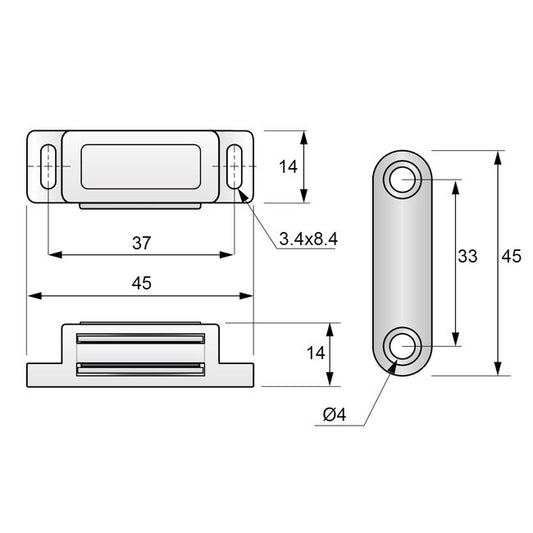

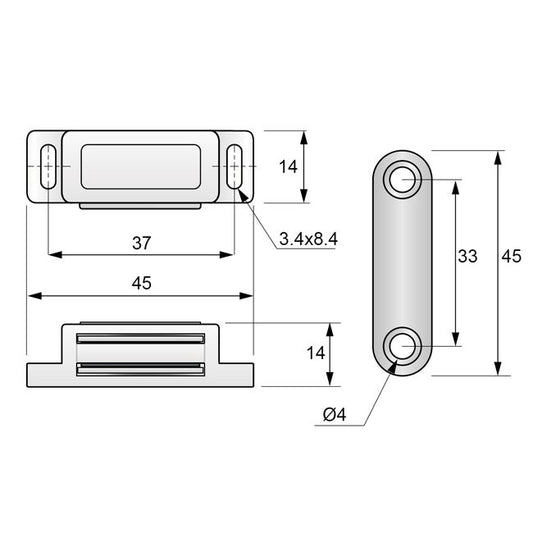

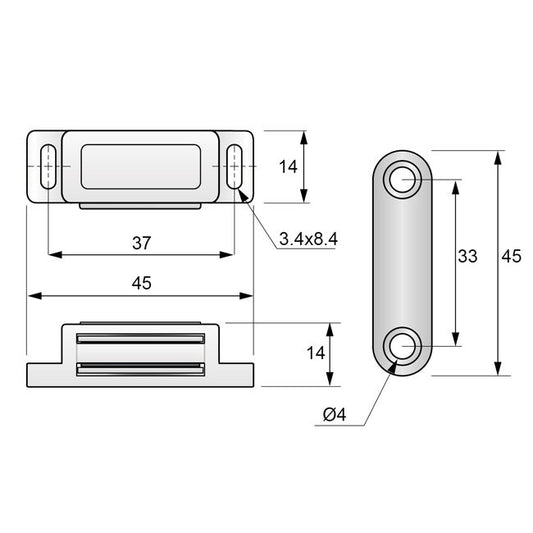
A magnetic door catch is a mechanical-magnetic closing mechanism designed to hold cabinet doors, flaps, or lightweight interior doors securely in a closed position without the need for a mechanical latch.Its construction consists of two primary components: a stationary housing containing a permanent magnet, and a ferromagnetic metal counterplate (strike plate). The system relies on magnetic attraction to bridge the gap between the cabinet body and the door front, holding the door flush against the frame stop.
In cabinet making and interior joinery, amagnetic door catchserves as an essential hardware solution whenever doors are designed without conventional locking mechanisms, such as mortise locks or spring-loaded hinge detents. Particularly on cabinets, access panels, or patio doors, this hardware prevents uncontrolled swinging caused by drafts or natural material tension.
Operating Principle and Technical Fundamentals
The technical reliability of a magnetic door catch depends on direct surface contact between the magnet and thecounterplate. The magnet inside the housing is typically made of hard ferrite or, in heavy-duty versions requiring maximum holding force, neodymium. The counterplate is stamped from ferromagnetic sheet steel.
As the door closes, the metal strike plate approaches the magnetic field. Within a distance of a few millimeters, magnetic attraction pulls the door flush against the cabinet body. Like an invisible anchor, the magnetic field keeps the cabinet front precisely in place, even if minor warping forces affect the wood. Maximumholding force(often specified in pounds, kilograms, or Newtons) is achieved only when the strike plate sits completely flat against the magnet's pole pieces without any air gap. Even a tiny air gap of 1/16 in (1 mm) or 3/32 in (2 mm) reduces the holding force exponentially. Precise adjustment during installation is therefore essential.
Select models feature a floating magnetic core. This design allows the magnet to pivot slightly (typically 2° to 3°) to compensate for minor angle alignment errors in the closed door, ensuring full surface contact with the strike plate.
Varieties and Designs in Cabinetry
Selecting the right catch depends on cabinet design, available interior space, and required holding force. Housings are typically molded from durable plastic (polyamide or ABS) that protects the magnet from mechanical impact when the door slams shut. To blend discreetly into furniture, catches are available in various colors to match standardparticleboardor solid wood finishes.
For dark wood decors such as Wotan oak, walnut, or black melamine panels, theMagnetic Catch with Metal Strike Plate - Blackis recommended. It integrates seamlessly into dark cabinet interiors.
For classic white kitchen cabinets, bathroom vanities, or light wardrobes, theMagnetic Catch with Metal Strike Plate - Whiteis the ideal choice. Alternatively, for identical applications, a slightly different housing style is available as theMagnetic Catch with Metal Strike Plate - White, which may feature slightly different mounting hole centers.
For natural wood furniture, rustic cabinets, or Sonoma oak finishes, woodworkers frequently select theMagnetic Catch with Metal Strike Plate - Brownto minimize visual contrast between the hardware and the timber.
Strike Plate Styles
The ferromagnetic strike plate is a critical component. Two primary mounting types are available:
- Rigid Strike Plates:Mounted with a single centered countersunk screw. They often feature small stamped prongs on the back that press into the wood or MDF panel when tightened, preventing the plate from spinning.
- Self-Aligning Strike Plates:Mounted loosely or featuring slight play within their housing. This allows the plate to adjust dynamically to the magnet upon closing.
Selecting and Calculating Holding Force
Holding force specification is the key technical metric when choosing hardware. A standardmagnetic door catchfor standard cabinetry (e.g., lightweight MDF fronts, 5/8 in (16 mm) or 3/4 in (19 mm) thickness, dimensions up to 23-5/8 in x 31-1/2 in (600 mm x 800 mm)) typically requires a holding force of 4.4 lbs to 8.8 lbs (2 kg to 4 kg / ~20 N to 40 N).
If holding force is oversized, opening the cabinet door requires excessive force, which can strip hinges or pull handles loose over time. If holding force is undersized, spring tension from un-damped concealed hinges or light air currents will push the door open.
Heavy Doors and High Tension Applications
When installing amagnetic door catchon heavy solid wood doors (e.g., oak, 7/8 in (22 mm) thickness, heights exceeding 78-3/4 in (2000 mm)), a single standard catch is often insufficient. In these scenarios, install two catches per door—one in the upper third and one in the lower third of the front. This also prevents timber warping over time by holding the door flush against the frame at two points.
Another specific application is thepatio magnetic door catch. These are significantly heavier-duty units. When a patio door is pulled shut from the outside, the magnetic closure keeps the door latched in the frame without engaging the main handle mechanism. This prevents wind from blowing the door open while using the patio. These systems require holding forces of 22 lbs to 33 lbs (10 kg to 15 kg) and are specifically designed for mounting into vinyl (PVC) or aluminum window profiles.
Detailed Application Areas
Themagnetic door catchis a versatile hardware component used across various woodworking projects.
Cabinet Doors and Storage Units
This is the primary application. A magnetic catch is required whenever cabinets feature hinges without built-in self-closing springs. On antique furniture with broken mechanical locks, woodworkers frequently retrofit an unobtrusive magnetic catch to restore functionality without damaging historical door fronts with new drill holes.
Drawers and Pull-Outs
Although modern drawers utilize roller or ball-bearing slides with integrated soft-close or detent mechanisms, custom wood-on-wood runner systems occasionally benefit from amagnetic drawer catch. Installed on the cabinet back panel, the magnet holds the drawer box perfectly flush against the front face frame when closed.
Access Hatches and Concealed Panels
In architectural millwork (such as bathtub access panels or utility chase covers), panels are designed without visible knobs or hinges. Standard magnetic catches can be paired with touch latches here. Note: A standard magnetic catch isnotthe same as a mechanical push-to-open touch latch. A standard catch holds the door passively, whereas a push-to-open system (tip-on mechanism) features a spring-loaded plunger that actively ejects the door upon pressing.
Professional Installation and Alignment
Installing a magnetic door catch requires precision. Misalignment leads to visible gaps between the door and cabinet frame or drastically reduces holding power.
Tools and Fasteners Required
For mounting into engineered wood (particleboard, MDF, plywood), you will need:
- Phillips screwdriver (typically #1 or #2 driver)
- Scratch awl or pilot drill bit (1/16 in to 3/32 in (Ø 2 mm to 2.5 mm))
- Tape measure and combination square
Use standardwood screwsorparticleboard screwsfor installation. For the plastic housing, pan-head or round-head screws with a diameter of 1/8 in (3 mm) or #6 (3.5 mm) are ideal. Countersunk screws will split the plastic slotted mounting holes when tightened. For the metal counterplate, you must use a countersunk screw (1/8 in / 3 mm) so the screw head sits completely flush with the metal face and does not block magnet contact.
Step-by-Step Installation Guide
- Positioning the Housing:Mount the magnetic door catch inside the cabinet frame, ideally at the corner farthest from the hinges for maximum leverage. Set back the housing from the front edge by a distance equal to the door thickness plus the counterplate thickness.
- Pilot Holes and Mounting:Mark the center of the slotted screw holes using an awl. After drilling pilot holes (max. 3/8 in (10 mm) deep), mount the housing hand-tight. Slotted holes allow approximately 1/16 in to 5/32 in (2 mm to 4 mm) of depth adjustment later.
- Attaching the Counterplate:Finding the exact location for the strike plate on the inside of the door is critical. A cabinetmaker's trick: Place the counterplate directly onto the mounted magnet. Apply a tiny dab of paint or a piece of double-sided tape to the back of the strike plate. Close the door firmly against the cabinet frame; the paint mark transfers, or the plate adheres to the door in the precise position.
- Screwing Down the Plate:Pre-drill at the marked spot using a 1/16 in (2 mm) bit and secure the counterplate using the flat-head countersunk screw.
- Fine Adjustment:Close the door. If the door face does not sit flush with the cabinet, loosen the housing screws slightly. Slide the housing forward or backward within its slotted holes by a fraction of an inch and re-tighten.
Compatibility with Hinge Systems
Hinge selection directly dictates whether a magnetic door catch is required.
- Concealed European Hinges without Self-Close:This is the ideal pairing. Because these cup hinges (typically 1-3/8 in (35 mm) cup diameter) lack integrated springs, a magnetic door catch is essential to keep the door closed.
- Self-Closing Spring Hinges:Adding a magnetic catch is usually redundant and creates unnecessary resistance when opening the door.
- Soft-Close Hinges:Combining soft-close hinges with magnetic catches is technically possible but difficult to calibrate. The soft-close mechanism slows the door down before it hits the frame. The magnet must be strong enough to pull the door closed through the dampening resistance over the final fraction of an inch, but not so strong that it snaps the door shut and overrides the soft-close feature.
Troubleshooting Common Installation Issues
Even simple hardware like a magnetic door catch can encounter performance issues during installation.
Problem: The door does not close flush, leaving a visible gap.Cause:The magnet housing is mounted too far forward toward the room side.Solution:Loosen the mounting screws in the slotted holes, slide the housing back 1/16 in (1 mm to 2 mm), and retighten.
Problem: Holding force is extremely weak; the door pops open easily.Cause 1:The strike plate is misaligned and not centering over the magnet's pole pieces.Solution:Check horizontal and vertical alignment of the strike plate and correct position.Cause 2:The strike plate mounting screw head protrudes above the metal surface.Solution:Use a screw with a smaller countersunk head or slightly countersink the hole deeper so the screw head sits completely flush.
Problem: The plastic housing cracks during mounting.Cause:Countersunk screws were used instead of pan-head screws, or screws were overtightened with a power driver.Solution:Replace the housing and use round/pan-head screws (max. #6 / 3.5 mm diameter). Lower torque settings on power drivers or tighten manually.
---
Frequently Asked Questions: Magnetic Door Catches
What holding force rating (in lbs or kg) do I need for a standard cabinet door?For standard particleboard or MDF cabinet doors (approx. 15-3/4 in to 23-5/8 in (400 mm to 600 mm) wide, up to 31-1/2 in (800 mm) high), a holding force of 4.4 lbs to 8.8 lbs (2 kg to 4 kg) is sufficient. For heavier solid wood doors, select models rated at 8.8 lbs to 13.2 lbs (4 kg to 6 kg) or install two catches per door.
What is the difference between a standard magnetic door catch and a push-to-open latch?They are two entirely distinct mechanical systems. A magnetic door catch passively holds a door closed using magnetic attraction. A push-to-open system (touch latch) features an internal spring-loaded plunger that actively pushes the door open when pressed, enabling handleless cabinet designs.
Which screws should be used to install the metal strike plate?Flat-head countersunk screws (typically 1/8 in / 3 mm diameter) must be used for metal strike plates. The screw head must sit completely flush inside the metal recess to ensure direct surface contact with the magnet. Any protrusion creates an air gap and severely reduces holding force.
Can I use a furniture magnetic door catch on a patio storm door?No. Standard furniture catches are too weak to withstand the dynamic forces (wind load, heavy frame profiles) of a patio door. Special patio door magnetic catches must be used; these mount into the frame profile groove and feature much higher holding power (over 22 lbs (10 kg)).
Why does my magnetic catch seem to lose strength over time?Permanent ferrite magnets do not lose measurable strength under normal interior conditions. An apparent loss of holding force is almost always caused by mechanical sagging: as cabinet doors drop slightly over time due to hinge wear, the magnet and strike plate no longer align flush. Re-adjusting the hinges or strike plate solves the issue.
How do I accurately mark the strike plate position on the door?Screw the magnet housing into the cabinet first. Attach the strike plate onto the magnet. Apply a small piece of double-sided tape or a dot of paint to the back of the strike plate. Press the door closed firmly. The plate will stick or mark the precise spot on the inside face of the door for drilling.