
T-nuts
Popular Subcategories
-
T-nuts M8 - Zinc coated steel 1000 pcsRegular price $62.57Unit price / perRegular priceSale price $62.57
-
T-nuts M6 - Zinc coated steel 1000 pcsRegular price $42.41Unit price / perRegular priceSale price $42.41

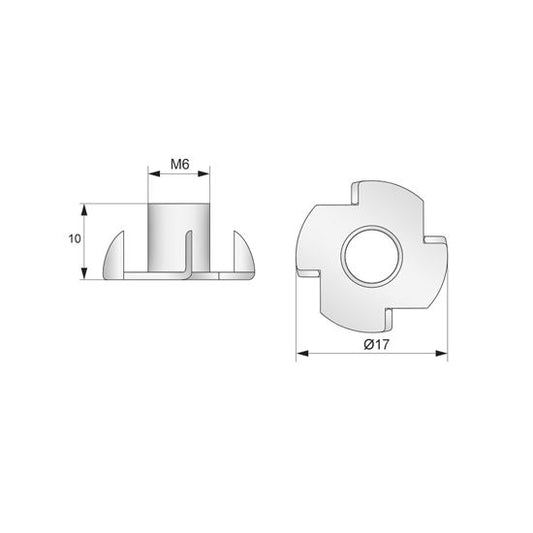

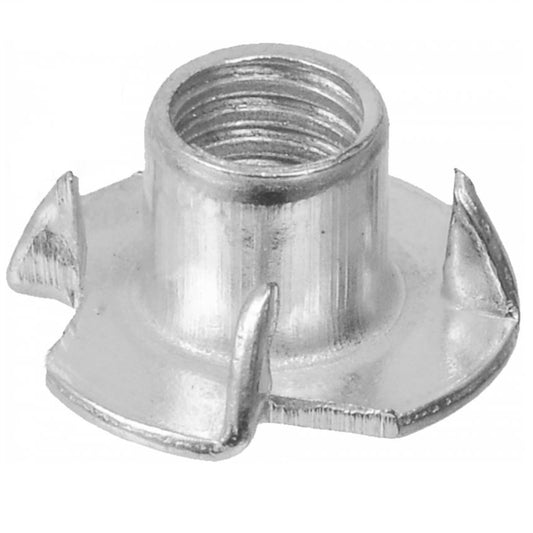
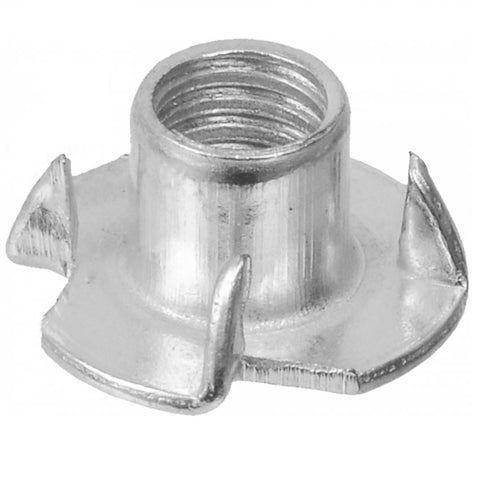
T-nuts(prong-tee nuts) are metallic threaded fasteners engineered with a metric internal thread and a flat flange featuring downward-facing prongs (or claws). They are primarily used to create high-load, re-usable threaded connections in wood and wood-based composite materials.
Often referred to as claw nuts or pronged nuts in wood shop practice, these specialty fasteners solve a fundamental problem in furniture making and jig building: they allow machine screws and metric bolts to anchor securely into soft base materials like particle board, MDF, or solid lumber without the risk of tearing out under tensile loads. The prongs bite into the wood like ice spikes on a winter boot, locking rotation when tightening the bolt and transferring tensile forces across a broad surface area within the surrounding wood structure.
Design and Mechanical Operation of T Nuts
A classic T-nut consists of three functional zones:
- The Threaded Barrel:A cylindrical shaft housing the internal metric thread (such as M6 or M8). This barrel is inserted directly into the pre-drilled hole of your workpiece.
- The Flange:A flat, disc-shaped seating flange at the top of the barrel. It acts as a stop to keep the nut from pulling completely through the drill hole and serves as a load-bearing surface.
- The Prongs:Typically four sharp prongs bent at a 90° angle relative to the flange. As driven into the timber, they penetrate the surface to secure the fitting against rotation (torsional force) while tightening the bolt.
The mechanical principle relies onblind-side installation. The T-nut is always inserted on the side of the workpiece facing away from the direction of the load. When a bolt is inserted and tightened from the front side, the flange is pulled deeper against the wood. The connection stabilizes under load, making pulling out through the front physically impossible thanks to the flange.
Sizes, Dimensions, and Choosing the Right Assortment
For professional cabinetry and jig construction, matching the precise thread size to the anticipated load capacity is essential. A comprehensiveT-nuts product rangespans from M3 for delicate modeling projects up to M12 for heavy-duty structural applications.
M6 T-Nuts
The M6 size is the industry standard in conventional furniture production. When woodworkers check forM6 T-nut dimensions, it usually involves attaching light to medium-duty fittings. An M6 barrel typically requires a drill hole diameter of 19/64 in to 5/16 in (7.5 mm to 8.0 mm), depending on the wall thickness of the barrel. They are widely used for mounting adjustable leveling feet, joining cabinet components, or mounting handle rails. For production runs, buying bulk contractor packs like theT-Nuts M6 - Zinc Plated Steel 1000 Pcs.ensures a continuous hardware supply in the shop.
M8 T-Nuts
When connections face higher shear stress or dynamic loads, scaling up to an M8 thread size is ideal. AnM8 T-nut for woodtypically demands a pilot hole of 3/8 in to 25/64 in (9.5 mm to 10.0 mm). This size is essential for mounting heavy-duty furniture legs on upholstered sofas, securing heavy casters under shop carts, or building solid workbenches. Commercial shops benefit economically from bulk quantities such asT-Nuts M8 - Zinc Plated Steel 1000 Pcs., reducing unit costs and eliminating reordering downtime.
Additional Thread Sizes (M4, M5, M10, M12)
- M4 and M5:Mainly applied in audio speaker building to bolt subwoofer and tweeter chassis securely into MDF baffles without vibration looseness.
- M10:The standard hardware for climbing wall construction.Climbing wall T-nutsmust absorb extreme, concentrated leverage forces when hold grips are secured using socket head cap screws.
- M12:Utilized in heavy timber framing, temporary stage structures, or machine beds constructed from plywood or multiplex panels.
Material Selection: Zinc-Plated Steel vs. Stainless Steel
The long-term reliability of the joint depends heavily on the base material chosen for thesethreaded insert nuts for wood.
Zinc-Plated Steel:The vast majority of T-nuts, including ourT-Nuts M6 - Zinc Plated Steel 1000 Pcs., are fabricated from carbon steel featuring a electro-galvanized zinc plating. The zinc coating (typically 5 µm to 8 µm thick) offers reliable cathodic corrosion protection for dry indoor applications. For cabinet making, interior trim, and indoor climbing walls, this material represents the most technically sound and cost-effective choice.
Stainless Steel (A2 / A4):Whenever structures face moisture, weather exposure, or harsh environments, stainless steel is mandatory. Typical applications include outdoor garden furniture, playground equipment, or marine interiors. Stainless steel T-nuts are harder, which can make driving prongs into dense hardwoods (like oak or ipe) slightly more demanding because the claws flex less around dense wood fibers.
Proper Installation: How to Install T-Nuts
UsingT-nuts effectivelyrequires precision. Improper installation results in crooked threads, splintered wood surfaces, or spinning nuts during final assembly. Follow these key steps for optimal results:
1. Accurate Pilot Drilling
The pilot hole must match the exact outer diameter of the barrel. If the hole is too small, the barrel will split the wood when hammered in. If it is too large, the barrel loses lateral support, causing the nut to tilt when starting the bolt.
- Use sharp brad point wood drill bits with sharp spurs.
- Drill at an exact 90° angle to the surface. A drill press or portable drill guide is strongly recommended.
- Sizing guidelines: ForT-Nuts M8 - Zinc Plated Steel 1000 Pcs., measure the barrel OD with calipers—usually 23/64 in to 3/8 in (9.0 mm to 9.5 mm)—and select your drill bit accordingly.
2. Positioning and Driving
Insert the barrel from the back (the non-load side) into the pre-drilled hole.
- The Hammer Method:In softwoods (pine, fir) or particle board, a firm strike with a machinist hammer is sufficient. Ensure you strike the flange flat to avoid deforming the internal threads.
- The Draw-In Method (Recommended for Hardwood):In dense hardwoods like beech, oak, or hard maple, driving prongs with a hammer often bends the claws. Instead of hammering, draw the T-nut in place. Insert the nut into the hole, place a large fender washer over the opposite side, pass a bolt through, and thread it into the nut. Tightening the bolt with a wrench gently draws the prongs into the hardwood perfectly flush without impact damage.
3. Flush Mounting
Once installed, the flange should seat firmly against the wood surface with the prongs fully embedded. If two surfaces must mate completely flat against each other, counterbore the flange surface using a Forstner bit—matching the flange diameter, e.g., 7/8 in (22 mm) for M8—to a depth of 1/16 in to 5/64 in (1.5 mm to 2.0 mm).
Common Practical Applications
Versatilewood T-nutsare indispensable hardware components across a variety of woodworking trades.
- Furniture Fabrication & Frames:Securing leveling feet, caster wheels, or leg glides. Here,T-Nuts M6 - Zinc Plated Steel 1000 Pcs.are regularly driven into end-grain framing or bottom corner blocks of upholstered sofas.
- Climbing Wall Construction:A standard climbing wall grid requires hundreds of attachment points per panel. M10 T-nuts are hammered into the back of 23/32 in to 13/16 in (18 mm to 21 mm) thick plywood sheets.
- Jigs, Fixtures & CNC Spoilboards:To hold workpieces securely on CNC routers, grid patterns of T-nuts (typically M6 or M8) are installed across MDF spoilboards.
- Speaker Enclosures:Mounting heavy subwoofers requires robust machine threads; standard wood screws eventually strip out under continuous speaker vibration.
T-Nut Alternatives: When to Use Threaded Inserts?
Woodworkers often look for aT-nut alternativewhen space or mounting conditions make pronged nuts impractical. The main alternative is a screw-in threaded insert (Rampa-style insert).
The major difference lies in load direction and accessibility:
- T-Nut:Installed from therear. Unmatched holding strength when the load pulls away from the flange. However, if the pull force pulls toward the nut (e.g., when forced to install from the front), the prongs can pull out of the wood.
- Threaded Screw-In Insert:Features coarse external wood threads and screws into the workpiece from thefront. It is the best choice when the back of the panel is inaccessible after assembly (such as in enclosed cabinets) or when thin panel materials cannot accept T-nut prongs.
When rear access is available, T-nuts—such as those from ourT-Nuts M8 - Zinc Plated Steel 1000 Pcs.selection—offer significantly faster installation and straightforward alignment without the risk of cross-threading external coarse threads.
Clarification: Drive-In Screws vs. T-Nuts
In workshop terminology, hardware terms can get confusing. Phrases like "drive-in wood screws" or "M6 wood nuts" are often used interchangeably, but technically refer to different items. A screw features external threads, whereas a nut features internal machine threads. In 95% of furniture manufacturing contexts, "drive-in wood hardware" actually refers to standard T-nuts. True drive screws (with serrated shanks for metal driving) exist in industrial engineering but are rarely used in joinery. When purchasing hardware, always verify you are selecting internal metric thread T-nuts.
FAQ – Frequently Asked Questions
How do I remove a stuck T-nut?
To remove a T-nut already anchored in wood, thread a matching bolt into the internal thread from the flange side (the back) by three to four full turns. Tap the bolt head gently with a hammer. This pushes the barrel and prongs forward out of the timber without damaging the front face.
Which side of the wood board should a T-nut be installed on?
Always on the non-load side (the back side). For example, when securing a climbing hold to a panel, the T-nut must be seated on the back of the sheet. The bolt pulls the flange tightly against the wood. Installing it on the front side will cause the bolt to pull the nut right out of the hole under load.
What size drill bit is needed for an M8 T-nut?
The M8 designation refers to the internal machine thread diameter. For drilling, measure the barrel's outer diameter. On standardT-Nuts M8 - Zinc Plated Steel 1000 Pcs., this is typically 23/64 in to 3/8 in (9.0 mm to 9.5 mm). Use a wood bit matching this outer diameter. An 5/16 in (8 mm) bit is too small and will split the wood.
Can I use T-nuts in dense hardwoods (oak, beech)?
Yes, but installation requires preparation. Hammering prongs into dense hardwood can bend the claws. Position the nut, mark the prong locations with a pencil, and pre-drill these points about 3/16 in (5 mm) deep using a 5/64 in or 3/32 in (2.0 mm or 2.5 mm) drill bit. Alternatively, use the draw-in method with a bolt and washer described above.
What does the "1000 Pcs." bulk packaging option mean?
For commercial woodworking shops, cabinet makers, or building large fixtures, hardware is supplied in cost-effective bulk contractor boxes. TheT-Nuts M6 - Zinc Plated Steel 1000 Pcs.pack provides ample hardware to complete extensive project grids—like CNC spoilboards or modular seating systems—without running out mid-job.
Do I need to apply glue when installing T-nuts?
No. Mechanical anchoring provided by the four prongs combined with clamping pressure from the flange is completely sufficient to prevent rotation. Applying wood glue or epoxy to the flange adds negligible holding strength and makes future hardware removal extremely difficult.