
Leather Cabinet Pulls
Popular Subcategories
-
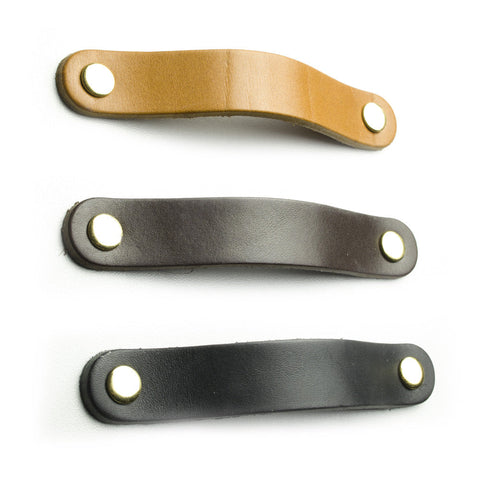
Leather handle rectangular 96mm - 160mmRegular price $9.80Unit price / perRegular priceSale price $9.80
-
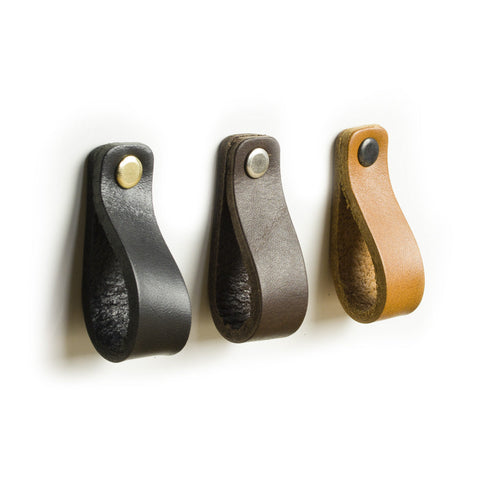
Leather handle foldableRegular price $9.80Unit price / perRegular priceSale price $9.80
-
Leather handle rounded 96mm - 128mmRegular price $9.80Unit price / perRegular priceSale price $9.80

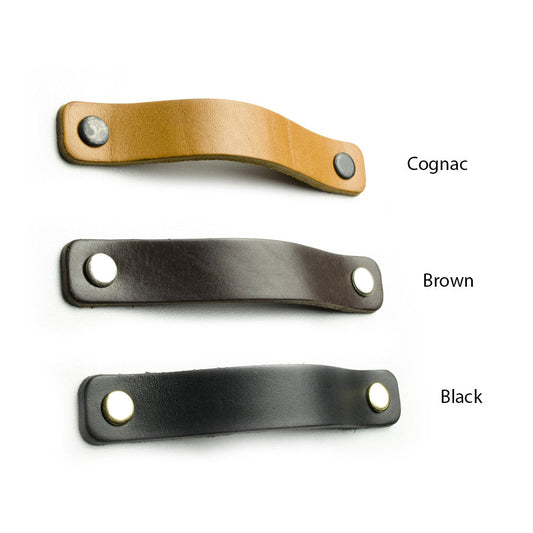

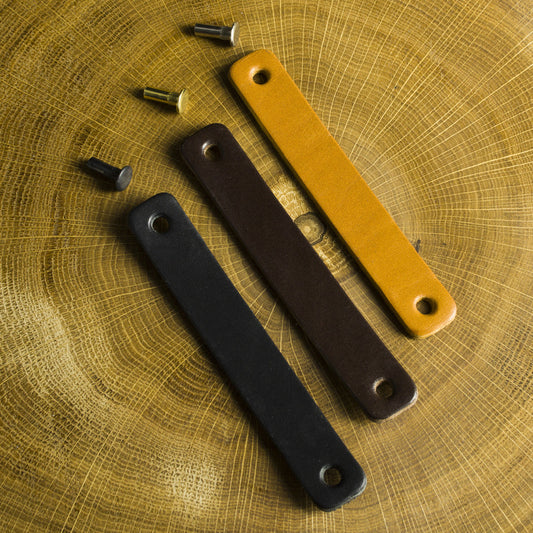

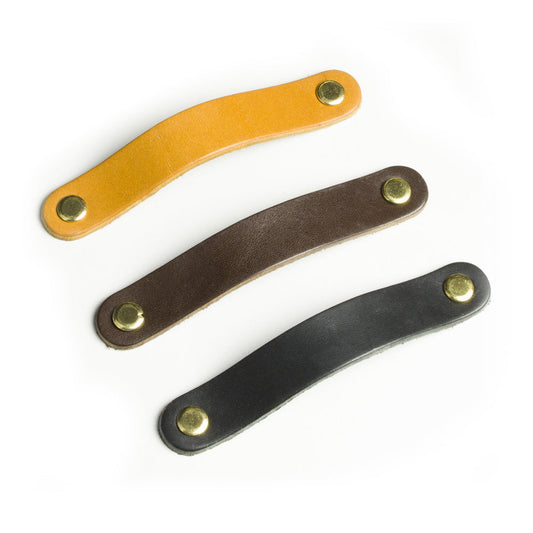
Leather cabinet pullsare flexible, soft-touch hardware elements for furniture fronts that serve as functional pull handles and are typically crafted from durable cowhide leather.
In professional cabinetmaking and custom woodworking,leather furniture handlesoffer a versatile alternative to rigid metal, wood, or plastic hardware. They deliver high tensile strength paired with natural flexibility. These unique material properties require specific considerations regarding installation, center-to-center hole spacing, and fastening hardware. Unlike rigid handles,leather pullssubtly evolve over time, developing a unique shape and surface texture (patina) through daily mechanical use and environmental exposure.
Material Properties and Tanning Processes
The technical quality of aleather cabinet pulldepends heavily on the raw hide selected and the tanning method used. For application on cabinet doors and drawer fronts, split leather or full-grain leather with a thickness of 5/64 in - 9/64 in (2.0 mm - 3.5 mm) is standard. This thickness is necessary to absorb pulling forces when opening heavy drawer slides—such as full-extension slides rated for 66 lbs (30 kg)—without stretching or tearing.
When manufacturingleather handles for furniture, two primary tanning processes are utilized, each defining the physical characteristics of the final product:
- Vegetable Tanning:This process uses natural tannins derived from tree bark and wood. The resulting leather is more dimensionally stable, features a higher fiber density, and is less prone to sagging or stretching under heavy loads. It is the preferred choice forleather wardrobe handlesand heavy-duty applications subjected to continuous pull forces.
- Chrome Tanning:This chemical process yields a softer, more pliable leather. It is ideal forleather tab pullsor loops requiring high flexural strength at the mounting point. Edges on chrome-tanned pulls often require additional edge-sealing to prevent fraying caused by friction.
Design Styles: Leather Loop Pulls vs. Flat Cabinet Pulls
The specific design ofleather cabinet pullsdetermines the required drilling pattern on the cabinet front. Hardware designs are broadly categorized into two mounting styles:
Leather Loop Pulls (Single-Hole Mount)
Aleather loop pullconsists of a leather strap folded in half with aligned mounting holes at both ends. Installation requires only a single borehole, typically 5/32 in - 13/64 in (4 mm - 5 mm) in diameter. Both ends of theleather tab pulloverlay each other and are secured to the front using a single machine screw. Acting like a shock absorber on the cabinet front, these flexible loops absorb hard impacts, making them exceptionally safe in tight spaces or high-traffic areas where rigid, sharp-edged handles pose a bumping hazard.
Flat Leather Pulls (Two-Hole Mount)
In this style, the leather strap lies flat or slightly arched against the cabinet face, secured at two separate mounting points. Precise center-to-center distance (the measurement between the centers of each hole) is critical. Mostleather furniture handlesadhere to the industry-standard 32 mm system, where hole spacings are engineered in multiples of 1-1/4 in (32 mm). Standard center-to-center dimensions forleather cabinet pullsinclude 3-25/32 in (96 mm), 5-3/64 in (128 mm), and 6-19/64 in (160 mm).
Mounting Technique and Fastening Hardware
Installingleather pulls on furniturerequires matching screw lengths precisely to the thickness of the door or drawer panel. Cabinet fronts are commonly constructed from particle board or MDF with standard thicknesses of 5/8 in (16 mm) or 3/4 in (19 mm).
Because leather is a compressible material, fasteners must not be overtightened from the rear to avoid stripping the threads in the decorative cap or sleeve. On the front face, the pull is usually fixed with a decorative screw cap, binding post, or wide washer. A wide load-bearing washer or collar is technically essential to distribute tensile forces across a larger surface area of the leather. Without adequate surface pressure, strong pulling forces—such as pulling open a heavily loadeddresser with leather pulls—can tear the bolt head through the punched hole in the leather.
Standard metric M4 machine screws are typically supplied. The required screw length is calculated as follows:Cabinet front thickness + leather thickness (doubled for loop pulls) + 5/64 in to 1/8 in (2 mm to 3 mm) thread engagement into the decorative cap/nut.For a 3/4 in (19 mm) panel and aleather loop pullmade from 3/32 in (2.5 mm) thick leather (folded double = 13/64 in (5.0 mm)), a screw length of at least 1-1/32 in (26 mm) is required.
Applications and Hardware Compatibility
Leather pullscan be easily retrofitted onto almost any case goods or cabinetry, provided the center-to-center measurements align. Application requirements are determined by pull load and environmental conditions:
- Leather Cabinet Pulls in Kitchens:On kitchen cabinets, handles face exposure to humidity, cooking oils, and temperature shifts. High-density, surface-sealed leather is strongly recommended here. For heavy deep-drawer pot pull-outs, ensure thatleather drawer pullsare wide enough to comfortably distribute pulling forces up to 100 lbs (45 kg) across the hand.
- Leather Wardrobe & Closet Pulls:Tall cabinet doors—such as 78-3/4 in (2000 mm) full-height wardrobe doors hanging on multipleconcealed European hinges(frequently with a 110° opening angle)—benefit from longer leather pulls to offer ergonomic leverage.
- Leather Dresser Pulls:In living rooms and bedrooms, these pulls serve as a popular upgrade for refreshing existing furniture. Vertical or horizontal mounting orientation is a matter of preference, though horizontal mounting offers superior ergonomics on drawer fronts.
Important Technical Note:Leather furniture handlesare designed exclusively for manually pulled cabinet doors and drawers. They are not compatible with push-to-open (tip-on) touch latches, as these mechanisms rely on inward pressure and do not utilize pull handles. However, they perform flawlessly when paired with soft-close hinges or soft-close drawer slides.
Product Specifications for Selected Styles
Depending on cabinet design, various pull geometries are available. Precision dimensions ensure a perfect fit during installation.
- Rectangular Leather Pull 3-3/4 in / 5 in / 6-5/16 in (96 mm / 128 mm / 160 mm):This classic flat handle mounts at two points. Its rectangular punched ends provide a wide contact area on the cabinet front, preventing twisting during uneven pulls. Standard center-to-center spacings (3-3/4 in (96 mm), 5 in (128 mm), and 6-5/16 in (160 mm)) make it a seamless replacement for existing metal handles with identical drilling footprints.
- Foldable Leather Pull 5-5/8 in (143 mm):A clever hybrid combining the look of a flat pull with the ergonomic grip of a loop. Measuring 5-5/8 in (143 mm) in total length when folded, it offers ample hand clearance for multiple fingers, optimizing force distribution when opening heavy-dutysingle-extension drawer slides.
- Rounded Leather Pull 3-3/4 in / 5 in (96 mm / 128 mm):This style features semi-circular rounded ends. Rounding serves both aesthetic and functional purposes: under repeated friction, rounded edges resist curling or fraying far better than sharp 90-degree corners. Available in standard 3-3/4 in (96 mm) and 5 in (128 mm) hole centers.
Beyond geometry, color choice impacts longevity. Ablack leather cabinet pullor dark brown leather pull masks natural skin oils and daily wear significantly better than light tan shades, making dark finishes ideal for high-traffic environments like kitchens, entryways, and mudrooms.
Care and Maintenance of Leather Hardware
Leather is a natural organic material. Unlike anodized aluminum or stainless steel, it requires basic periodic care to prevent drying out or cracking over time.
Never cleanleather cabinet pullswith harsh solvents, alcohol-based cleaners, or microfiber cloths, as these strip essential oils and open the leather pores. To remove dust and superficial dirt, simply wipe with a damp cotton cloth. To preserve elasticity and tensile strength over years of use, apply a specialized leather conditioner or balm once or twice a year. This seals the burnished edges and prevents moisture—especially when usingleather cabinet pulls in kitchens—from penetrating the leather fibers and causing swelling.
Frequently Asked Questions (FAQ) About Leather Cabinet Pulls
What center-to-center hole spacing is required for leather pulls?
It depends on the pull style. Single-holeleather loop pullsrequire only one borehole. Flatleather cabinet pullsrequire two boreholes. Center-to-center spacings generally conform to standard 32 mm system layouts, with common sizes being 3-3/4 in (96 mm), 5 in (128 mm), and 6-5/16 in (160 mm). When replacing old hardware, always measure precisely from center-of-hole to center-of-hole.
Can leather pulls be installed on standard furniture like IKEA cabinets?
Yes, retrofitting is quick and simple. Many homeowners specifically chooseleather pulls for IKEAfurniture upgrades (such as PAX wardrobes or BESTÅ units) to achieve a custom look. Simply ensure that the hole centers of the new pulls match the existing drill holes or drill fresh holes on un-drilled fronts.
Are leather cabinet pulls durable enough for large wardrobe doors?
Yes, provided the leather has adequate material thickness (at least 3/32 in (2.5 mm)) and the mounting fasteners (screws, sleeves, washers) are correctly specified. For heavy, full-height doors hung on multipleconcealed European hingesor for wide drawers, two-holeflat leather pullsare preferred over narrowleather loop pullsbecause they distribute load forces much more evenly across the cabinet face.
How tightly should screws be fastened on leather pulls?
Screws should be tightened just until the leather pull sits firmly flush against the cabinet face without wobbling. Overtightening compresses the leather fibers, damages the material structure around the mounting hole, and can cause the screw head to tear through the leather under heavy pull loads later on.
Do leather cabinet pulls stretch out over time?
Minimal stretching under constant tensile load is natural for organic materials, particularly with soft, chrome-tanned leathers. However, high-quality, vegetable-tannedleather cabinet pullsfeature high fiber density, keeping operational stretch to a negligible, millimeter-level minimum.