
Cam Dowels
Popular Subcategories
-
Cam Expanding Dowel 15/16 inch, M8 - 100 pcsRegular price $8.69Unit price / perRegular priceSale price $8.69
-
Cam Dowel 1-5/16 inch with M6 Screw-Thread - 100 pcsRegular price $5.59Unit price / perRegular priceSale price $5.59
-
Cam Dowel 1-5/16 inch with Euro Screw-Thread - 100 pcsRegular price $5.59Unit price / perRegular priceSale price $5.59
-
Cam Dowel 1-5/16 inch with M6 Screw-Thread - 1000 pcsRegular price $46.57Unit price / perRegular priceSale price $46.57
-
Cam dowel 15/16 inch with Euro Screw-Thread - 100 pcsRegular price $3.54Unit price / perRegular priceSale price $3.54
-
Cam Dowel 1-1/8 inch with Euro Screw-Thread - 100 pcsRegular price $5.15Unit price / perRegular priceSale price $5.15
-
Cam Dowel 15/16 inch with M6 Screw-Thread - 1000 pcsRegular price $41.84Unit price / perRegular priceSale price $41.84
-
Cam Dowel 15/16 inch with Euro Screw-Thread - 1000 pcsRegular price $41.84Unit price / perRegular priceSale price $41.84
-
Cam Dowel 15/16 inch with Euro Screw-Thread - 100 pcsRegular price $5.02Unit price / perRegular priceSale price $5.02
-
Cam dowel 15/16 inch with Euro Screw-Thread - 1000 pcsRegular price $29.52Unit price / perRegular priceSale price $29.52
-
Cam Dowel 1-1/8 inch with M6 Screw-Thread - 1000 pcsRegular price $65.57Unit price / perRegular priceSale price $65.57
-
Cam Dowel 1-5/16 inch with Euro Screw-Thread - 1000 pcsRegular price $46.57Unit price / perRegular priceSale price $46.57
-
Cam Expanding Dowel 15/16 inch, M8 - 1000 pcsRegular price $72.37Unit price / perRegular priceSale price $72.37
-
Cam Dowel 1-1/8 inch with Euro Screw-Thread - 1000 pcsRegular price $42.95Unit price / perRegular priceSale price $42.95
-
Cam Dowel 15/16 inch with M6 Screw-Thread - 100 pcsRegular price $5.02Unit price / perRegular priceSale price $5.02
-
Screw-In 24mm Cam Dowels with Euro Thread (1 Pc.)Regular price $0.11Unit price / perRegular priceSale price $0.11
-
34mm Cam Dowels with Euro Thread (1 Pc)Regular price $0.11Unit price / perRegular priceSale price $0.11
-
Screw-In Cam Dowel with Euro Thread - 15/16 inch (24 mm) - 1 PcRegular price $0.08Unit price / perRegular priceSale price $0.08
-
Expanding Screw-In 24mm Cam Dowel, 5/16 inch (8 mm) Dia. (1 Pc.)Regular price $0.17Unit price / perRegular priceSale price $0.17
-
Double-Sided Cam Dowel 1-5/16+5/8+1-5/16 inch - 1000 pcsRegular price $327.23Unit price / perRegular priceSale price $327.23
-
28mm Cam Dowels with Euro Thread (1 pc.)Regular price $0.11Unit price / perRegular priceSale price $0.11

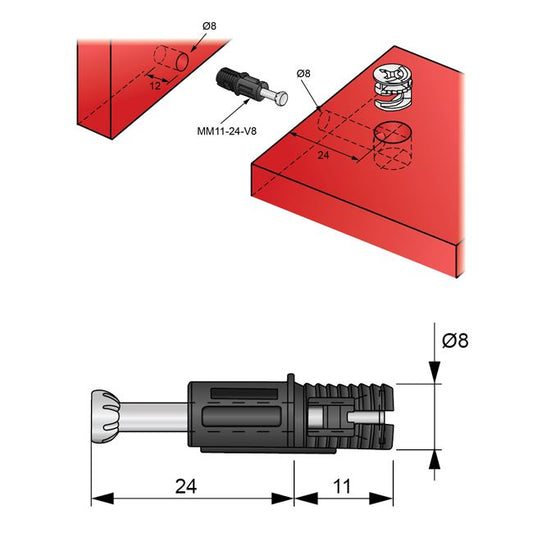


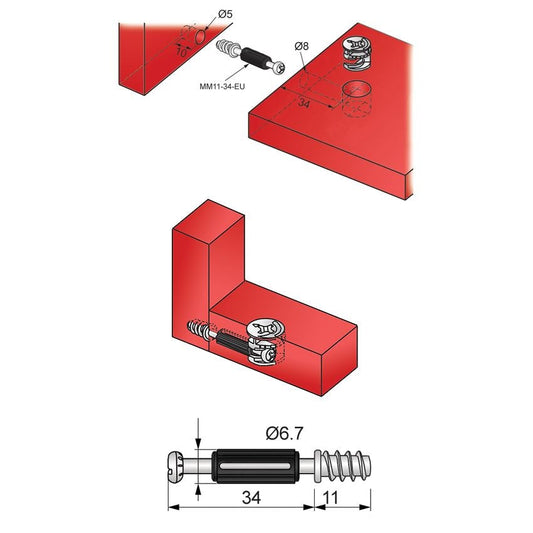

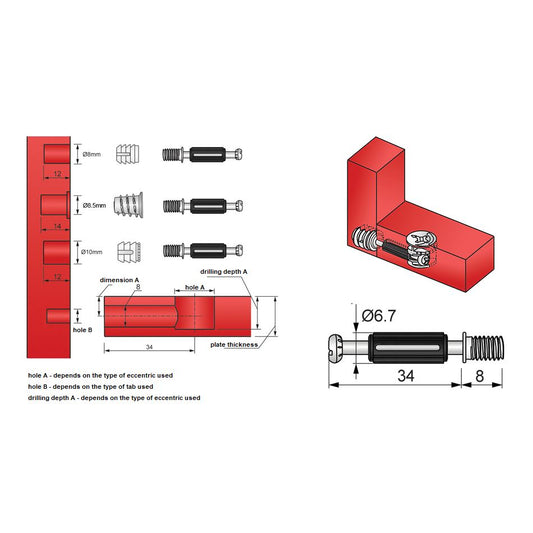

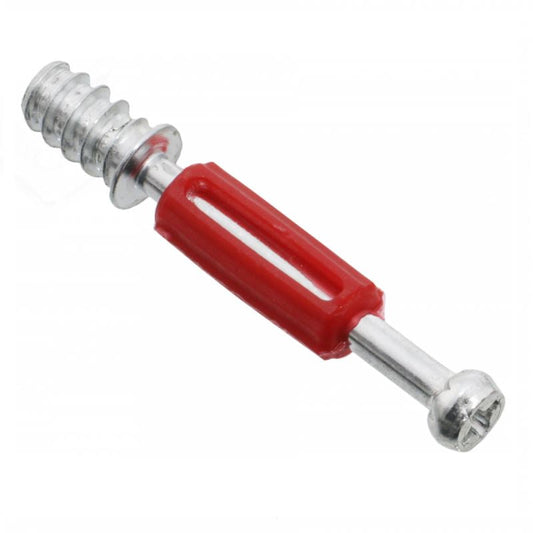

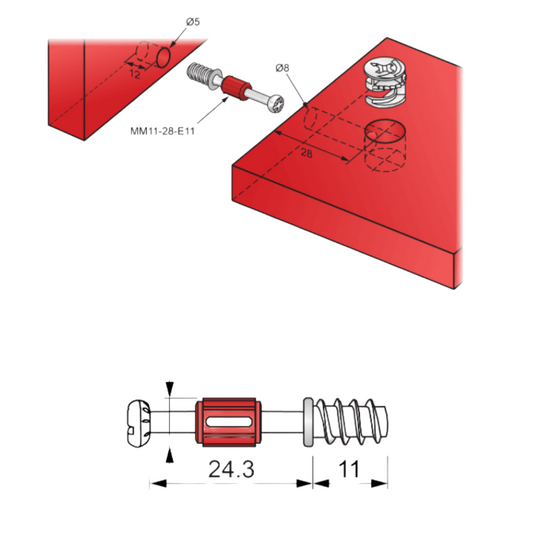

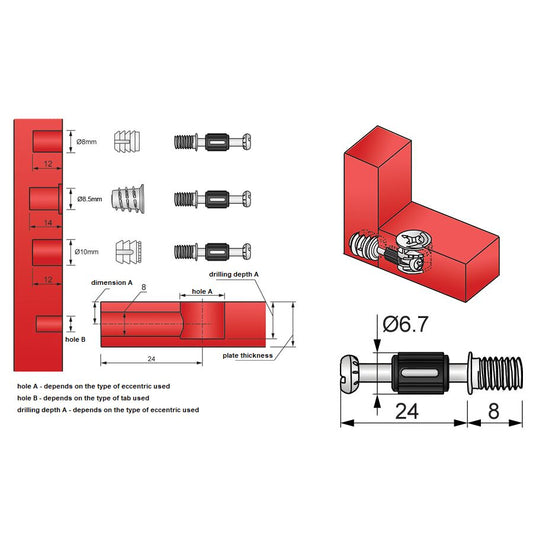

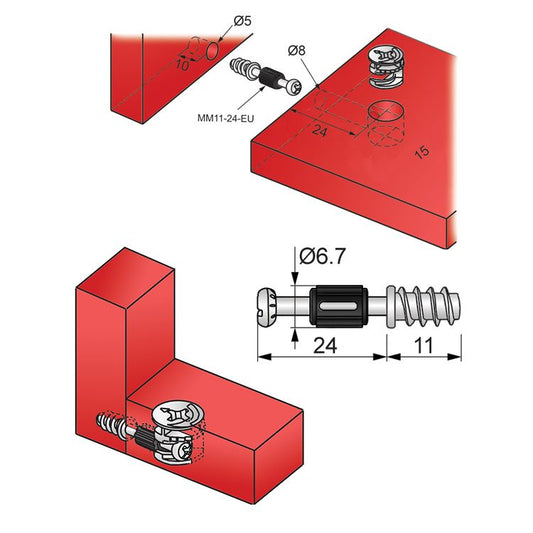

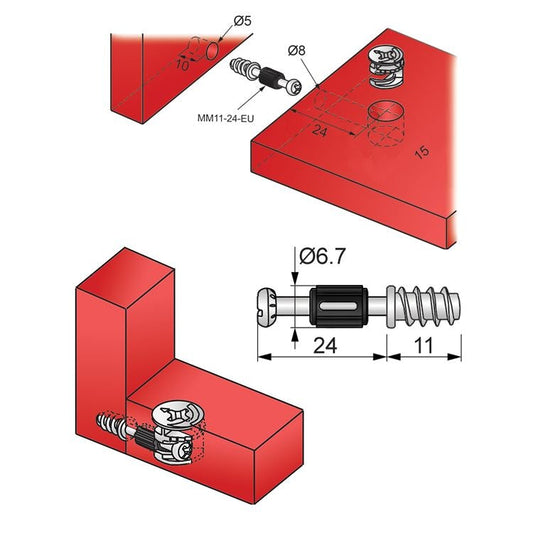

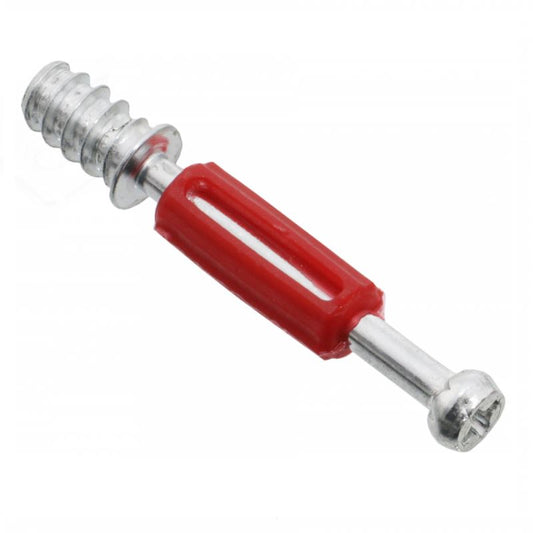

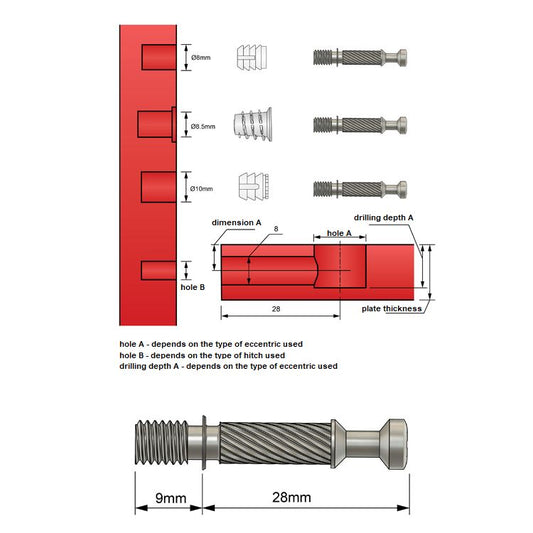

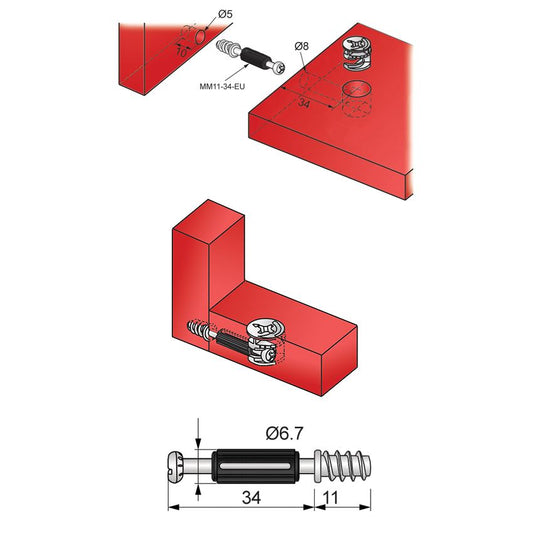

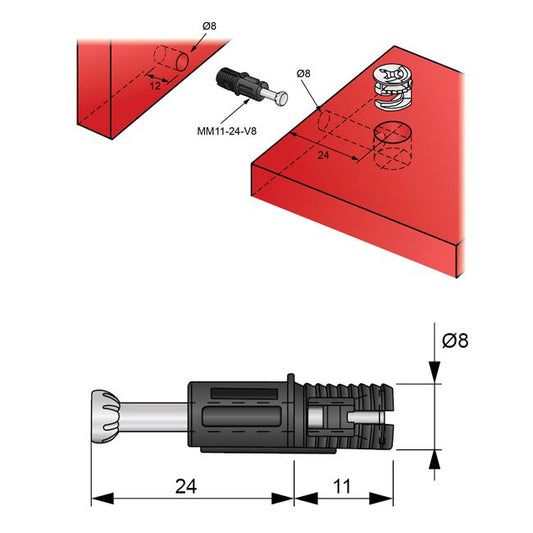

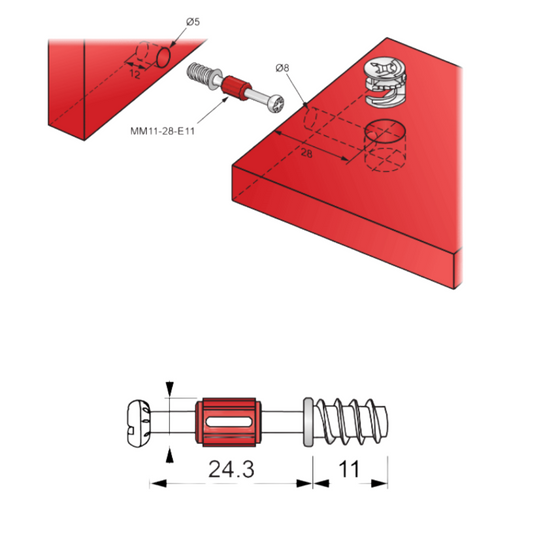

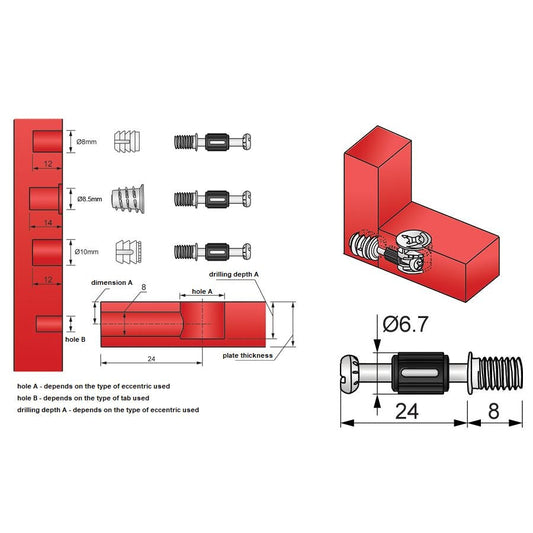

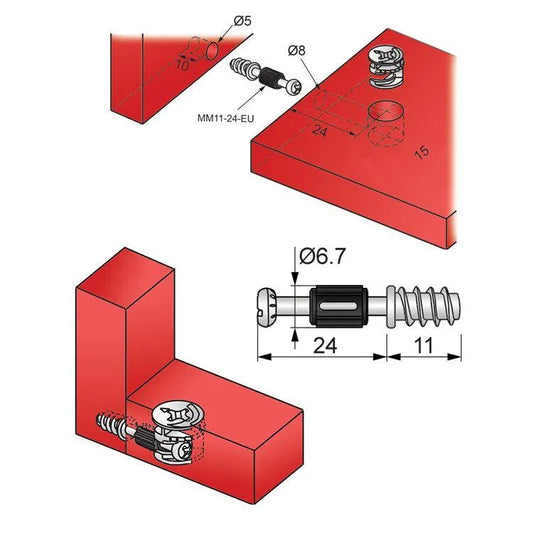

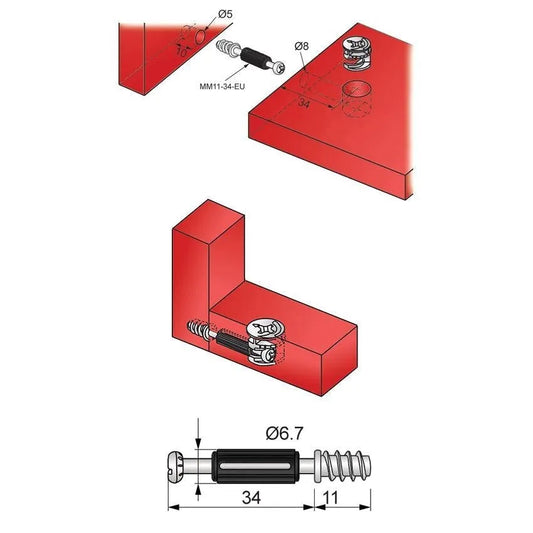

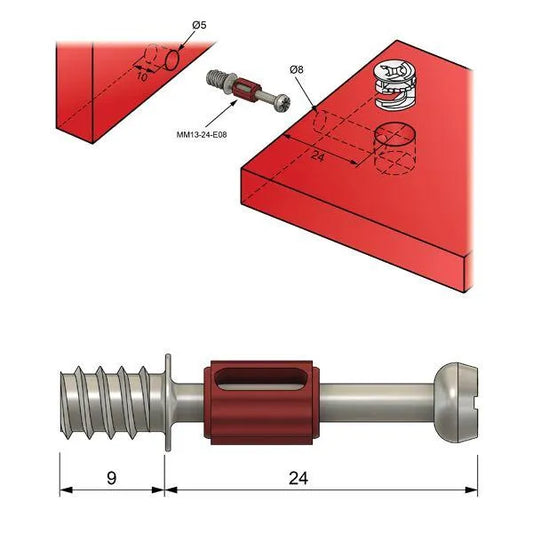


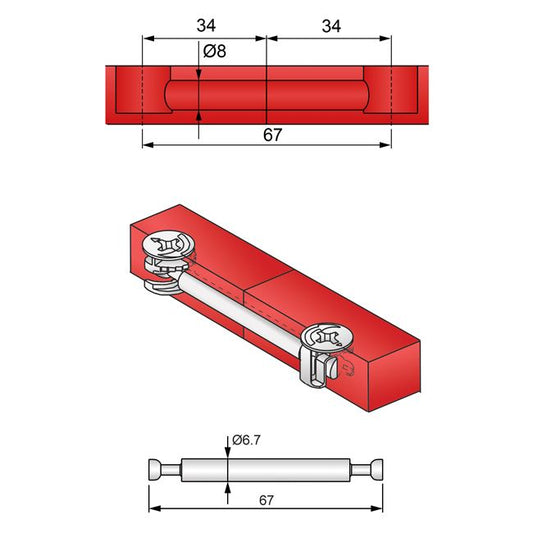

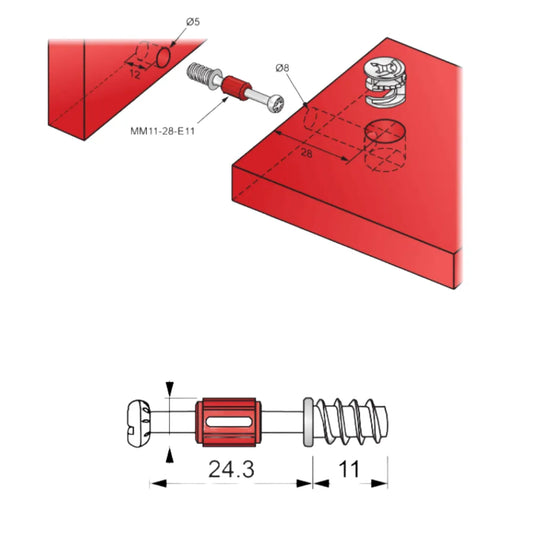
Cam dowelsare the central tension pins in eccentric connecting fittings, used in modern cabinet making for non-positive, re-openable right-angle panel joints. As an indispensable component of cabinet assembly, they form the counterpart to the cam lock housing (often known as Minifix systems). The dowel is screwed into the edge or face of one panel, while its head projects into the drilling of the second panel where it is locked in place by the cam lock.
This category is aimed at cabinetmakers, furniture installers, and ambitious woodworkers who require precisecam dowels as furniture connectorsfor mass production or custom builds. Choosing the exact dowel determines cabinet stability, pull-out resistance under load, and the fit accuracy of the joints.
Operating Principle and Mechanics of Cam Lock Fittings
The system consisting of a cam dowel and cam lock enables furniture components to be joined securely without visible screw heads on the outside. When the cam lock inside the housing is rotated with a screwdriver, it hooks under the specially shaped head of the dowel. The cam dowel acts like a steel anchor bolt that is pulled in by the rotating cam disc, clamping the two wood panels together flush and free of play.
This principle makes the fitting a trueinvisible furniture connectorworking inside the cabinet body. The connection can be loosened and retightened as often as needed, greatly facilitating the disassembly and transport of large wardrobes, dressers, or shelving systems.
Thread Types: The Connection to the Base Material
The pull-out strength of a cam dowel depends heavily on the thread type and the substrate material. Depending on the panel material (particle board, MDF, solid wood), different mounting concepts are available.
Cam Dowels with Euro Thread
TheEuro threadis the standard for direct screwing into engineered wood materials, particularly melamine-coated particle board and MDF. It features a coarse thread pitch and sharp flanks that cut deep into the board material. For these dowels, a blind hole with a diameter of 3/16 in (5 mm) is typically pre-drilled. When installing into hard materials, the drill diameter can be adjusted minimally. A typical representative for cabinet joints is theCam Dowel with Euro Thread L 1-3/8 in (34 mm) (1000 pcs), which is ideal for series production. For smaller projects or repairs, packs such as theCam Dowel with Euro Thread - 15/16 in (24 mm) - 100 pcsare preferred.
Cam Dowels with Metric M6 Thread
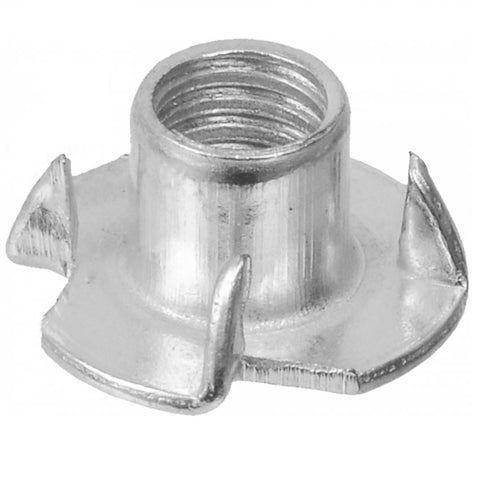
When extremely high tensile forces occur or the substrate (such as soft solid wood or porous particle board) does not permit direct screwing,M6 cam dowelscome into play. These feature a metric machine thread. Rather than being screwed directly into the wood, they require an insert socket (such as a threaded insert nut or an expanding plastic/brass socket). Using atee nut in combinationwith an M6 dowel is another variation to achieve maximum stability in through-hole applications. A common size for this technique is theCam Dowel with M6 Thread L 1-3/8 in (34 mm) (100 pcs). For shorter distances, theCam Dowel with M6 Thread L 1-1/8 in (28 mm) (1000 pcs)is ideal.
Expanding Cam Dowels
These specialized dowels feature a plastic sleeve or expanding mechanism. They are pressed into a 5/16 in (8 mm) hole. When tightening the cam lock or driving an internal pin, the lower part of the dowel expands inside the borehole and anchors firmly into the material. This variant is especially installer-friendly, as it can often be set tool-free or with minimal effort. An example is theExpanding Cam Dowel L 15/16 in (24 mm), Ø 5/16 in (8 mm) (1000 pcs). Matching options can be found in the8mm Cam Dowelssubcategory.
Clamping Dimensions and Lengths: Finding the Right Measure
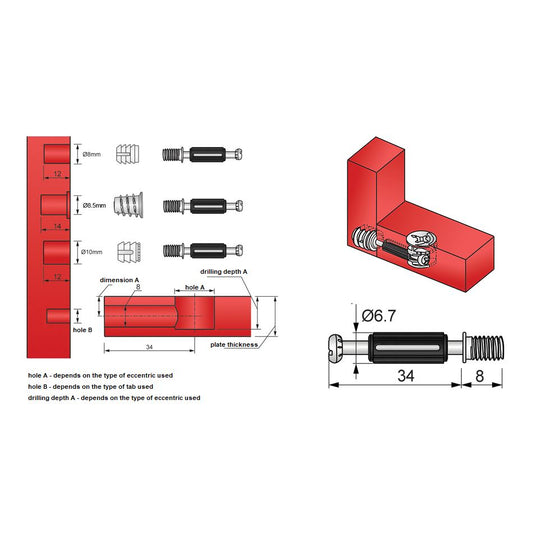
Length specifications for cam dowels (e.g., 15/16 in (24 mm), 1-1/8 in (28 mm), 1-3/8 in (34 mm)) refer to theclamping dimension. This is the exact distance from the seating shoulder of the dowel (the edge of the wood panel it is installed into) to the center of the cam lock housing in the adjoining panel. Selecting the right length depends directly on the location of the cam hole in the matching panel.
Clamping Dimension 15/16 in (24 mm)
This shorter dimension is frequently used in slender constructions or specialized hardware systems where the cam drilling sits closer to the edge. This dimension requires precise drilling due to tighter tolerances.
- Category:24mm Cam Dowels
- Sample Product:Cam Dowel with Euro Thread L 15/16 in (24 mm) (100 pcs)
- For Metric Joints:Cam Dowel with M6 Thread L 15/16 in (24 mm) (1000 pcs)
Clamping Dimension 1-1/8 in (28 mm)
An intermediate size used with specific panel thicknesses or specialized cam housings. It offers a solid compromise between strength and space savings within the component.
- Category:28mm Cam Dowels
- Sample Product:Cam Dowel with Euro Thread L 1-1/8 in (28 mm) (1 pc)
Clamping Dimension 1-3/8 in (34 mm)
The 1-3/8 in (34 mm) clamping dimension is the absolute industry standard in European cabinet making. It aligns with theSystem 32grid and works seamlessly with most commercially available cam locks. The cam hole (usually 19/32 in (15 mm) diameter) is drilled at a center-to-edge distance of exactly 1-3/8 in (34 mm).
- Category:34mm Cam Dowels
- Sample Product:Cam Dowel with Euro Thread - 1-3/8 in (34 mm) - 100 pcs
Double-Ended Dowels for Center Partition Walls
A specific technical challenge in cabinet design is center partition walls where shelves meet from both sides at the exact same height. Using two standard cam dowels would cause their threads to collide and block inside the partition wall.
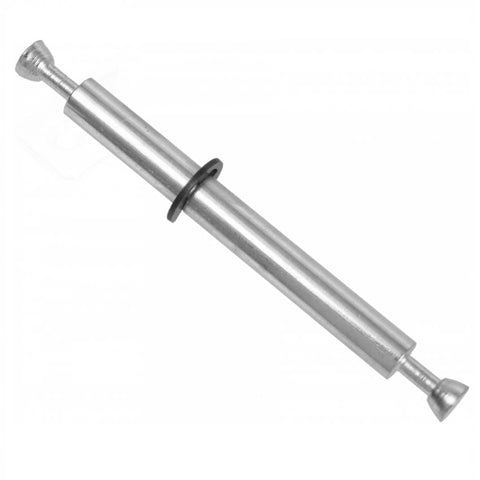
The solution isdouble-ended cam dowels. These feature a continuous steel shank with two dowel heads and a center plastic or metal collar. The double dowel is inserted through a pass-through hole in the partition wall. The heads extend out both sides to be engaged by the cam locks in the adjoining shelves.
Specifications for double-ended dowels consist of three values: left clamping dimension + partition panel thickness + right clamping dimension.
- For a 5/8 in (16 mm) partition wall and standard cams, choose theDouble-Ended Dowel 34+16+34mm.
- For an 11/16 in (18 mm) partition wall, the Double-Ended Dowel 34+18+34mm is used.
- For specialized designs without a continuous partition thickness, direct connectors like the Double-Ended Dowel 34+34mm are also available.
Material and Load Capacity
Professional cam dowels are manufactured from durable steel. The surface is typically zinc-plated to prevent corrosion and ensure smooth operation with the cam housing (which is often made of die-cast zinc). Ametal threaded dowelensures that the dowel head will not deform, even under heavy torque from the cam lock.
The load capacity of the joint depends less on the steel dowel itself and more on the pull-out resistance of the thread in the wood. Therefore, keeping precise pre-drilling dimensions is essential. For particle board with Euro threads, a 3/16 in (5 mm) drill diameter is recommended, executed precisely centered and perpendicular.
Installation Tips and System 32
Proper installation of cam dowels requires accuracy. In modern cabinet making, drillings follow theSystem 32standard.
- Dowel Hole:Drill a 3/16 in (5 mm) hole (for Euro threads) into the side panel. The depth depends on the thread length (typically 7/16 in to 19/32 in (11 mm to 15 mm)).
- Driving In:Screw in the dowel using a Phillips screwdriver (PZ2 or PZ3). Ensure the dowel's shoulder sits flush against the wood surface. It must not be over-driven into the material nor left loose, as this distorts the clamping dimension (e.g., 1-3/8 in (34 mm)).
- Cam Hole:Drill an edge hole (usually 9/32 in or 5/16 in (7 mm or 8 mm) diameter) in the adjoining shelf for the dowel shaft. At the exact clamping distance (e.g., 1-3/8 in (34 mm) from the edge), drill the face hole (usually 19/32 in (15 mm) diameter) perpendicular to it for the cam housing.
- Assembly:Push the shelf onto the dowel, insert the cam lock, and turn it roughly 180° clockwise until the joint locks firmly into place.
For installers processing high volumes, we offer bulk packs such as theCam Dowel with Euro Thread - 7x24mm - 1000 pcs. For sampling or single repairs, items are also available individually, such as theCam Dowel with Euro Thread - 7x24mm - 1 pc.
FAQ – Frequently Asked Questions About Cam Dowels
What exactly is a cam dowel and what is it used for?A cam dowel is a metallic connecting pin. It is part of a two-piece fitting system and, combined with a cam lock housing, is used to join two furniture panels securely and invisibly at a 90-degree angle.
Are cam dowels suitable for any type of wood?Yes, provided the thread type is matched. Acam dowel for wood panels(especially particle board and MDF) uses a Euro thread. For solid wood or soft substrates, an M6 threaded dowel combined with a threaded insert or expansion socket should be used to prevent tear-out.
Which screwdriver do I need for installation?Most cam dowels feature a cross-recess drive, typically Pozidriv (PZ2 or PZ3). Using the exact matching bit is essential to avoid stripping the drive head during installation, which would prevent the cam lock from engaging smoothly.
Are these fittings compatible as replacement cam dowels for IKEA furniture?Many furniture manufacturers, including IKEA, utilize the standardized Minifix system principle. If you are looking for replacement parts, measure the clamping dimension (distance from the panel edge to the center of the cam, usually 15/16 in (24 mm) or 1-3/8 in (34 mm)) and verify the thread type (direct into wood vs. metric). If the measurements match, the dowels are fully compatible.
Is there an installation video for cam dowels?Installation is a straightforward mechanical process: pre-drill, drive the dowel in flush to its shoulder, slide on the mating panel, and tighten the cam lock. Pay attention to precise drill sizes (3/16 in (5 mm) for Euro threads, 19/32 in (15 mm) for the cam), and the setup is self-explanatory.
How do I disassemble a cam dowel connection?Turn the cam lock in the shelf counterclockwise until the arrow on the housing points toward the dowel pin. The lock is now open, and you can pull the panel straight off the dowel. The dowel itself remains seated in the side panel.