
Pull Down Closet Rod
Popular Subcategories
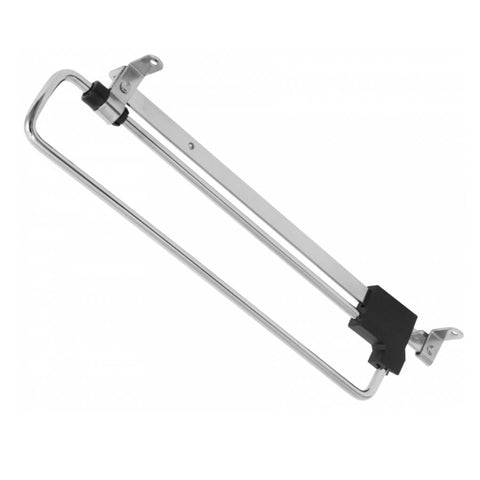
-
Pull Down Wardrobe Rail 17-11/16-25-5/8 inchRegular price $51.61Unit price / perRegular priceSale price $51.61
-
Pull Down Wardrobe Rail 32-11/16 - 45-1/4 inchRegular price $51.61Unit price / perRegular priceSale price $51.61
-
Pull Down Wardrobe Rail 23-5/8 - 32-11/16 inchRegular price $51.61Unit price / perRegular priceSale price $51.61
-
Pull Down Wardrobe Rail 17-11/16-25-5/8 inch - Chrome/WhiteRegular price $51.61Unit price / perRegular priceSale price $51.61
-
Pull Down Closet Rod 32-11/16–45-1/4 inch (830–1150 mm) - Chrome/WhiteRegular price $51.60Unit price / perRegular priceSale price $51.60

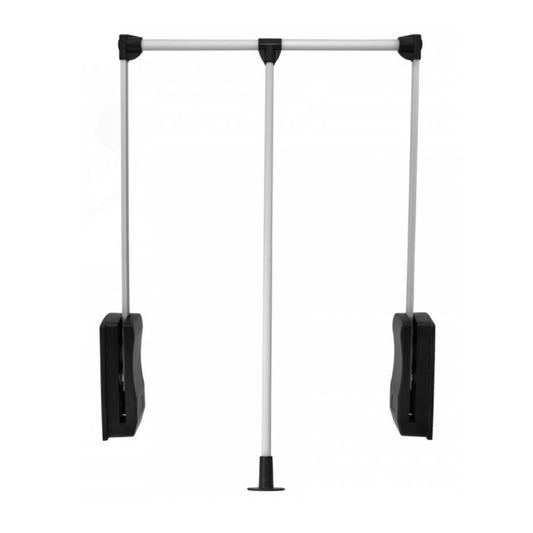

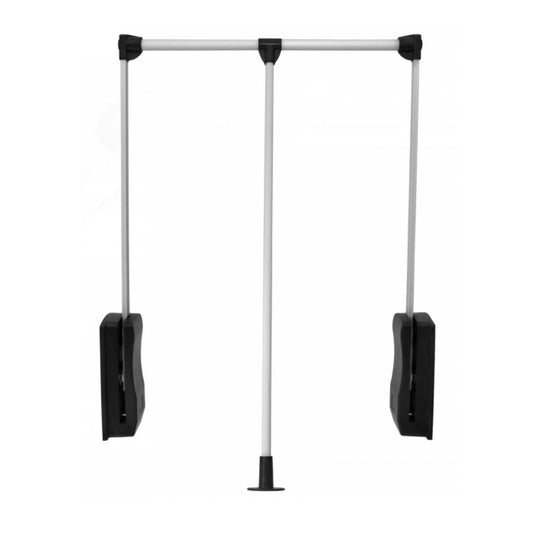

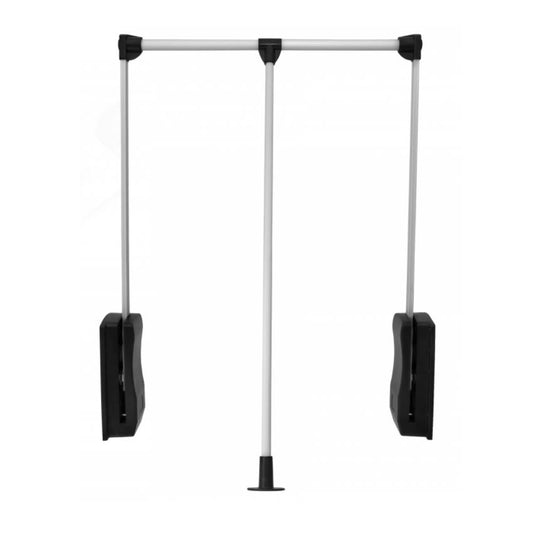

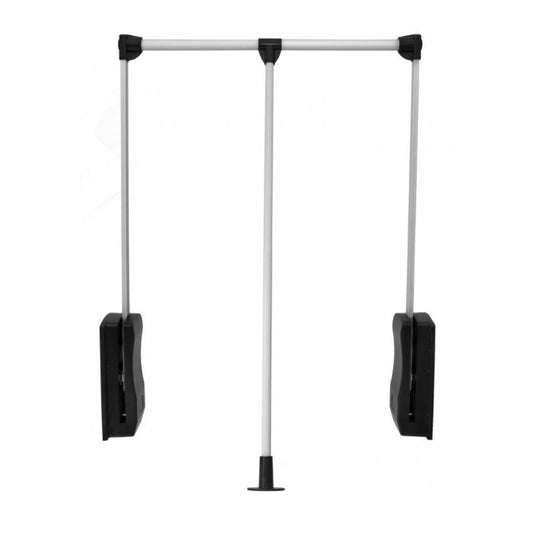

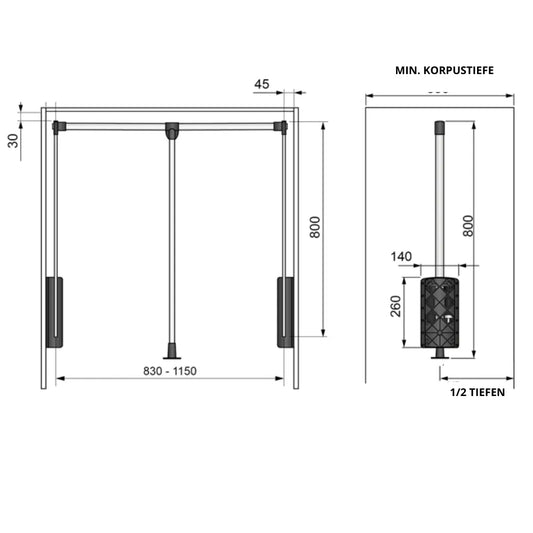
Apull down closet rod(also known as a wardrobe lift) is a pivoting hardware system designed for tall wardrobes and closets. It uses a lever mechanism powered by an integrated gas cylinder or tension spring to lower a clothing rail down to an ergonomically accessible height. This mechanism allows you to efficiently utilize upper, hard-to-reach storage space in floor-to-ceiling closets for hanging garments—without needing step stools or ladders.
For cabinetmakers, interior designers, and experienced DIYers, integrating these systems is a standard solution in modern furniture construction. When planning a closet layout, factors such as clear cabinet interior width, cabinet depth, clothing weight, and clearance around door hinges play a critical role. This guide provides all the technical specifications, dimensions, and installation guidelines required for selecting and professionally installing a pull down closet rod.
Operating Principle and Mechanics of a Pull Down Closet Rod
The movement mechanism of apull down closet rodrelies on double-sided lever arms mounted to the interior side walls of the cabinet. Much like landing gear, the rod lowers outward in a guided arc and locks into its lower position until a light push smoothly guides it back upward.
This movement is supported by energy storage units inside the side housings, typically utilizinggas struts(gas springs). The force of the spring—measured in Newtons (N)—is precisely calibrated to the allowable payload weight. When pulling down on the vertical pull handle, you move past the gas spring's tipping point. On the return motion, the spring force assists the lifting process, allowing even fully loadedpull-down closet rodsto slide back into their upper parked position effortlessly. An integrated dampening mechanism prevents the mechanism from slamming hard against the cabinet frame.
Load Capacities and Weight Classes: From Standard to Heavy-Duty
Weight capacity is the most critical selection factor. Overloading will inevitably lead to gas strut failure or cause the mounting screws to pull out from particle board or MDF side walls.
- Standard Wardrobe Lifts (22–33 lbs / 10–15 kg):These models cover everyday needs for shirts, blouses, and light jackets. They are ideal for narrower cabinet widths.
- Medium Capacity (up to 44 lbs / 20 kg):Apull down closet rod rated for 44 lbs (20 kg)is suitable for wider wardrobes and heavier garments such as suits or winter coats.
- Heavy-Duty Systems (66–110 lbs / 30–50 kg):When filling the entire width of a wide closet with heavy leather jackets or motorcycle gear, a66 lbs (30 kg) pull down closet rodor even a110 lbs (50 kg) pull down closet rodis required. These demand reinforced cabinet construction because the lever forces exerted on the side walls are immense. For such weights, standard wood screws in 5/8 in (16 mm) particle board are often insufficient; installation requires through-bolts or specialthreaded inserts(Rampa bushings).
System Grid Dimensions, Width Adjustment, and Telescopic Bars
To fit various clear cabinet widths, the horizontalpull down closet rodfeatures a telescopic design. It consists of interlocking steel or aluminum tubing that expands seamlessly to match the exact internal dimension of your cabinet frame. The position is secured via a set screw or a twist-lock mechanism.
These systems are typically divided into three standard niche widths based on common cabinetry dimensions:
1. Niche Width 17-3/4 to 23-5/8 in (450–600 mm)
Designed for narrow cabinets, often used as accent modules in wall units. Space is limited here, requiring particularly compact hardware side housings.
- Pull Down Closet Rod 17-3/4 to 23-5/8 in (450-600mm)(Standard Version)
- Pull Down Closet Rod 17-3/4 to 23-5/8 in (450-600mm) - Chrome/White
- Pull Down Closet Rod 17-3/4 to 23-5/8 in (450-600mm) - Anthracite
2. Niche Width 23-5/8 to 32-11/16 in (600–830 mm)
The standard size for double-door closet sections. This width offers an optimal balance between storage space and mechanical stability, as sag in the telescopic bar remains minimal at this length.
- Pull Down Closet Rod 23-5/8 to 32-11/16 in (600-830mm)
- Pull Down Closet Rod 23-5/8 to 32-11/16 in (600-830mm) - Chrome/White
3. Niche Width 32-11/16 to 45-1/4 in (830–1150 mm)
Engineered for wide closet configurations and large sliding door wardrobes. For spans exceeding 39-3/8 in (1000 mm), the tubing wall thickness is reinforced to prevent permanent bending under heavy loads.
- Pull Down Closet Rod 32-11/16 to 45-1/4 in (830-1150mm)
- Pull Down Closet Rod 32-11/16 to 45-1/4 in (830-1150mm) - Chrome/White
- Pull Down Closet Rod 32-11/16 to 45-1/4 in (830-1150mm) - Anthracite
Materials and Surface Finishes
Material selection impacts both durability and interior closet aesthetics. The side housings, which enclose the mechanical components, are typically crafted from high-impact ABS plastic or polyamide to keep weight down and ensure quiet operation.
The load-bearing components—the lever arms and horizontal rod—are manufactured from high-gradesteeloraluminum.
- Steel Tubingprovides exceptional flexural strength but is heavier. It is usually electro-galvanized and chrome-plated (Chrome/White finish).
- Aluminum Profilesare lighter and entirely corrosion-resistant. They are frequently anodized or powder-coated (e.g., in Anthracite), creating a scratch-resistant surface over which hangers slide quietly.
Technical Installation Requirements
Before installing apull down closet rod, verify the exact interior geometry of your cabinet. Incorrect planning can cause the lift mechanism to hit doors or interior shelves when lowered.
Cabinet Depth and Swivel Clearance
The minimum clear cabinet depth generally needs to be19-11/16 to 20-1/2 in (500–520 mm). As you lower the mechanism, the lever arm swings in an arc. The geometry is engineered so that hanging clothes do not drag along the back wall and, when fully lowered, clear the front of the cabinet far enough for effortless loading and unloading.
Hinge Clearance and Collision Check
A frequent issue in hinged-door wardrobes is collision between the lift mechanism and cabinet door hinges. A standard Europeancup hingewith a1-3/8 in (35 mm)cup diameter and a110°opening angle projects into the cabinet interior. Mounting the lift’s side housing at the same height as a hinge will cause the lever arm to bind. Solution: Position the housing height so it sits directly between two hinges, or installspacer plates(spacers). Spacers offset the mechanism outward by 5/8 to 1 in (15–25 mm) from the side panel, allowing the arm to swing past the hinge without contact. Spacers are mandatory for inset doors or center-mullion partitions.
Sliding Doors and Bifold Doors
In sliding door wardrobes, ensure that the open door completely clears the drop-zone area. If a sliding door overlaps the clear interior width even by an inch, the lift arm will strike it during operation.
Accessibility and Ergonomics
Beyond saving space, apull down closet rodis a essential feature for accessible living and ADA-inspired universal design. According to accessibility standards (such as DIN 18040-2 for accessible housing), control elements and storage areas for wheelchair users should be reachable between 33-1/2 to 41-5/16 in (850–1050 mm) off the floor.
A standard closet places upper hanging space at heights over 70-78 in (1800 mm)—out of reach for wheelchair users or individuals with limited shoulder mobility. Thanks to the vertical pull rod reaching down to roughly 35-7/16 in (900 mm), an entire upper wardrobe can be pulled down into a seated reach zone, making this an invaluable fitting for Universal Design homes.
Step-by-Step Installation Guide
Precision installation is vital. Any misalignment between the left and right side housings will cause the mechanism to bind and prematurely wear out the gas struts.
Required Tools:
- Cordless drill/driver
- Wood drill bits (Ø 1/8 in (3 mm) for pilot holes, Ø 3/16 in (5 mm) for System 32 hole patterns)
- Phillips (PZ2) or Torx driver bit (TX20)
- Level and tape measure
- Wood screws / Particle board screws(Countersunk, typically #8 x 5/8 in (4.0 x 15 mm) or #8 x 11/16 in (4.0 x 17 mm) for 3/4 in (18 mm) side panels)
Step 1: Measuring and Marking
Determine the mounting height. The top edge of the housing should sit approximately 4 to 6 in (100–150 mm) below the cabinet ceiling so coat hangers clear the top panel when swinging back up. Mark the mounting holes on both interior side panels. If present, utilize theSystem 32hole pattern; many housings feature hole layouts designed to match standard 1-1/4 in (32 mm) center spacings.
Step 2: Pre-drilling and Mounting the Housings
To prevent splitting particle board or MDF, pre-drill the marked spots with a 1/8 in (3 mm) bit to a depth of roughly 3/8 in (10 mm). Screw the left and right housings securely into place, ensuring they are perfectly parallel. For heavy-duty models (such as a66 lbs (30 kg) pull down closet rod), utilize all available screw holes in the housing to distribute shear forces evenly across the side wall.
Step 3: Assembling Horizontal and Vertical Rods
Connect the adjustable horizontal rod and attach it to the mounting brackets on both lever arms. Adjust the width so the rod fits snugly without bowing the lever arms outward. Secure the selected width using the lock screw. Next, fasten the vertical pull handle to the exact center of the horizontal rod.
Step 4: Functional Check and Fine-Tuning
Gently pull the lift down using the handle. Check that the movement is smooth and even without catching. The rod should noticeably catch/lock into the lower position. When returning it upward, the dampeners should smoothly engage during the final third of the travel path, guiding the system silently into its resting position.
Maintenance and Troubleshooting
When properly installed, a high-qualitypull down closet rodis virtually maintenance-free. However, occasional wear can occur over years of daily use and can easily be fixed with quick adjustments.
- Stiff Movement or Squeaking:Squeaking or stiffness usually originates at the pivot points of the lever arms. A drop of silicone-free machine lubricant applied to the joint pins fixes this issue. Avoid oil-based sprays, as they can degrade plastic housings.
- Rod Fails to Lift Completely:This is a classic indicator of overloading. Weigh the hanging clothes and remove excess items. If the lift struggles even while unloaded, the gas cylinder has lost pressure (Newtonian force) and the gas spring or complete side housing must be replaced.
- Uneven or Asymmetrical Lowering (Binding):Use a level to check if one of the housings has loosened. Retighten the mounting screws. If the screw holes in the wood are stripped out, ream the hole to 3/16 in (5 mm) or 5/16 in (8 mm) and glue in a wooden dowel. Once cured, re-drill and drive the screw back into solid wood.
Frequently Asked Questions (FAQ)
What is a pull down closet rod?
A pull down closet rod is a mechanical wardrobe fixture that allows a high-mounted clothing rail to swing downward and forward out of the cabinet via a lever mechanism. It is used to maximize upper closet and ceiling-height space for hanging clothes.
Does a pull down closet rod fit in an IKEA PAX wardrobe?
Yes, installation in standard closet frames like IKEA PAX is straightforward, provided you match the interior width. PAX frames come in clear interior widths of roughly 18 in (46 cm), 28 in (71 cm), and 38 in (96 cm) (with 3/4 in (18 mm) panel thickness). For a 19-3/4 in (50 cm) frame, choose the 17-3/4 to 23-5/8 in (450–600 mm) model. For a 29-1/2 in (75 cm) frame, pick the 23-5/8 to 32-11/16 in (600–830 mm) size. For a 39-3/8 in (100 cm) frame, you will need the 32-11/16 to 45-1/4 in (830–1150 mm) variant. For hinged PAX doors, pay attention to hinge placement and use spacer plates if necessary.
Can a pull down closet rod be mounted directly to a wall?
Standard models are designed for side mounting between two parallel cabinet panels. Direct wall mounting to a room wall is only possible if you securely anchor sturdy mounting plates (e.g., solid wood or thick plywood) to the wall at the required width gap. The lift housings can then be screwed into these support panels just like inside a wardrobe cabinet.
How much weight can a vertical pull rod handle?
The vertical pull handle itself is strictly designed for operating the mechanism and should never be used to hang clothes or hangers. The horizontal weight capacity of the overall lift system ranges between 22 and 33 lbs (10–15 kg) for standard models, while specialized heavy-duty units carry 44 to 110 lbs (20–50 kg). Always verify the manufacturer's exact weight limit for your specific model.
What should I do if the pull down closet rod binds when pulled?
First, check whether the telescopic horizontal bar is set precisely to the cabinet's width. If it is under mechanical tension, the pivot joints will bind. Loosen the lock screw on the crossbar slightly, pull the lift mechanism down, and retighten the screw in the lowered position. This re-centers the system tension-free.
Are replacement parts available for pull down closet rods?
Many hardware systems are modular. For well-known furniture hardware brands, individual internal gas springs can often be ordered and replaced separately. However, for fully enclosed compact housings, the entire side unit is usually replaced if the dampeners lose pressure after years of heavy use.
Can the pull rod handle be extended?
The vertical pull handle typically comes in a fixed standard length (often between 27-1/2 to 33-1/2 in (700–850 mm)). In extra-tall closets (e.g., 9 ft (2800 mm) ceiling heights), this standard length can occasionally be hard to reach for shorter individuals. Certain modular systems offer extendable or telescopic pull rods to customize ergonomics based on user height.