
155 Degree Cabinet Hinges
Popular Subcategories
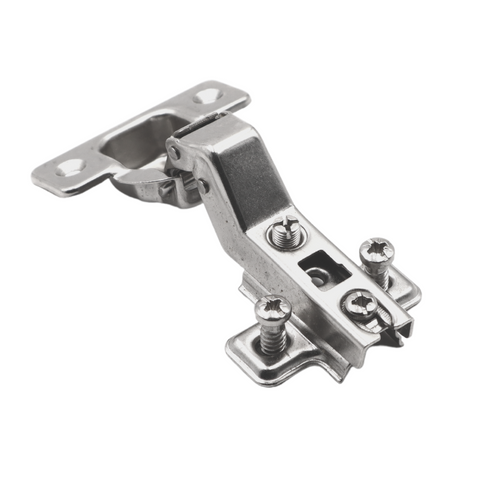
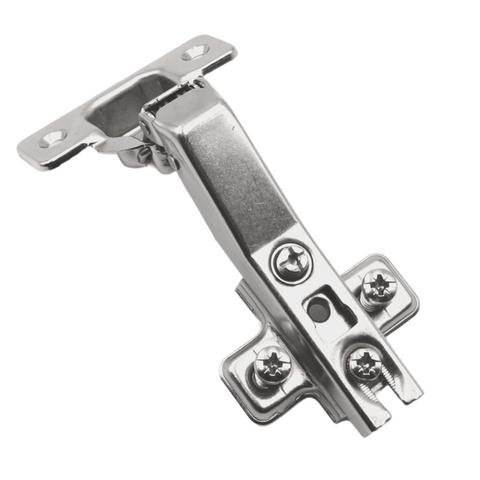
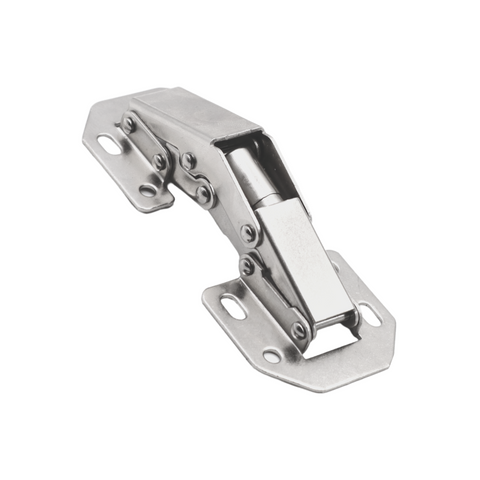
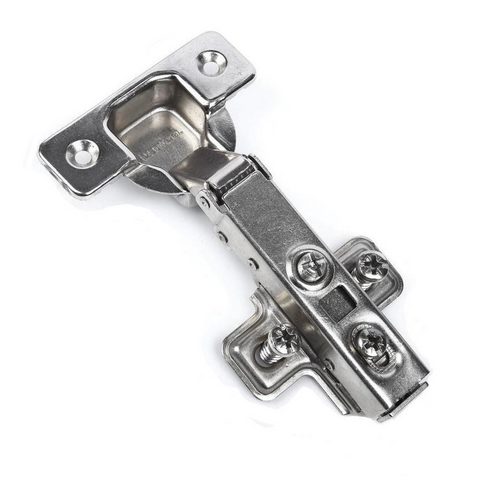
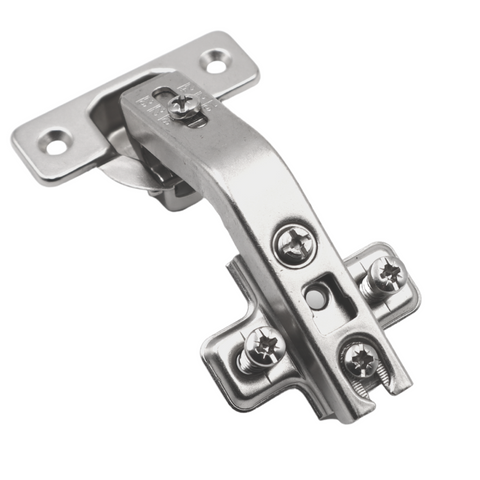
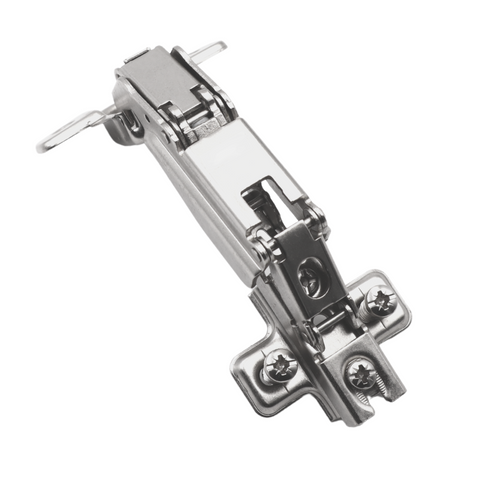
-
165° Soft-Close Hinge, H2 Mounting Plate with EURO Screws, Overlay DoorsRegular price $5.22Unit price / perRegular priceSale price $5.22
-
165º Hinge, H2 Mounting Plate with EURO Screws, Overlay DoorsRegular price $2.39Unit price / perRegular priceSale price $2.39

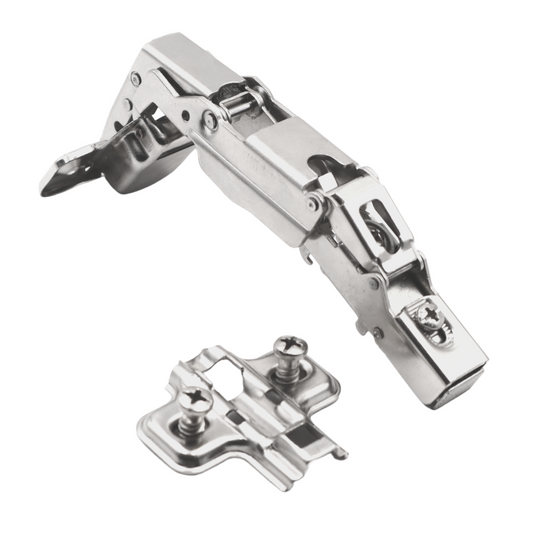

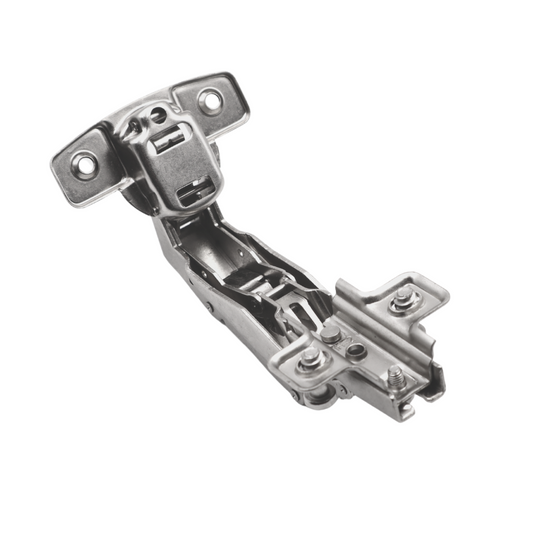
155 degree cabinet hingesare concealed furniture hinges that allow an extra-wide door opening angle, primarily used in cabinet designs with internal roll-out drawers or complex corner configurations.
Thanks to the unique kinematics of these wide-angle hinges, the open door pivots completely clear of the cabinet's interior clearance. This is an essential technical requirement when drawers or pull-out trays are installed behind closed doors and must not collide with the door edge when pulled out. In professional cabinetmaking and woodworking, these hardware components form the backbone of highly functional cabinet interiors.
Technical Specifications and Dimensions
When planning and installingEuropean cabinet hingeswith a155°opening angle, standard industry specs apply to ensure compatibility with most cabinet box systems.
- Cup Diameter:The standard drill hole in the door panel is 1-3/8 in (35 mm). This matches the common dimension for nearly all modern cabinet hinges.
- Cup Depth:Milling for the hinge cup typically requires a depth of 7/16 in to 1/2 in (11.5 mm to 12.5 mm). Consequently, the door panel must have a minimum thickness of 19/32 in to 5/8 in (15 mm to 16 mm) to prevent drilling through or blowout. Maximum door thicknesses up to 15/16 in (24 mm) can be easily accommodated.
- Cup Distance (C Dimension):The distance from the door edge to the edge of the 1-3/8 in (35 mm) bore ranges between 1/8 in and 9/32 in (3 mm and 7 mm), depending on the desired overlay and manufacturer.
- Opening Angle:The nominal value is155°. In practice, hinges with a slightly larger radius are often installed in this hardware class. Therefore, this range frequently overlaps with165 degree cabinet hinges.
A 155 degree cabinet hinge functions much like an industrial robot arm: rather than simply swinging the door open, its multi-pivot linkage smoothly lifts the door entirely out of the cabinet's entry path. This zero-protrusion mechanism guarantees that 100 percent of the interior cabinet width remains fully accessible.
Overlay Types for Wide-Angle Hinges
Choosing the correct hinge depends heavily on the door's position relative to the cabinet side panel. There are three basic mounting configurations, each requiring a specific hinge arm crank.
Full Overlay (Full Overlay Door)
In a full overlay setup, the door completely covers the front edge of the side wall when closed. The edge of the side panel is not visible from the outside. The hinge arm is straight (uncranked) for this application.Full overlay European hingesare used for this standard construction, providing maximum overlay finely adjusted via mounting plate selection and side screw tuning.
Half Overlay (Dual / Twin Door Mounting)
When two doors share a single partition wall inside a cabinet (for example, in continuous wall units), each door must cover only half of the partition wall edge. Here, the hinge arm has a half crank (typically 3/8 in (9.5 mm)). Matchinghalf overlay European hingesensure that both doors open independently without rubbing against one another.
Inset (Inset Door)
In an inset configuration, the door sits flush with the front edge of the cabinet box sides, leaving the box edges exposed. The hinge arm features a high crank (typically 5/8 in to 23/32 in (16 mm to 18 mm)). Flush designs like this useinset European hingesor hinges for inset cabinet doors. 155 degree technology applies here as well, though it requires precise gap calculations as the door swings slightly inside the cabinet box before pivoting outward.
Damping Systems and Closing Mechanisms
A key feature of modern cabinet hardware is the closing behavior, divided into self-closing (un-damped) systems and those with integrated soft-close mechanisms.
Soft-Close European Hinges
When cabinet hinges feature integrated damping, a small hydraulic cylinder is built into the hinge arm or cup. This absorbs the kinetic energy of the closing door starting at an angle of roughly30°, bringing it to a smooth, silent close. Soft-close hinges protect cabinet boxes and prevent slamming. Installers often search for these systems under soft-close cabinet hinges or soft-close door hardware. The complete selection of damped options is available undersoft-close cabinet hinges.
Self-Closing Hinges (Un-Damped)
Self-closing hinges without soft-close feature a simple spring mechanism that pulls the door shut over the final few inches, closing firmly. These are commonly used when separate external dampers (such as clip-on or door-bore dampers) are installed, or when cabinet designs utilize touch-release / push-to-open latch systems for handle-free fronts. Note: A soft-close hinge should never be combined with a mechanical push-to-open system, as the hydraulic dampening will block the door spring release.
Mounting Plates and Fastening Hardware
A European hinge always consists of two parts: the main hinge body (drilled into the door) and the cross mounting plate (attached to the cabinet wall).
- Mounting Plate Height (Off-set):Plates come in various heights, most commonlyH0 (0 mm off-set)orH2 (2 mm off-set). Height selection dictates door overlay: an H2 plate reduces overlay by exactly 3/32 in (2 mm) compared to an H0 plate.
- Plate Fastening:Mounting plates are attached directly into wood using standard wood/chipboard screws (1/8 in or 5/32 in (3.5 mm or 4 mm) diameter, Pozidriv or Torx drive) or come pre-equipped with Euro screws. Euro screws seat into standardized 32 mm line bore holes (3/16 in (5 mm) drill holes), offering significantly higher pull-out resistance.
How to Adjust Cabinet Hinges (3D Adjustment)
A crisp, uniform reveal is the hallmark of professional installation. 155 degree cabinet hinges feature built-in 3-way adjustment via three screws on the hinge arm:
- Depth Adjustment:Loosening the rear screw on the hinge arm allows you to adjust door depth (distance from the cabinet box), regulating pressure against door bumpers or seals. Adjustment range is typically +1/8 in / -3/32 in (+3 mm / -2 mm).
- Side-to-Side Adjustment (Reveal):The front adjustment screw regulates door overlay. Turning it shifts the door horizontally left or right to align vertical gaps between adjacent doors parallelly.
- Height Adjustment:Performed directly on the mounting plate. Loosening plate mounting screws (or using an integrated cam screw on premium plates) shifts the entire door up or down by ±3/32 in (±2 mm).
To bore hole locations accurately, using a hinge drilling jig is highly recommended to ensure the 1-3/8 in (35 mm) hole is drilled perfectly perpendicular and at the correct C dimension.
Featured Products for Wide-Angle Applications
Multiple options are available in this technical specification, varying by damping style and mounting plate configuration. Because the 155° range overlaps closely with 165° solutions, components suitable for zero-protrusion needs include:
- 165° 3D Soft-Close European Hinge, H2 Mounting Plate with EURO Screws, Full Overlay:A fully damped system for full overlay doors. The H2 plate slightly reduces overlay, ideal for thicker side panels. Euro screws ensure maximum hold in 32 mm line borings.
- 165° Soft-Close European Hinge, H0 Mounting Plate with EURO Screws, Full Overlay:Also features an integrated hydraulic damper. The H0 plate delivers maximum standard overlay, ideal for standard 5/8 in to 3/4 in (16 mm to 19 mm) particle board/plywood boxes.
- 165° European Hinge, H2 Mounting Plate with EURO Screws, Full Overlay:The un-damped version. Selected when using independent dampers or on large doors requiring three hinges where only two are soft-close and the third is un-damped to prevent excessive closing resistance.
Frequently Asked Questions (FAQ) About 155 Degree Cabinet Hinges
How many hinges do I need per cabinet door?Hinge count depends on door weight and height. As a general rule for 1-3/8 in (35 mm) cup hinges: doors up to 35 in (900 mm) high and 9 lbs to 13 lbs (4 kg to 6 kg) require 2 hinges. Up to 63 in (1600 mm) (approx. 26 lbs (12 kg)), 3 hinges are needed. For doors 78 in (2000 mm) and taller (approx. 37 lbs (17 kg)), 4 hinges are required.
Can I swap 110 degree hinges for 155 degree cabinet hinges?Yes, provided the boring pattern (1-3/8 in (35 mm) cup diameter and matching cup distance) aligns. Swapping is often required when standard110 degree cabinet hingesobstruct retrofitted interior pull-out drawers. Mounting plates usually need to be replaced when changing the opening angle degree.
What does "zero protrusion" mean for 155° hinges?Zero protrusion means that when opened between90°and155°, the door completely clears the interior cabinet opening width without projecting inside. This is an absolute prerequisite for installing pull-out trays or internal drawers.
Can I mix soft-close and self-closing hinges on the same door?Yes, this is common practice in field installations. If a large cabinet door requires three or four hinges, using soft-close on every hinge can make closing extremely slow and opening stiff. Combining one self-closing hinge with two soft-close hinges balances resistance perfectly.
Related Cabinet Hardware & Opening Angles
Different opening angles are required depending on room layouts or cabinet geometries. For specialty builds like bi-fold doors, corner units, or angled fronts, we offer these specificEuropean cabinet hinges:
- For sharp angled applications or special corner solutions:30 degree cabinet hingesand45 degree cabinet hinges.
- For flush blind corner attachments:90 degree cabinet hinges.
- The industry standard for standard swinging doors:110 degree cabinet hinges.
- For bi-fold doors in corner lazy susan cabinets:135 degree cabinet hinges.
- For maximum opening range (often matching 155° applications):165 degree cabinet hinges. If you are specifically searching for standard cup size options, explore our35 mm cabinet hingescollection.