
Biscuit Joiners
Popular Subcategories
-
No. 20 Jointing Biscuits - 1000 pcsRegular price $35.94Unit price / perRegular priceSale price $35.94
-
No. 10 Jointing Biscuits - 1000 pcsRegular price $35.94Unit price / perRegular priceSale price $35.94
-
Wood Joining Biscuits - Beechwood No. 0 - 100 pcs.Regular price $12.38Unit price / perRegular priceSale price $12.38
-
Wood Joining Biscuits, Biscuit Joiners - Beech Wood No. 0 - 200 pcs.Regular price $14.45Unit price / perRegular priceSale price $14.45
-
Wood Joining Biscuits - Beech Hardwood No. 10 - 100 pcsRegular price $12.38Unit price / perRegular priceSale price $12.38
-
Wood Joining Biscuits - Beech Wood No. 10 - 200 pcs.Regular price $14.45Unit price / perRegular priceSale price $14.45
-
Wood Joining Biscuits, Biscuit Dowels - Beech Wood No. 20 - 100 pcs.Regular price $12.38Unit price / perRegular priceSale price $12.38
-
Wood Biscuit Joiners, Wood Biscuit Joints - Beechwood No. 20 - 200 pcs.Regular price $14.45Unit price / perRegular priceSale price $14.45

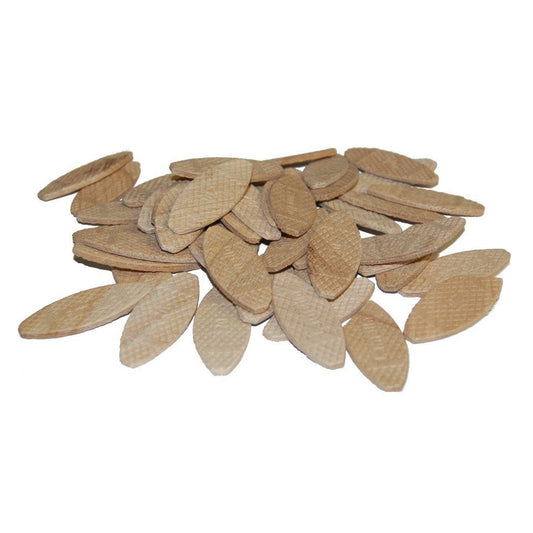

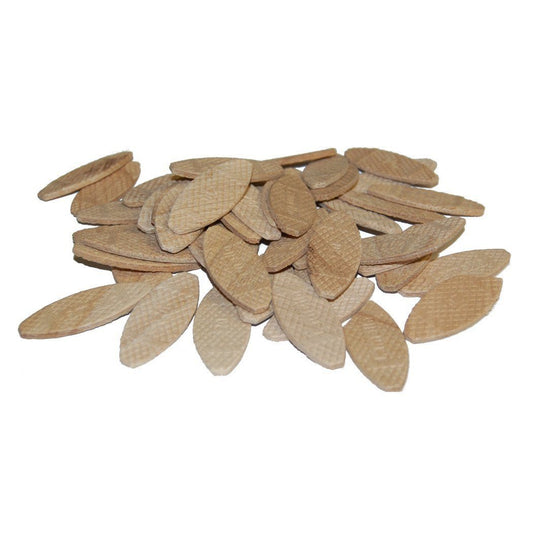

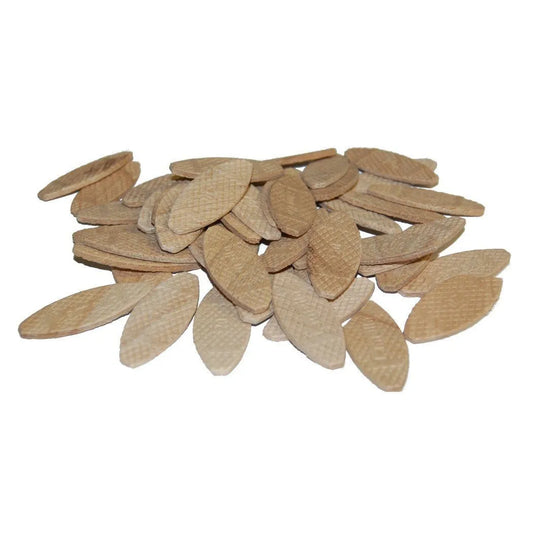

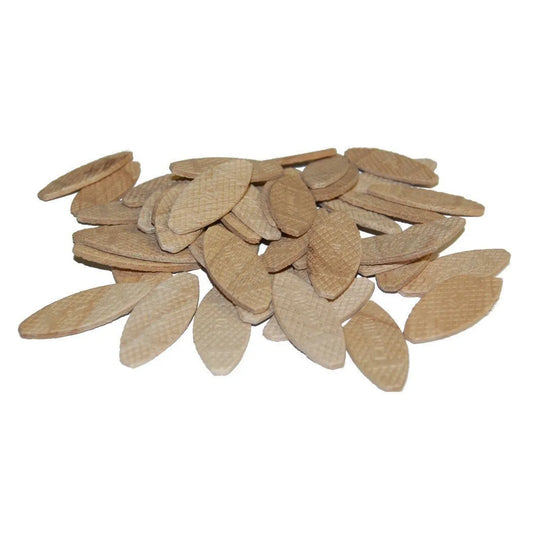

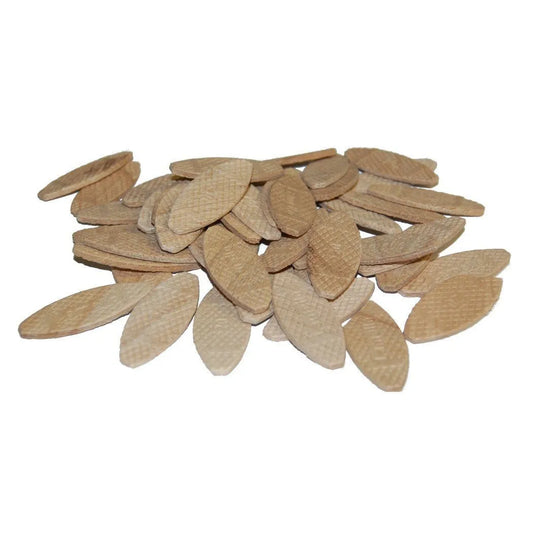

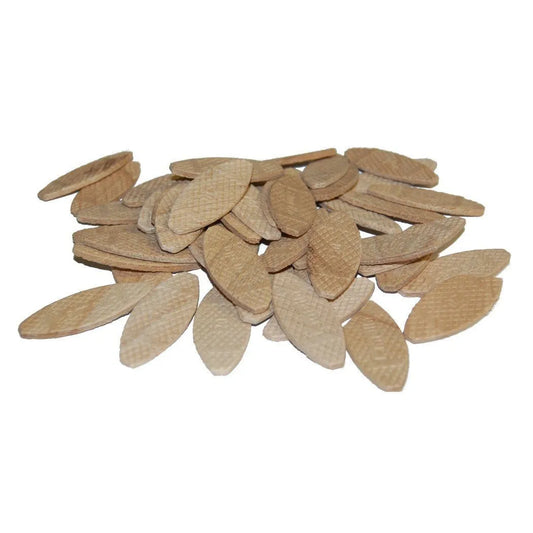

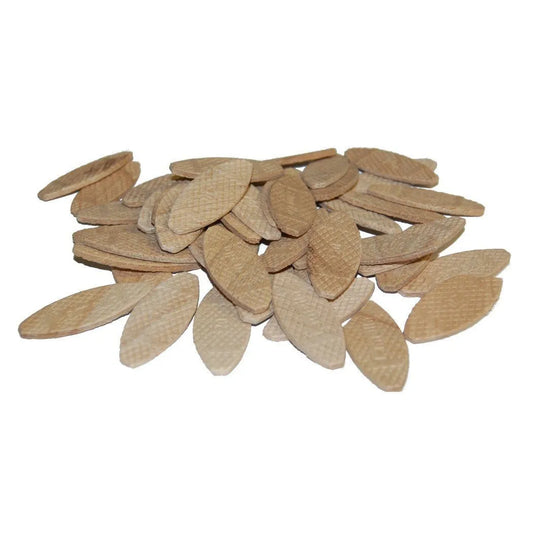

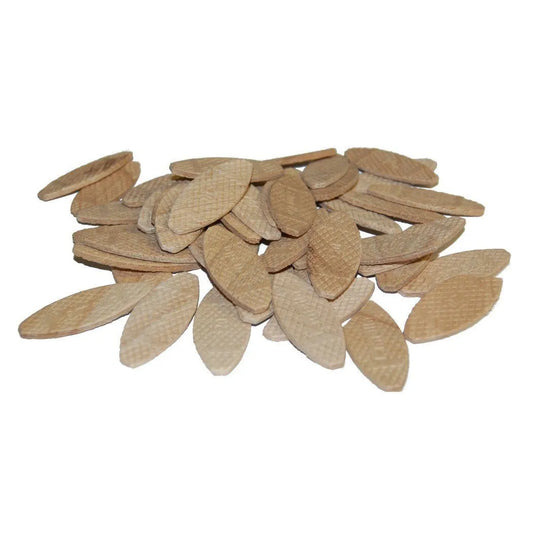
Biscuit joiners, often referred to in woodworking as wood biscuits or joinery biscuits, are oval-shaped connecting plates made of compressed beech wood. They are widely used in modern cabinetmaking and interior millwork to create strong, flush-aligned joints in engineered panels and solid wood. By being glued into a pre-routed slot, they absorb moisture from the adhesive and swell to form a rigid, high-strength bond that stabilizes carcases, frames, and mitered joints.
Systematics and Standardized Sizes for Biscuit Joiners
Constructing cabinet carcases requires standardized joinery components. The system behind wood biscuits is based on a uniform material thickness of exactly 5/32 in (4 mm). Variations in load capacity and application areas depend entirely on the length and width of the biscuits. Slots are cut using a standard biscuit joiner machine (plate joiner), which typically features a saw blade with a kerf width of 5/32 in (3.96 mm to 4 mm).
Three main sizes have established themselves in professional woodworking, covering the vast majority of furniture-making applications:
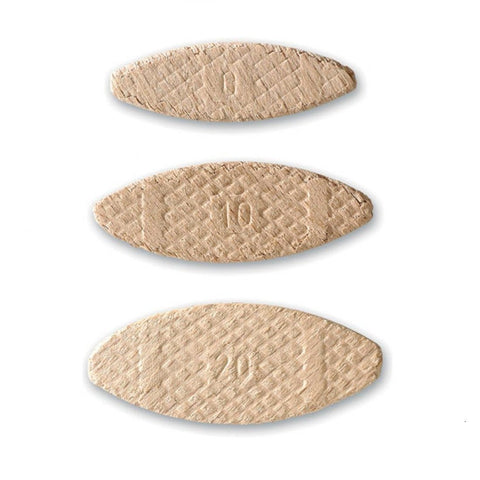
Size 0 Wood Biscuits
The smallest standard size measures 1-27/32 in (47 mm) in length and 19/32 in (15 mm) in width. This dimension is primarily designed for narrow frame joints, decorative trim, or thin panel stock starting at 3/8 in (10 mm) thickness. The required cutting depth on the machine is 5/16 in (8 mm) per mating workpiece. The following package sizes are available for delicate work and small production runs:
- Wood Biscuit Joiners, Beech Wood No. 0 - 100 pcs.
- Wood Biscuit Joiners, Beech Wood No. 0 - 200 pcs.
- Wood Biscuit Joiners, Beech Wood No. 0 - 1000 pcs.
Size 10 Wood Biscuits
Measuring 2-3/32 in x 3/4 in (53 mm x 19 mm), Size 10 serves as the ideal mid-range option. It is frequently used for board thicknesses between 15/32 in and 19/32 in (12 mm and 15 mm). It is also the go-to solution for narrow drawer fronts or intermediate shelves where the required 25/64 in (10 mm) routing depth per side must not compromise the integrity of the material. Workshop stock packages include:
- Wood Biscuit Joiners, Beech Wood No. 10 - 100 pcs.
- Wood Biscuit Joiners, Beech Wood No. 10 - 200 pcs.
- Wood Biscuit Joiners, Beech Wood No. 10 - 1000 pcs.
Size 20 Wood Biscuits
Size 20 is the industry standard for traditional cabinet construction. With dimensions of 2-7/32 in x 29/32 in (56 mm x 23 mm), it delivers the maximum gluing surface and highest mechanical load capacity. It is routinely used for all panel thicknesses of 5/8 in (16 mm) and above (especially standard 3/4 in (19 mm) particle board or MDF). For this size, the plate joiner is set to a routing depth of 31/64 in (12.3 mm). Options for industrial and professional applications include:
- Wood Biscuit Joiners, Beech Wood No. 20 - 100 pcs.
- Wood Biscuit Joiners, Beech Wood No. 20 - 200 pcs.
- Wood Biscuit Joiners, Beech Wood No. 20 - 1000 pcs.
Material Properties: Mechanics of Compressed Wood
Wood biscuit joiners are not made from ordinary lumber. Their production is a high-tech process designed to alter the physical properties of the raw material. Select beech wood is gently kiln-dried and then mechanically compressed under extreme pressure. Oval biscuits are die-cut from these compressed sheets so that the wood grain runs diagonally to the length of the biscuit. This diagonal grain orientation prevents the biscuit from shearing under lateral loads across the joint.
The core mechanical advantage reveals itself during assembly. Inside the routed slot, the biscuit acts like a dry sponge in water: as soon as it comes into contact with water-based PVA wood glue, the compressed beech wood absorbs the moisture. This causes the material to swell by up to 20% of its original thickness. Initially inserted with a slight tolerance into the 5/32 in (4 mm) slot, the expanding biscuit presses tightly against the walls of the pocket, creating an unbreakable, form-fitting, positive-locking bond.
Applications and Compatibility
Wood biscuit joiners are used across virtually all branches of woodworking. The oval geometry permits lateral adjustments during assembly, giving it a distinct advantage over traditional round dowels.
Cabinet Construction with Particle Board and MDF
When joining MDF boards or assembling melamine-faced particle board into cabinet carcases, flush alignment along visible edges is critical. Because the routed slot is cut roughly 5/64 in (2 mm) wider than the length of the biscuit, the edge of the workpiece can be micro-adjusted perfectly flush before the glue sets. This eliminates flush-trimming or excessive sanding later on. Biscuits used in MDF must provide high shear strength because the edges of medium-density fiberboard tend to split under point loads; the oval design distributes stress evenly across a wider surface area.
Solid Wood and Frame Joinery
When edge-gluing solid wood—such as joining oak or beech stock with wood biscuits—the plates not only help align the panels but also prevent warping. In tabletop and countertop glue-ups, biscuit slots are routed every 6 in to 8 in (150 mm to 200 mm) along the mating edges. They lock individual boards into a perfectly flat plane and absorb shear stresses caused by the natural movement of the wood.
Miter Joints
Joining mitered corners (typically 45°) is a demanding task where traditional dowels often fail, as drilling must be perfectly angled and depth-controlled to prevent blowing through the outer face. A biscuit joiner features a swiveling fence that can be set precisely to 45°. Slots are routed perpendicular to the miter face, leaving ample material backing even on thinner 5/8 in (16 mm) stock.
Technical Comparison: Biscuit Joiners vs. Round Dowels
Choosing the right fastener is a key step in production planning. While both systems have their place, they differ significantly in handling and margin for error.
- Tolerance and Alignment:Round dowels (e.g., 5/16 in x 1-1/2 in (8 x 40 mm)) require absolute drilling precision. A discrepancy of just 1/64 in (0.5 mm) results in misaligned joints. Biscuit joiners allow approximately 5/64 in (2 mm) of lateral play, letting you slide parts into perfect alignment after assembly.
- Load Distribution:Round dowels concentrate force at localized points, which can cause tear-out in porous materials like coarse particle board. The flat, oval surface of a biscuit spreads the load across a much larger area, reducing surface pressure.
- Tooling Requirements:Dowel holes can be drilled with a standard drill and jig. Using joinery biscuits requires a dedicated plate joiner (biscuit joiner machine).
- Anti-Rotation:A single round dowel offers no resistance against twisting, meaning at least two dowels are required per joint location. A single wood biscuit inherently prevents rotation due to its wide profile.
Proper Installation: Parameters and Workflow
Achieving structural integrity with biscuit joiners requires precise tool setups and execution steps.
1. Machine Setup
Plate joiners feature depth stops—often on a rotating turret—that quickly adjust to standard biscuit sizes (0, 10, 20). The plunge depth must always be slightly deeper than half the width of the biscuit to create a glue pocket.
- For Size 20 (29/32 in (23 mm) width), the machine cuts to a depth of approx. 31/64 in (12.3 mm). Combined, the two slots yield a total depth of 31/32 in (24.6 mm). This leaves about 1/16 in (1.6 mm) of clearance for glue to pool without hydraulic lock preventing a tight joint.
2. Marking and Slot Cutting
Align the workpieces flush and draw a pencil line across both edges at each joint location. Place the alignment mark of the joiner directly over the line. Hold the base flat against the reference face and plunge the blade smoothly to prevent the 5/32 in (4 mm) blade from wandering.
3. Glue Application and Assembly
Apply glue into the routed slot rather than onto the biscuit itself, using a bottle equipped with a flat applicator nozzle. Press the biscuit in by hand and join the components. Because compressed beech wood swells quickly upon contacting water-based glues, clamping must be completed within a few minutes.
4. Clamping Pressure
Secure the assembly using cabinet clamps. Apply sufficient pressure until a thin line of glue squeezes out along the joint line (indicating full glue coverage) without crushing the wood fibers. Leave clamps attached at room temperature (approx. 68 °F (20 °C)) for at least 30 to 45 minutes until initial handling strength is reached. Full cure occurs after 24 hours.
Storage and Quality Control
The effectiveness of wood biscuits relies on their ability to absorb moisture, making them sensitive to improper storage. If stored in high-humidity environments (such as unheated workshops during winter or damp job sites), they absorb ambient moisture and swell prematurely. A biscuit expanded to 11/64 in (4.2 mm to 4.4 mm) will no longer fit smoothly into a standard 5/32 in (4 mm) slot. Forcing it with a hammer can crack the slot walls or split particle board materials.
Keep wood biscuits stored in a dry location. Reseal open bags carefully or transfer stock to airtight plastic containers. When buying biscuit joiners, match stock quantities to your project needs: a 100-piece or 200-piece pack suits occasional projects, while high-volume production shops benefit from bulk packs of 1,000 pieces.
Frequently Asked Questions (FAQ) About Biscuit Joiners
Which size biscuit joiner should I use for 3/4 in (19 mm) particle board?For panel thicknesses ranging from 5/8 in to 3/4 in (16 mm to 19 mm), Size 20 is the industry standard. It provides maximum surface area for gluing and superior strength.
What is the recommended spacing between wood biscuits?For cabinet carcase assembly, place the first biscuit approximately 2 in (50 mm) from the edge. Space remaining biscuits every 6 in to 10 in (150 mm to 250 mm). For heavy-load applications like bookshelf panels, reduce spacing to 4 in to 6 in (100 mm to 150 mm).
Can I install wood biscuits without a dedicated joiner tool?No. The precise 5/32 in (4 mm) wide, half-moon slot can only be cut reliably with a specialized biscuit joiner. While routing slots using a slot cutter bit on a router table is theoretically possible, it is time-consuming, inaccurate, and presents safety concerns.
What is the difference between "biscuit joiners" and "Lamello"?There is no technical difference. "Lamello" is the brand name of the Swiss company that invented the system in 1955. Over time, the name became a generic trademark in parts of Europe. "Biscuit joiner" or "wood biscuit" is the standard industry term in North America.
What type of glue should be used with beech wood biscuits?Use water-based adhesives to trigger the swelling action of the compressed wood. Standard PVA wood glues (Type I, Type II, or Type III) are recommended. Polyurethane (PU) glues cure via ambient humidity and do not contain water, meaning the biscuit will not swell, which can reduce joint strength.
How deep should I route for a Size 10 wood biscuit?A Size 10 biscuit is 3/4 in (19 mm) wide. Set the tool depth stop to plunge 25/64 in (10 mm) into each workpiece. Combined, the total pocket depth is 25/32 in (20 mm), providing 3/64 in (1 mm) of clearance for glue accumulation and fit adjustments.
Can wood biscuits be used for outdoor applications?Standard compressed beech wood biscuits are designed for indoor use. Outdoor weather exposure will rot beech wood and cause excessive expansion that breaks the joint. For exterior applications, use specialty biscuits made from weather-resistant composite materials or modified woods paired with waterproof polyurethane or epoxy resins.