
Wohnwand Mit Vitrine
-
Wall Unit CLIF - Living Room Furniture Set - San Remo Oak / Anthracite GreyRegular price $529.99Unit price / perRegular priceSale price $529.99

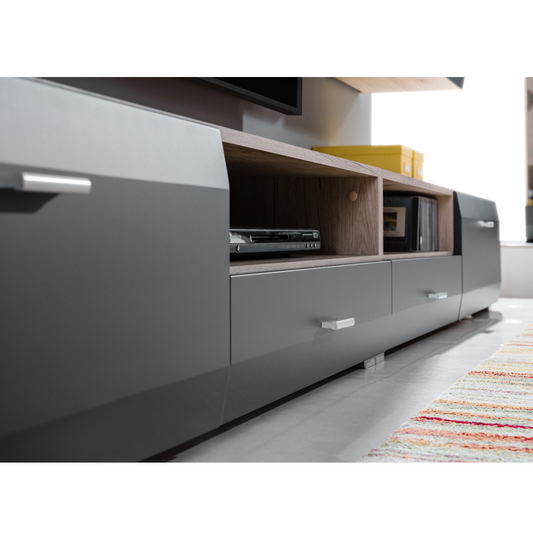
A entertainment center with display cabinetis a modular or integrated combination of closed storage units, open shelving, and at least one cabinet featuring glass doors. It serves as the central multimedia hub for the television in the living room while providing a protected display area for glassware, collectibles, or home decor. Unlike the bulky, continuous wall units of the past, amodern entertainment centerfeatures airy, often wall-mounted elements that structure the room without overpowering it.
For the DIY enthusiast, assembling such a furniture set involves coordinating various components: from floor-standing TV stands and floating shelves to wall-mounted display cabinets. In this guide, you will learn how to plan the rightentertainment centerfor your room dimensions, which materials and hardware fittings are used, and what critical details to keep in mind during wall mounting and door alignment.
Core Components: What Belongs in an Entertainment Center with Display Cabinet?
A classicwall unit with display cabinetconsists of several individual furniture pieces that are visually and functionally matched. The TV stand forms the foundation, while the glass display cabinet acts as a focal anchor point in the room.
- The TV Stand / Lowboard:The base for home electronics. It typically measures between 13-3/4 in and 17-3/4 in (35 cm to 45 cm) high with a depth of 15-3/4 in to 19-3/4 in (40 cm to 50 cm). It holds receivers, gaming consoles, and cables. ATV entertainment centeroften features pre-drilled cable pass-throughs in the back panel.
- The Glass Display Cabinet:The signature element. Available as freestanding or wall-mounted cabinets. The front features partial or full glass paneling. Inside, safety glass shelves ranging from 3/16 in to 1/4 in (4 mm to 6 mm) in thickness provide ample load capacity for glassware and china.
- The Credenza or Highboard:Many sets supplement the combination with a mid-height storage unit. Adisplay cabinet credenzabridges the gap between low TV stands and tall cabinets.
- The Floating Wall Shelf:A simple shelf with concealed wall brackets that utilizes the open space above the TV.
Models like theMIRANDA - Entertainment Center with 4 Cabinets - Wotan Oak / Gloss Whitedemonstrate typical layouts where wall-hung and floor-standing units can be flexibly arranged.
Materials and Finishes in Cabinet Making
The durability and appearance of aliving room cabinet with glass displaydepend significantly on the core materials and surface coatings used.
The Carcass: Core Stability Made of Particle Board
The concealed structure of the furniture (side panels, shelves, top and bottom panels) is typically made from 5/8 in (16 mm)melamine-faced particle board. The melamine resin coating makes the surface scratch-resistant and moisture-repellent. Edges are sealed with ABS edgebanding (usually 1/64 in to 3/64 in (0.5 mm to 1 mm) thick) to prevent moisture ingress and edge chipping.
The Fronts: MDF for Shape and High-Gloss Finishes
For visible cabinet doors and drawer fronts,MDF (Medium-Density Fiberboard)is frequently used. MDF has a finer structure than particle board, making it easier to route or wrap with high-gloss foils. A white high-gloss entertainment center owes its smooth, reflective surface to such an MDF core finished with PET or acrylic coating.
Wood grain finishes like Artisan Oak, Wotan Oak, or Sonoma Oak are achieved through textured decorative foils that replicate the tactile grain of real wood. Those seeking a warm room atmosphere often choose anoak/wood entertainment centerfeaturing these authentic laminates. Bold contrasts are created by combining dark accents, as seen in theFAME Entertainment Center - Living Room Furniture Set - Black / Gold.
Layout Planning and Dimensions: How to Choose the Right System
Before installing amodern entertainment center with ample storage, precise measurement of your wall space is essential.
- Total Width:Plan a gap of 3-7/8 in to 7-7/8 in (10 cm to 20 cm) between individual modules to create a light, open appearance. A modular wall unit for a 118 in (300 cm) wide wall should ideally have a combined module width of about 94 in to 102 in (240 cm to 260 cm).
- Depth:Pay attention to walkways. A TV stand typically extends 15-3/4 in (40 cm) into the room. If your living room is narrow, check the clearance between the sofa and the furniture.
- Wall-Mounted Modules:Afloating entertainment centerrequires structurally sound walls. Position the lower edge of the wall-mounted display cabinet so that it aligns smoothly with the top edge of doors or windows for clean architectural sightlines.
- Small Spaces:For compact rooms, asmall entertainment centeris recommended. These setups often skip wide floor cabinets in favor of slim, vertical wall-mounted units to keep floor space clear.
Hardware Technology: The Inner Workings of Your Wall Unit
The functionality of anentertainment center with glass displaystands or falls with the cabinet hardware used. This is where technical precision meets accurate installation.
Hinges and Concealed Cup Hinges
Cabinet and display doors are attached to the carcass usingconcealed cup hinges(Euro hinges). The standard cup drilling diameter for the door is1-3/8 in (35 mm).
- Opening Angle:Standard cabinet doors open to an angle of110°.
- Mounting Type:For a single door covering the carcass edge completely, afull overlay hingeis used. If two doors share a central partition wall, ahalf overlay hingeis required.
- Adjustment:Using the adjustment screws on the cross-shaped mounting plate, you can adjust the door in three dimensions (height, depth, and side-to-side) with millimeter precision to maintain uniform reveal gaps (approx. 1/16 in to 1/8 in (2 mm to 3 mm)).
Drawer Slides
When the TV stand ordisplay credenzaincludes drawers, the selection of slide rails is key.
- Ball-Bearing Slides:These side-mounted telescopic slides often featurefull extension(allowing the drawer to pull out 100%). Depending on the design, they support loads from 33 lbs to 66 lbs (15 kg to 30 kg).
- Undermount Slides:Installed invisibly beneath the drawer box, these slides offer a clean, sleek appearance.
Opening Mechanisms: Soft-Close vs. Push-to-Open
Consider your preferred operating mode, as these mechanisms function oppositely and cannot be mixed on the same component:
- Soft-Close (Dampening):A hydraulic damper cushions the door or drawer during the last few inches, pulling it closed smoothly and silently. The cabinet front requires a handle or pull.
- Push-to-Open (Tip-On):A spring-loaded plunger releases and pushes the door open with a gentle press on the front. This system is used for handleless, minimalist designs (e.g., on theSWITCH Entertainment Center - Living Room Set - Matte White / Gloss White).
For households with young children, aglass display lockcan be retrofitted to secure fragile items.
Assembly Guide: Tools, Preparation, and Set-Up
Assembling aliving room wall unitis a classic DIY project. Depending on the size of the set, expect an assembly time of 3 to 5 hours.
Required Tools
- Cordless screwdriver with bits (PZ2for chipboard screws, optionallyTX20). Avoid confusing Phillips (PH) and Pozidriv (PZ) to prevent stripping screw heads.
- Spirit level (at least 24 in (60 cm) long).
- Tape measure and pencil.
- Hammer drill or rotary hammer (for masonry wall mounting).
- Rubber mallet (for wooden dowels).
Step-by-Step Assembly Sequence
- Carcass Assembly:Begin with the TV stand. Connect the bottom, top, and side panels usingcam lock fasteners(Minifix) and wooden dowels. Dowels (typically 5/16 in x 1-3/16 in (8 mm x 30 mm)) align the panels, while the eccentric cam locks them tight. Models like theFUNNY PLUS Entertainment Center - Living Room Set - Matte White / Gloss Whiteutilize this proven system.
- Nailing the Back Panel:Measure the diagonals of the carcass with your tape measure. If both measurements are equal, the cabinet is square. Only then should you nail or screw the HDF back panel in place, providing the furniture with its final structural rigidity.
- Wall Mounting:Floating cabinets are usually mounted via adjustable cabinet suspension brackets onto a wall rail. For solid masonry (concrete/brick), use5/16 in (8 mm)nylon wall anchors with matching hex or cross-recess screws. For drywall (gypsum board), heavy-duty hollow-wall toggle bolts are mandatory.
- Hanging the Doors:Install the doors only after the cabinets are in their final position on the floor or wall. Adjust the concealed hinges until reveal gaps run parallel.
- Inserting Glass Shelves:Insert metal or plastic shelf support pins with a3/16 in (5 mm)pin diameter into the pre-drilled pinholes. Carefully lay the glass shelves on top.
Popular Styles and Color Combinations
The choice of finish determines the room's atmosphere. Awhite glass display entertainment centerreflects light and makes the living room feel spacious. Matte surfaces resist fingerprints better than high-gloss fronts.
If you prefer an industrial loft aesthetic, models like theSOLIDO Entertainment Center - Living Room Set - Matte Black / Artisan Oakoffer a striking blend of dark surfaces and warm timber tones. Aconcrete-look wall unitor ananthracite entertainment centeralso pairs brilliantly with modern interior concepts featuring metal elements.
For a more timeless look, consider aSonoma Oak wall unit, whose light wood grain complements existing furniture effortlessly. Homeowners often look for a matching standalonesideboard with glass displayto create additional dining or living room storage in the same style, such as theCLIF Entertainment Center - Living Room Set - San Remo Oak / Anthracite Gray.
FAQ – Frequently Asked Questions About Entertainment Centers with Display Cabinets
Can I arrange the individual modules of an entertainment center flexibly?Yes. Most modern sets consist of independent modular units (TV stand, floor display cabinet, wall-mounted unit, floating shelf). They are not permanently joined together and can be positioned freely according to your wall width and room layout.
How do I retrofit lighting into a glass display cabinet?LED glass-edge clip lighting is ideal for glass shelves; these clips simply push onto the rear edge of 3/16 in to 1/4 in (4 mm to 6 mm) thick glass shelves. Cables are routed out through a small hole in the back panel.
How much weight can a TV stand support?A standard TV lowboard made of 5/8 in (16 mm) particle board easily supports modern flat-screen TVs weighing 44 lbs to 66 lbs (20 kg to 30 kg) on its top panel. Ensure heavy equipment is placed directly over the vertical partition walls of the carcass to prevent sagging.
How do I properly clean high-gloss cabinet fronts?Use only mild soapy water and a soft cotton cloth. Microfiber cloths can cause micro-scratches on acrylic or PET surfaces if applied with heavy pressure. Standard glass cleaner is sufficient for glass inserts.
What does "Push-to-Open" mean for living room cabinets?It is a mechanical system designed for handleless fronts. Pressing gently on the door triggers a spring-loaded latch that pushes the door open slightly. It cannot be combined with soft-close hinges, as their closing tension counteracts the push-spring force.
Which wall anchors do I need to securely mount a floating display cabinet?The included standard anchors (usually 5/16 in (8 mm)) are suitable for concrete and solid brick walls. For aerated concrete, use masonry expansion anchors. For drywall/sheetrock, you must use heavy-duty metal hollow-wall anchors and verify the wall's total load capacity.
Explore Related Categories
To complete your living room project or compare alternative designs, browse through our specialized product collections:
- Modern Entertainment Centers– Clean lines and current trends.
- Black Entertainment Centers– For bold contrast and home theater ambiance.
- Beige Entertainment Centers– Subtle, warm tones for a tranquil living space.
- Modern Wood Entertainment Centers– The perfect mix of natural wood looks and minimalist design.
- Entertainment Centers with Desk – Smart hybrid solutions for home office integration.
- High-Gloss Wall Units
- Designer Entertainment Centers
- Gray Entertainment Centers
- Oak Wall Units