
Soft Close Lid Stay
Popular Subcategories


-
Mechanical Door Supporter PM03, NickelRegular price $6.46Unit price / perRegular priceSale price $6.46
-
Lift Hinge Left+RightRegular price $5.14Unit price / perRegular priceSale price $5.14
-
Mechanical Door Supporter PM01, ChromeRegular price $4.28Unit price / perRegular priceSale price $4.28
-
Mechanical Door Supporter PM04, NickelRegular price $4.28Unit price / perRegular priceSale price $4.28


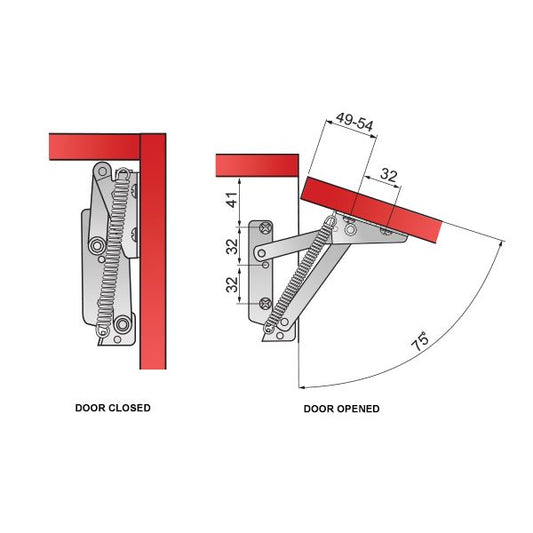


Lid stays are mechanical or pneumatic fittings that ensure controlled opening, holding, and closing of cabinet doors upward or downward, including high-performance soft close lid stay options.In modern cabinet construction, particularly for kitchen wall cabinets, bathroom vanity units, and RV interiors, they are indispensable hardware components. A lid stay works inside a cabinet like a gas strut on a vehicle's tailgate: it supports the door weight, dampens movement in a controlled manner, and securely holds the door in the open position so the user has both hands free to access the cabinet interior.
This guide is written for cabinetmakers, installers, and skilled DIYers. It covers technical specifications, accurate sizing, and proper installation of cabinet stays and lift mechanisms.
Operating Principle and Technical Classification
Selecting the rightsoft close lid stayor cabinet stay depends primarily on the direction of travel (opening upward or dropping downward), door weight, and the desired opening angle. Stays are fundamentally categorized into purely mechanical systems and gas spring-assisted systems.
Mechanical Lid Stays
Mechanical stays rely on a linkage mechanism whose resistance is usually adjusted via a tension screw. They use friction to hold the cabinet door in position. A traditionaldrop-down stayprevents a downward-opening door from slamming down uncontrolled (for example, on a bar cabinet or shoe storage unit). Adjusting friction allows the fitting to be calibrated precisely to the weight of the wood or MDF front panel.
For upward-opening doors, anupward lid stay with hold-open positionis commonly used. This engages at the maximum opening position (frequently at `75°`, `90°`, or `110°`) and is released with light push or pull pressure. Models such as theMechanical Lid Stay PM01, Chromeoffer a robust metal construction designed for minimal wear, even under high-frequency operation.
Lift Hinges and Stay Systems
While basic lid stays are often installed alongside standard concealed hinges (featuring a `1-3/8 in (35 mm)` cup drill hole) on the cabinet top panel, specializedwall cabinet lift systemscombine both hinge and stay functions. ALift Hinge Left+Right Setlifts the panel upward and swings it parallel or at a set angle above the cabinet body. This offers a major advantage in spaces with low ceilings or wide door fronts.
Sizing: Load Capacity and Leverage
Selecting the correct hardware for the door weight is critical when planning cabinetry. When looking for aheavy-duty lid stay, you must calculate the total weight of the front panel, including the handle.
Required holding force is specified inNewtons (N)for gas struts, and in maximum allowable weight inlbs (kg)at a specific panel height for mechanical stays. Typical load brackets include:
- Lightweight doors (up to approx. `6.6 lbs (3 kg)`): Standard mechanical stays or light springs (e.g., `50 N` - `60 N`).
- Medium-weight doors (`6.6–11 lbs (3–5 kg)`): Heavy-duty friction stays or gas struts rated for `80 N` - `100 N`.
- Heavy doors (`11 lbs (5 kg)` and up): Specializedheavy-duty cabinet flap staysor gas struts starting at `120 N`. Installing stays on both sides (left and right) is mandatory here to prevent door warping.
When installing models like theMechanical Lid Stay PM02, Nickel, always consult the mounting guidelines regarding maximum door height (often between `9-7/8 in to 19-11/16 in (250 mm - 500 mm)`), as increasing height lengthens the leverage arm and exponentially increases load on the fitting.
Specific Application Areas
Requirements for awall cabinet lid stayvary significantly depending on where the furniture is installed.
Kitchen and Living Room Furniture
In standard cabinetry, user convenience comes first. Akitchen cabinet lift staymust operate silently and bring the door to a soft halt. Soft close lid stays with integrated dampening are the preferred choice here. For handleless cabinetry, the stay is paired with a push-to-open system. Note: Mechanical stays must be set so the push-to-open pin can push the panel forward without being blocked by stay friction. A model like theMechanical Lid Stay PM03, Nickelallows precise adjustments for fine-tuning.
Lid Stays for RVs and Campers
Outfitting recreational vehicles subjects hardware to extreme demands. AnRV cabinet lid stayorcamper overhead cabinet staymust hold the door open while standing up to continuous road vibration during transit. Hardware with rigid detents or strong spring force (such as aspring-loaded lid stay) is essential here. Doors must not shake open while driving. Furthermore, overhead cabinet space in campers is tight, making compact mechanical systems or a low-profileLift Hinge Left+Right Setthe professional choice.
Shoe Cabinets and Storage Chests
For downward-opening doors (e.g., shoe storage tilt boxes), adrop-down flap stayis required to control fall speed. These friction drop-down stays protect lower hinges from tearing out due to sudden stopping forces from heavy panels.
Materials and Finishes
Cabinet hardware must resist corrosion and torsional stress. Most high-qualitycabinet stays and lid supportsare made from die-cast zinc or cold-rolled steel.
- Nickel (Nickel-Plated):Provides excellent corrosion resistance and a clean, subtle finish that blends seamlessly into white or wood-grain cabinet interiors. An ideal example is theMechanical Lid Stay PM04, Nickel.
- Chrome (Chrome-Plated):Delivers a high-gloss, extremely hard surface that resists scratching. Ideal for visible hardware in modern design-focused furniture, such as theMechanical Lid Stay PM01, Chrome.
Professional Installation and Adjustment
Installing acabinet stay mechanismrequires precision. Deviations of even a millimeter can cause cabinet doors to close crookedly or cause the fitting to bind.
1. Preparation and Mounting Hole Spacing
Determine the exact mounting points on the cabinet sidewall and door panel. Technical drawings from manufacturers state distances relative to the cabinet edge (e.g., `1-7/16 in (37 mm)` from the front edge for standard 32 mm hole systems). For mounting into cabinet walls (usually `5/8 in (16 mm)` or `3/4 in (18 mm)` particleboard), use `3/16 in (5 mm)` Euro screws or classic wood screws (PZ2 or TX20 drive) with a `0.14 in (3.5 mm)` or `0.16 in (4 mm)` diameter. Pre-drill wood screw holes with a `1/8 in (3 mm)` drill bit to prevent material splitting.
2. Symmetrical Installation
For door widths over `23-5/8 in (600 mm)` or weights exceeding `6.6 lbs (3 kg)`, stays should always be installed in pairs (left and right side). Mounting a singlelid support staycentered or on one side causes long-term panel twist, leading to uneven reveal gaps. For wide doors, use paired mechanisms like theLift Hinge Left+Right Set.
3. Setting the Opening Angle
Many mechanical stays, such as theMechanical Lid Stay PM02, Nickel, can be configured for different opening angles (e.g., `75°`, `90°`, or `110°`) by repositioning the door mounting plate. A `90°` angle is ergonomically ideal in most setups because the handle remains comfortably within reach for closing.
4. Adjusting Hold Force (Friction)
After mounting, adjust the mechanism to match the door weight. Mechanical stays feature an Allen key or Phillips adjustment screw located at the main joint.
- Clockwise rotation: Increases friction resistance (for heavier panels).
- Counter-clockwise rotation: Decreases friction resistance (for lighter panels).
Calibrate the screw so the door holds steady in any position without sagging or springing upward.
Troubleshooting Installation Issues
Even with careful planning, issues can arise when mountingwall cabinet lift mechanisms. Here are common installation problems and technical solutions:
- The cabinet door does not close flush:If the panel sticks out when closed, the cabinet-side bracket is often positioned too far back. Check the measurement from the front edge. Additionally, an overly stronggas strut lid staycan push the panel slightly open.
- The door drops unexpectedly:On mechanical systems like theMechanical Lid Stay PM04, Nickel, tighten the friction adjustment screw. If tightening does not solve the issue, the panel weight exceeds the capacity of the model, requiring an upgrade to aheavy-duty soft close lid stay.
- Hinges pulling out from cabinet floor:When installing downward-opening doors, if cup hinges tear out from the bottom panel, adrop-down friction stayis missing or set too loose. Kinetic energy from dropping panels must be absorbed by the stay, not the hinge.
- Squeaking or grinding noises:Mechanical joints should receive a light application of non-resinous lubricant (such as PTFE spray) if running dry. On gas spring systems, squeaking points to lateral binding—verify that left and right stays are mounted perfectly parallel.
Maintenance and Durability
Mostcabinet door staysare designed to be maintenance-free. However, on high-use cabinets (such as kitchen trash pull-outs or frequently accessedRV lid stay supports), check mounting screws for tightness after a few months. Engineerd wood like particleboard can relax under constant tension, requiring light re-tightening of `#6 or #8 (3.5 mm or 4 mm)` wood screws.
Gas springs naturally lose pressure over many years. If a door fails to hold in its top position after 5 to 10 years, the gas cylinder can usually be swapped out individually without removing the cabinet mounting plates. Mechanical stays such as theMechanical Lid Stay PM03, Nickeloffer exceptional longevity, as friction disc wear is easily compensated for by tightening the tension screw.
---
Frequently Asked Questions (FAQ)
How do I calculate cabinet door weight to choose the right lid stay?
To choose the correctheavy-duty soft close lid stay, calculate door volume (height x width x thickness in feet or meters) and multiply by material density. Particleboard weighs approx. `40.6 lbs/ft³ (650 kg/m³)` and MDF weighs approx. `46.8 lbs/ft³ (750 kg/m³)`. Add the weight of cabinet handles (typically `0.22–0.66 lbs (0.1–0.3 kg)`).
What is the difference between a lid stay and a lift hinge?
A standard lid stay (such as theMechanical Lid Stay PM01, Chrome) is installedin additionto top-mounted concealed hinges to keep the door open. Alift hinge mechanismcombines both functions: it connects the front panel to the cabinet frame while managing movement and holding the door open.
Why is my drop-down stay no longer holding the cabinet panel?
When adrop-down stayloses holding power on a downward-opening door, the joint friction screw has usually loosened over repeated cycles. Turn the screw clockwise using an Allen wrench or Phillips screwdriver until proper resistance is restored.
Are these stays suitable as lid stays for RV overhead cabinets?
Yes, mechanicalRV lid staysare exceptionally suited for mobile applications. Select models featuring positive detents or lockable joints so cabinet doors do not vibrate open while driving over rough roads.
Can I use an upward lid stay with a hold-open position on handleless doors?
Yes, with conditions. When installing push-to-open latches, the door panel must still be able to press inward roughly `1/16 to 1/8 in (2 mm - 3 mm)` to release the touch mechanism. Theupward stay with hold-open functionmust not hold tension when closed, allowing for this minor play.
Which screws should I use to mount stays inside wall cabinets?
For mounting base plates into cabinet side walls (typically `5/8 in (16 mm)` board), use Euro screws (`Ø 3/16 in (5 mm)`) if system 32 holes are pre-drilled. If no holes are pre-drilled, use flat-head wood screws sized `#6 x 5/8 in (3.5 x 15 mm)` or `#8 x 5/8 in (4 x 15 mm)`. Pre-drilling with a `1/8 in (3 mm)` bit is strongly recommended.
When is installing two lid stays strictly necessary?
Whenever a cabinet door width exceeds `23-5/8 in (600 mm)` or total weight exceeds `6.6 lbs (3 kg)`, you must install asoft close lid stayon both left and right sides. One-sided loading causes long-term door warping and damages opposite hinges.