
Half Overlay Cabinet Hinges
Popular Subcategories
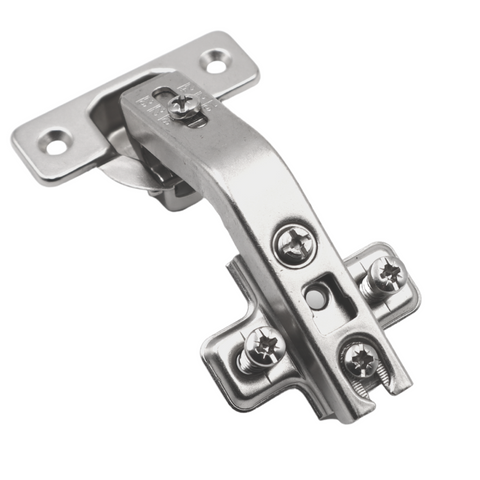
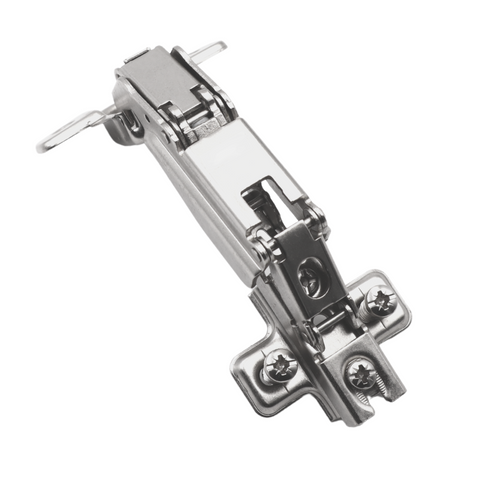
-
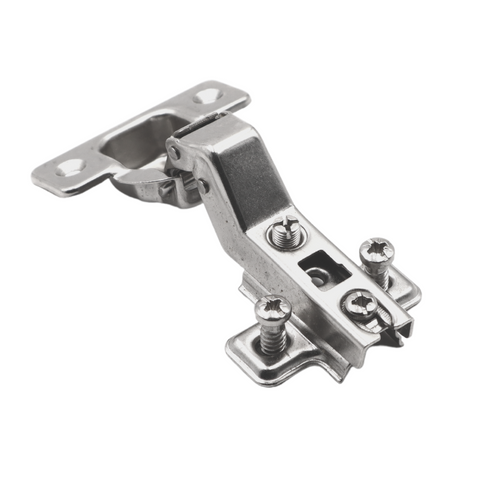
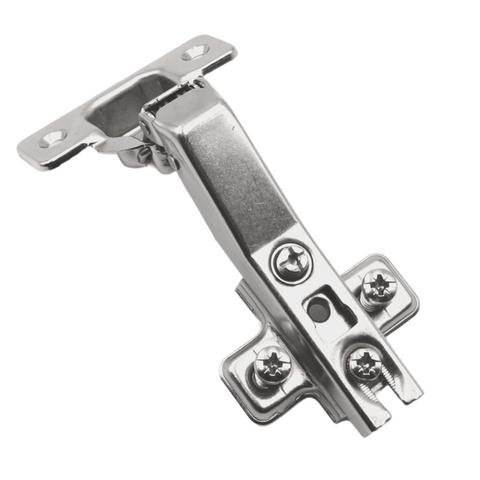
Hinge, H0 Mounting Plate with EURO Screws, Twin DoorsRegular price $0.68Unit price / perRegular priceSale price $0.68
-
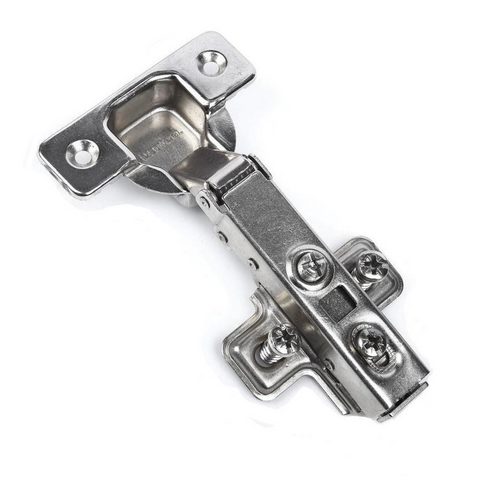
Soft-Close Hinge, H0 Mounting Plate with EURO Screws, Twin DoorsRegular price $1.33Unit price / perRegular priceSale price $1.33

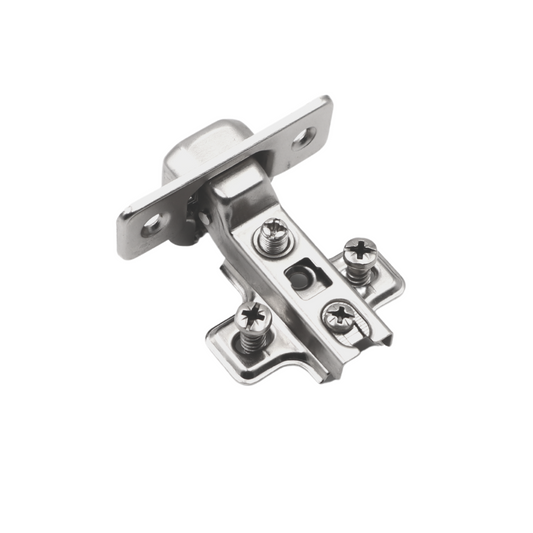

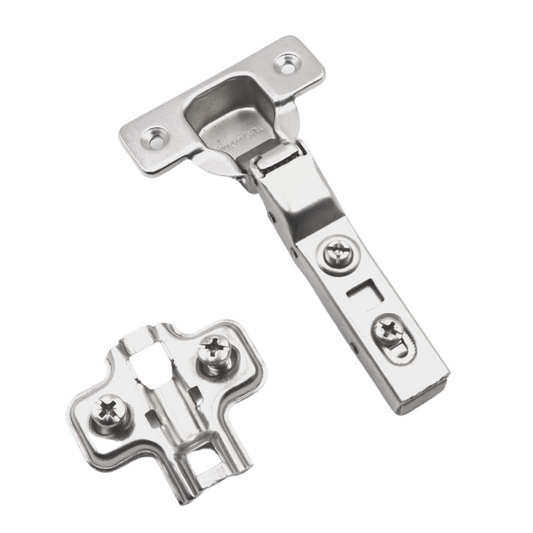
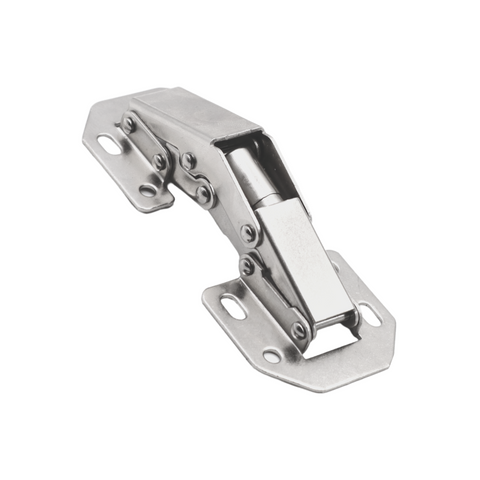
Half overlay cabinet hingesare cranked European-style cup hinges specially designed for mounting two adjacent cabinet doors onto a shared center partition wall (dual-door mounting).
In professional cabinetmaking and custom architectural woodwork, the center partition of a multi-section cabinet carcass presents a unique geometric challenge. When two doors are mounted on the same vertical partition, only half of the panel thickness is available as a mounting edge for each door. Standard full overlay hinges would cause the doors to overlap when closed or collide when opened. Ahalf overlay cabinet hingesolves this issue with a distinctly cranked hinge arm. This offset reduces the door overlay on the cabinet side to the exact required dimension, leaving a clean, uniform reveal of typically 1/16 in to 3/16 in (2 mm to 4 mm) between both closed doors.
This guide is written for cabinetmakers, installers, and experienced woodworkers who require detailed technical specifications regarding dimensions, overlay types, installation, and 3D adjustment of half overlay hinges.
Understanding Overlay Types: Full Overlay, Half Overlay Cabinet Hinges, and Inset
To correctly plan cabinet hinge kinematics, the exact position of the closed door relative to the cabinet wall must be defined. Searching for the difference between full overlay, half overlay, and inset hinges is one of the most fundamental planning steps in cabinetry. Choosing the wrong hinge type invariably results in colliding doors or cabinet fronts that will not close.
- Full Overlay:The door covers almost the entire outer edge of the cabinet side. The hinge arm is straight (uncranked). These hinges are used on the outer side walls of a cabinet. For more details, visit our categoryFull Overlay Cabinet Hinges.
- Half Overlay (Twin / Dual Mount):The door overlays only half of the cabinet partition wall. The hinge arm features a distinct crank offset, usually 3/8 in (9.5 mm). This allows two doors to be mounted back-to-back on a single partition wall, typically 5/8 in to 3/4 in (16 mm to 19 mm) thick.
- Inset:The door does not overlay the cabinet side, but sits completely flush inside the cabinet frame opening. The hinge arm has a heavy crank offset (usually 5/8 in to 23/32 in (16 mm to 18 mm)). Suitable solutions can be found underInset Cabinet Hingesand Inset Hinges for Flush Doors.
The center wall of a cabinet functions like a single lane shared by two vehicles: thanks to its cranked design, ahalf overlay cabinet hingeensures that both doors cover precisely half the edge without colliding during operation.
Technical Specifications and Cup Hinge Dimensions
When selecting hardware for center partition mounting, exact millimeter precision is required to achieve a clean reveal. The geometry of the hinge must match the thickness of your particle board or MDF panels.
The Hinge Cup Diameter
The standard for modern cabinet hardware is a1-3/8 in (35 mm)cup drilling diameter. This size offers ample space for the complex mechanical lever system and integrated soft-close dampening cylinders. Standard hardware in this size is available under35 mm Cabinet Hinges. Only delicate furniture or narrow frame doors occasionally require 1 in (26 mm) mini hinges.
Opening Angle and Kinematics
The opening angle defines accessibility to the cabinet interior.
- 110° Standard:An opening angle of 110° is the construction standard for most wardrobes, kitchen cabinets, and office furniture. A classic example is the self-closing110° Concealed Hinge, H0 Mounting Plate with EURO Screws, Half Overlay. For a full overview of this angle class, see110 Degree Cabinet Hinges.
- Wide-Angle (155° / 165°):If the cabinet houses internal pull-out drawers, the door must swing completely clear of the interior opening (zero-protrusion hinge). For this setup, wide-angle hinges are used, such as those found under155 Degree Cabinet Hingesand165 Degree Cabinet Hinges.
- Specialty Angles:Corner cabinets and angled carcasses require specialized solutions. The hardware system covers options like30 Degree Cabinet Hinges,45 Degree Cabinet Hinges,90 Degree Cabinet Hinges, and135 Degree Cabinet Hinges. However, these are specialized corner solutions and do not replace standard half overlay hinges.
Soft-Close Mechanism
Integrated dampening within the hinge arm is now an industry standard in modern cabinetry. A hydraulic damper absorbs the kinetic energy of the closing door and gently pulls it shut silently over the last few degrees. A ideal choice is the110° Soft-Close Concealed Hinge, H0 Mounting Plate with EURO Screws, Half Overlay.
If you are upgrading existing furniture, you can explore the complete range underSoft-Close Cabinet Hinges. Note: For very lightweight or narrow doors, installing soft-close on just one of two hinges is often sufficient to prevent overly slow closing.
Drilling Half Overlay Cabinet Hinges: Dimensions, Tools, and Installation
Preparing the cabinet door and carcass side requires precision. Woodworkers looking for cup hinge drilling dimensions need reliable setup data for drill presses or router jigs.
Drilling the Door Cup (Front)
A standard hinge with a 1-3/8 in (35 mm) cup requires a carbide-tipped Forstner bit.
- Drilling Depth:The hinge cup requires a bore depth of 15/32 in (11.5 mm to 12.0 mm). On standard 5/8 in or 3/4 in (16 mm or 19 mm) door stock, set the drill depth stop precisely to avoid drilling through or blistering the outer surface.
- Cup Distance (C-Dimension):This is the distance from the outer edge of the door to the edge of the bored cup hole. Depending on the desired reveal and mounting plate, this typically ranges between 1/8 in and 1/4 in (3 mm to 6 mm). A C-dimension of 5/32 in to 3/16 in (4 mm to 5 mm) is standard for a 3/4 in (19 mm) partition wall.
- Drilling Jig:To accurately mark the cup distance and screw hole pattern, a dedicatedhinge drilling jigis an indispensable tool for installers to eliminate alignment errors.
Mounting Plate Installation in the Carcass (System 32)
The hinge connects via its arm to across mounting platescrewed into the partition wall, following the standard 32 mm cabinet manufacturing system.
- Hole Spacing:Vertical distance between mounting holes in the carcass side is exactly 1-1/4 in (32 mm).
- Front Edge Distance:The front hole in the line of holes is positioned 1-7/16 in (37 mm) from the front edge of the cabinet.
- Mounting Plate Offset (D-Dimension):Mounting plates come in various heights, typically H0, H2, or H4. For half overlay setups on a 5/8 in to 3/4 in (16 mm to 19 mm) partition wall, anH0 mounting plate(0 mm distance) is standard.
- Fastening:Plates are secured either with 3/16 in (5 mm) Euro screws into pre-drilled holes or with 1/8 in (3.5 mm) wood screws directly into the material.
On center partition walls, the mounting plates for the left and right doors sit directly opposite each other. On a 5/8 in (16 mm) partition, ensure opposing screws do not hit each other by using offset height patterns or shorter specialized screws.
3D Adjustment for Perfect Door Alignment
After clipping the door onto the mounting plate, fine-tune the door reveals. A properly adjusted dual-door reveal displays a parallel gap of roughly 1/16 in to 1/8 in (2 mm to 3 mm) between both doors.
- Side Adjustment (Overlay Adjustment):The front screw on the hinge arm moves the door side-to-side. On half overlay hinges, this adjusts the center reveal gap width, typically offering +/- 1/16 in (+/- 2 mm) of travel.
- Depth Adjustment:The rear screw on the hinge arm (often an eccentric screw) adjusts the door’s distance relative to the front edge of the carcass (+1/8 in / -1/16 in (+3 mm / -2 mm)). This ensures the closed door sits flush without bouncing back.
- Height Adjustment:Vertical alignment is set at the mounting plate. Slightly loosening the mounting screws (or turning an eccentric cam on the plate) allows +/- 1/16 in (+/- 2 mm) vertical adjustment to align adjacent door tops seamlessly.
All products in our primaryConcealed Cabinet Hingescategory feature this essential 3-way adjustment system.
Material and Load Capacity
Half overlay cabinet hinges are made of high-grade nickel-plated steel, protecting against corrosion while ensuring smooth pivot action. Load capability depends on door size and weight.
- Doors up to 35 in (900 mm) in height and approx. 9 lbs to 13 lbs (4 kg to 6 kg) require 2 hinges.
- Doors up to 63 in (1600 mm) in height (approx. 26 lbs to 37 lbs (12 kg to 17 kg)) require 3 hinges.
- Doors up to 79 in (2000 mm) in height (approx. 37 lbs to 48 lbs (17 kg to 22 kg)) require 4 to 5 hinges.
Always consider door leverage: wider doors place greater strain on hinges than narrow doors of equal weight.
---
FAQ – Frequently Asked Questions About Half Overlay Cabinet Hinges
What is the difference between full overlay and half overlay cabinet hinges?A full overlay hinge (straight arm) is used when a door fully covers the outer cabinet side wall. A half overlay hinge (cranked arm) is used when two doors meet on a single center partition wall, so each door covers only half of the panel edge.
What size drill bit do I need for half overlay cabinet hinges?You need a 1-3/8 in (35 mm) Forstner bit for the door cup. For mounting plate pilot holes, use a 3/16 in (5 mm) drill bit for Euro screws or a 1/8 in (3 mm) bit for standard wood screws.
How do I calculate the reveal gap on a center partition?The gap between two back-to-back doors equals the partition wall thickness minus double the door overlay. Example: On a 3/4 in (19 mm) partition wall with a 5/16 in (8 mm) overlay per door (2 x 8 mm = 16 mm), the remaining center reveal gap is 1/8 in (3 mm) (19 mm - 16 mm). You can fine-tune overlay using the side adjustment screw.
Can I replace a standard concealed hinge with a soft-close hinge?Yes, provided the cup diameter (1-3/8 in (35 mm)) and screw hole pattern match. You will usually need to replace the mounting plate as well, as clip-on mechanism shapes vary by manufacturer.
What does H0 mean on a mounting plate?H0 (Height 0) indicates a flat mounting plate with no added height offset. For standard half overlay installations on 5/8 in or 3/4 in (16 mm or 19 mm) panels, an H0 plate paired with a cranked half overlay hinge is the correct and most common configuration.
Are there half overlay cabinet hinges available for handleless cabinet fronts?Yes, handleless doors use un-sprung hinges paired with a push-to-open latch mechanism. Do not combine soft-close hinges with push-to-open systems, as the soft-close damper works directly against the spring release mechanism.
How deep should I drill the 1-3/8 in (35 mm) hole in the cabinet door?Standard depth for the hinge cup is 15/32 in (11.5 mm to 12.0 mm). Always use a drill press or depth stop collar, as only a few millimeters of material remain on a standard 5/8 in (16 mm) door.