
Shelf brackets
Popular Subcategories

-
Floating Shelf Support (Concealed)Regular price $1.92Unit price / perRegular priceSale price $1.92
-
Angle Bracket ChromeRegular price $6.47Unit price / perRegular priceSale price $6.47

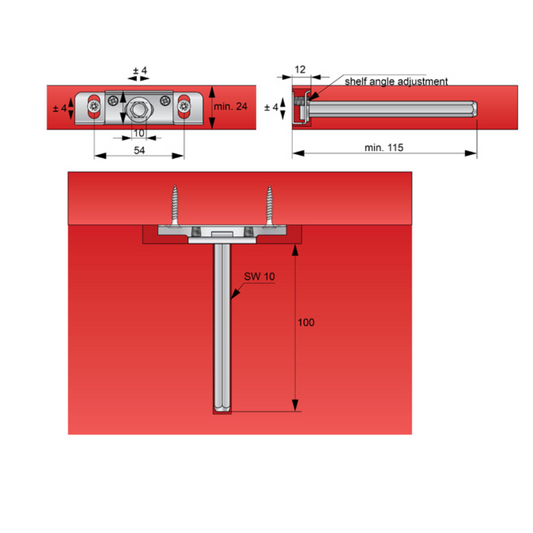

Shelf bracketsare load-bearing hardware components used to horizontally secure shelves, trays, and shelving systems to vertical surfaces or inside cabinet carcases. They transfer the vertical loads of the shelf contents as shear and tensile forces into the wall or cabinet body. Selecting the right bracket system depends on the required load capacity, the properties of the mounting surface (wall or cabinet carcase), and the depth of the shelf board.
In professional furniture assembly and interior fitting, a distinction is made between visible brackets, concealed systems, and simple push-in shelf pins. Technical specifications include parameters such as material thickness, hole pattern, leg length, and maximum load capacity in pounds (kilograms).
Shelf Bracket Types and System Designs
Constructing a shelf requires specific hardware precisely tailored to structural load requirements. Choosing between aConcealed Floating Shelf Bracketand a classicChrome Corner Bracketsignificantly impacts both the installation method and the allowable surface load.
Corner Brackets and Heavy-Duty Shelf Brackets
Thecorner bracketis the classic, L-shaped solution for wall mounting. It consists of two legs positioned at a precise 90° angle to each other. The vertical leg screws into the wall, while the horizontal leg supports the shelf board.
Standard residential applications often use simple steel angle brackets. However, when heavy loads like tools, binders, or equipment need to be stored, aheavy-duty shelf bracketis essential. Aheavy-duty L bracketdiffers from standard models by having a significantly greater material thickness (often 1/8 in to 3/16 in (3 mm to 5 mm) steel) and an added cross-brace. This diagonal strut (gusset plate or web) connects the horizontal and vertical legs, preventing the bracket from bending open under heavy loads.
Depending on the wall material and fasteners used, theseheavy-duty shelf supportsachieve load capacities ranging from 110 lbs to over 330 lbs (50 kg to over 150 kg) per pair. When installing aChrome Corner Bracket, ensure that the bracket's leg length covers at least two-thirds, ideally three-quarters, of the shelf board's depth. A 11-3/4 in (300 mm) deep shelf board requires a bracket with a horizontal extension of at least 7-7/8 in (200 mm).
Concealed Shelf Brackets (Floating Shelf Hardware)
For a seamless look without visible hardware,invisible shelf brackets(also known as floating shelf supports) are used. This design requires a shelf board with sufficient thickness, as the bracket is embedded inside the wood.
AConcealed Floating Shelf Brackettypically consists of a wall mounting plate (often solid hexagonal or round steel) and a supporting rod. For installation, the back of the shelf board must be drilled horizontally at a precise 90° angle. Depending on the model, the drill hole diameter for the pin is typically 3/8 in, 1/2 in, or 9/16 in (10 mm, 12 mm, or 14 mm). The minimum shelf thickness must equal the pin diameter plus sufficient remaining material (at least 3/16 in to 1/4 in (4 mm to 5 mm) per side). Therefore, a 1/2 in (12 mm) pin requires a shelf thickness of at least 7/8 in (22 mm), ideally 1 in (25 mm).
A key technical feature of high-quality floating shelf supports is eccentric adjustment. Since even solid steel rods deflect slightly downward under load, professionalheavy-duty floating shelf supportsfeature an asymmetrical sleeve or adjustment screw. Rotating this sleeve corrects the rod angle upward by a few degrees, ensuring the loaded shelf board rests perfectly level at 0°.
Shelf Pins for Cabinet Carcases
Inside enclosed furniture (wardrobes, kitchen upper cabinets), dedicatedshelf pinsare used. These small fittings made of steel, die-cast zinc (Zinc alloy), or plastic insert into pre-drilled hole rows in the cabinet side walls.
TheSystem 32standard is widely used across the furniture industry. Holes feature a diameter of exactly 1/8 in or 3/16 in (3 mm or 5 mm) and are arranged in a vertical 1-1/4 in (32 mm) grid pattern. The distance from the front edge of the cabinet to the first row of holes is a standardized 1-7/16 in (37 mm).
Cylindrical pins are sufficient for basic shelves. However, when supporting heavy loads, installers rely onheavy-duty shelf pegs. These often feature a flat supporting ledge that distributes weight across a surface rather than at a single point. Special brackets with rubber rings or plastic suction cups are used for glass shelves to prevent slippage and protect against scratching. For freestanding shelving or room dividers, shelf pegs with additional locking pins are used to engage the underside of the shelf and prevent it from pulling out.
Materials and Surface Finishes
The physical properties of ametal shelf bracketdetermine its area of application. The choice of material impacts not only load capacity, but also corrosion resistance and deflection resistance.
- Steel:The standard material forheavy-duty metal shelf brackets. Unalloyed steel provides exceptional tensile strength. To protect against rust, it is galvanized, powder-coated, or chrome-plated. AChrome Corner Bracketfeatures an extremely hard, smooth, easy-to-clean surface thanks to its chrome layer, making it ideal for bathroom furniture or hygienic settings.
- Zinc-Aluminum (Zinc alloy):This alloy (also known as Zamak) is processed using die casting. It is excellent for complex shapes, such as adjustable shelf pins or special clamping brackets. Zinc alloy maintains structural integrity and does not corrode under normal indoor conditions.
- Aluminum:Commonly used for continuous wall tracks or slender bracket systems. It is lightweight and rustproof, but does not achieve the localized load capacity of solid steel. As a result, aluminum is generally suitable forheavy-duty shelf supportsonly in extruded, thick-walled profiles.
- Plastic:Limited to lightweight cabinet shelves or as a dampening element combined with steel brackets. Plastic is structurally unsuitable for cantilevered wall shelves.
Structural Dynamics and Load Distribution: The Physics of Shelf Mounting
Ashelf bracketfunctions physically like a crane jib: the leverage force pulls entirely on the top mounting point, making the choice of wall anchor critical to overall structural stability.
When a shelf board is loaded, two distinct forces act on the wall attachment:
- Shear force (lateral force):The dead weight pulls the bracket downward parallel to the wall. This force is distributed evenly across all screws.
- Tensile force (leverage):The shelf depth creates a turning moment (torque). The board pushes the lower section of theChrome Corner Bracketagainst the wall while attempting to pull the top section out from the wall.
The deeper the shelf and the farther forward the weight is placed, the exponentially higher the tensile load on the top screw. For this reason,heavy-duty metal shelf bracketsoften feature multiple screw holes in the upper third of the vertical leg to distribute tensile load across several anchor points.
Span and Deflection of Engineered Wood Materials
Bracket load capacity is only one side of the equation; shelf material is the other. The distance between two brackets (span) must be matched to the material to prevent wood sagging (creep deflection).
- Particle board (3/4 in (18 mm - 19 mm)):Prone to severe sagging under continuous load. Spacing between brackets should not exceed 20 in to 24 in (500 mm to 600 mm).
- MDF (Medium-Density Fiberboard):Slightly stiffer than particle board, but vulnerable to moisture. Maximum bracket spacing: 24 in (600 mm).
- Blockboard / Lumber core:Highly rigid. Bracket spacing of 28 in to 31-1/2 in (700 mm to 800 mm) handles standard loads easily.
- Solid wood (e.g., 1 in (26 mm) oak):Exceptionally stable. Bracket spans of 31-1/2 in to 39 in (800 mm to 1000 mm) are achievable when usingbrackets for shelveswith appropriate load ratings (e.g.,heavy-duty L brackets).
When installing a long shelf board, it is structurally better to install threeConcealed Floating Shelf Bracketsspaced 16 in (400 mm) apart rather than two brackets spaced 31-1/2 in (800 mm) apart to prevent mid-span sagging.
Installation Guide for Woodworkers and Installers
Proper installation of shelf support systems requires precision and knowledge of the wall substrate. Manufacturer load ratings (e.g., "load capacity of 110 lbs (50 kg) per pair") always assume proper installation into solid concrete or solid brick. Non-solid wall materials drastically reduce pull-out strength.
Mounting to Different Wall Types
- Concrete and solid masonry:Standard expansion nylon wall anchors can be used. For mounting aChrome Corner Bracketunder medium loads, 5/16 in (8 mm) wall anchors with matching #10 or #12 (5 mm or 6 mm) wood/chipboard screws are sufficient. For trueheavy-duty shelf pegs, frame anchors or metal expansion bolts (wedge anchors) should be used.
- Hollow brick / cinder block:Standard expansion plugs slip or shatter internal brick webs. Long-shank anchors or cavity toggles are required. Under extreme loads, chemical injection systems (bonded anchor resin with mesh sleeves) provide the most secure long-term hold for aheavy-duty shelf bracket.
- Drywall (gypsum board):The greatest challenge in mounting hardware. Drywall panels (typically 1/2 in (12.5 mm) thick) have very low pull-out resistance. Aheavy-duty L bracketmust never be anchored into drywall alone. Screws must drive directly into underlying studs (wood or metal framing). If stud alignment is impossible, heavy-duty hollow-wall toggle bolts must be used, though load capacity drops to a fraction (often only 33 lbs to 55 lbs (15 kg to 25 kg) per anchor).Concealed Floating Shelf Bracketsare structurally unsuitable for plain drywall without backing framing, as leverage will immediately break the board.
Drilling and Alignment
Precision is critical, especially when installinginvisible shelf brackets. Holes drilled into masonry must be perfectly level and perpendicular to the wall. A drilling deviation of just 2° will cause the tip of theConcealed Floating Shelf Bracketto misalign by several millimeters up or down.
A drill press or portable drilling guide is essential when drilling into the edge of shelf boards. Freehand drilling with a 1/2 in (12 mm) auger bit into the edge of a 1 in (25 mm) board almost always leads to bit wander and blowout through the shelf surface.
Frequently Asked Questions (FAQ) About Shelf Brackets
What screws should I use for heavy-duty metal shelf brackets?
For wall mounting heavy-duty brackets, use screws with a diameter of at least #10 or #12 (5 mm or 6 mm). The screw head must match the bracket's countersink. If the head sits proud, the shelf board will not lie flush. ForChrome Corner Brackets, flathead countersunk screws with a Torx (TX) drive are ideal, as they ensure optimal torque transfer when driving into solid wall anchors.
How deep do I need to drill for concealed shelf brackets?
The hole depth in the shelf board must match the exact length of the support pin plus an extra 1/16 in to 1/8 in (2 mm to 3 mm). If the pin of theConcealed Floating Shelf Bracketis 4-3/4 in (120 mm) long, the drill hole must be 4-13/16 in to 4-7/8 in (122 mm to 123 mm) deep. If the hole is too shallow, the shelf will not sit flush against the wall.
What does "heavy-duty shelf brackets" refer to in industrial settings?
This term refers to plug-in or clip-in brackets used in industrial or heavy-use racking systems (e.g., workshop shelving). Unlike 3/16 in (5 mm) shelf pins for residential furniture, these are often crossbeams or heavy galvanized steel hook brackets that snap into slotted upright posts and support loads often exceeding 440 lbs (200 kg) per shelf.
Can I use Chrome Corner Brackets in high-moisture areas?
Yes, electroplated chrome finishes on hardware like theChrome Corner Bracketseal the underlying steel and protect it against oxidation. They are well-suited for bathrooms or kitchens. However, for applications exposed to direct water spray or outdoor environments (such as open patios), 304 or 316 (V2A or V4A) stainless steel should be used.
Why is my floating shelf sagging forward?
Sagging usually stems from two causes: either the wall substrate is too soft (e.g., drywall or weak historical plaster), allowing the wall anchor to yield under leverage, or theConcealed Floating Shelf Bracketwas not adjusted using its eccentric sleeve. Check the wall mounting. If secure, remove the shelf board and rotate the pin upward by 1° to 2° via the adjustment screw to compensate for the weight.
How do I calculate the required length for shelf brackets?
The rule of thumb in installation is that the load-bearing (horizontal) leg of the bracket must support at least 70% of the shelf depth. For a 15-3/4 in (400 mm) deep shelf, the bracket should extend at least 11 in (280 mm). For very rigid solid hardwoods, you can go slightly below this threshold; for soft particle board, it must be strictly observed to prevent the front edge of the board from snapping off.