
Push Latch
Popular Subcategories

-
Push to Open latch - Springless Hinges - with magnetic tip Zinc/GreyRegular price $1.88Unit price / perRegular priceSale price $1.88
-
Push to Open latch - Spring Hinges - with rubber tipRegular price $1.00Unit price / perRegular priceSale price $1.00
-
Cabinet Door Bumper - Ash Wood Finish with Silicone Tip (Short)Regular price $1.89Unit price / perRegular priceSale price $1.89
-
Push to Open Catch - with Rubber TipRegular price $1.14Unit price / perRegular priceSale price $1.14
-
Push to Open latch - Spring Hinges - with rubber tip Zinc/GreyRegular price $1.61Unit price / perRegular priceSale price $1.61
-
Push to Open latch - Springless Hinges - with magnetic tipRegular price $1.18Unit price / perRegular priceSale price $1.18

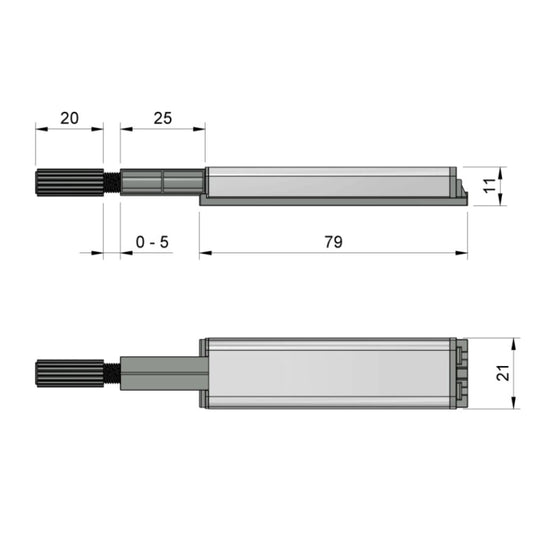

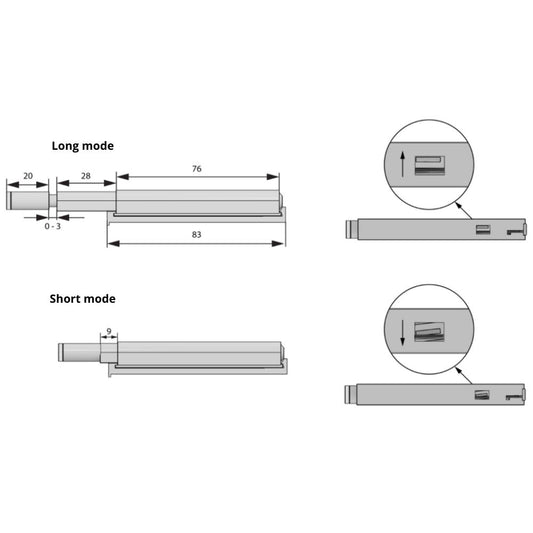

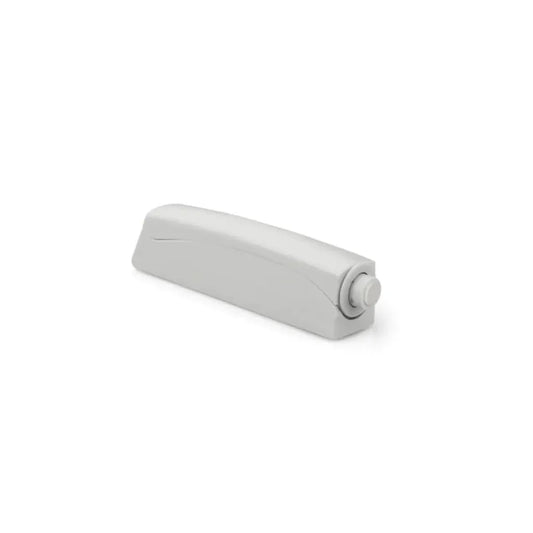

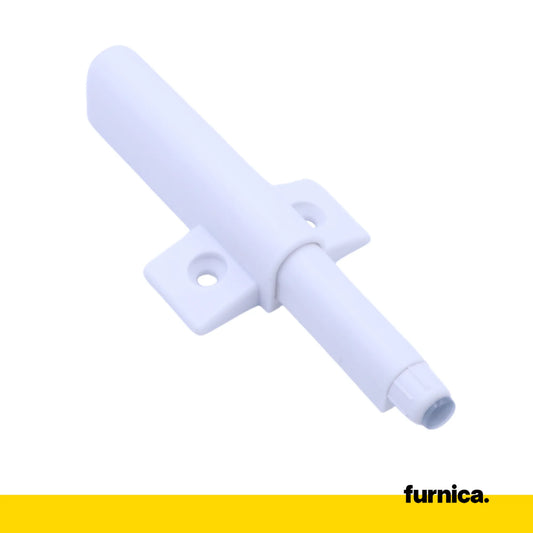

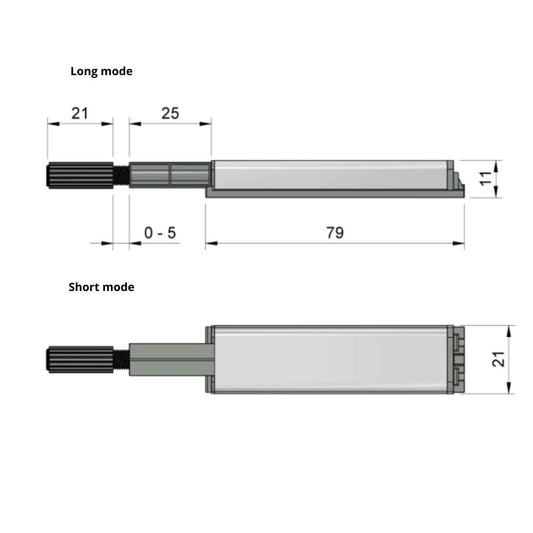

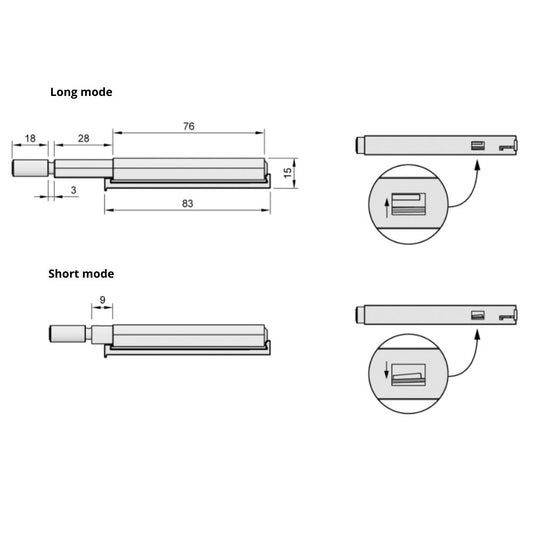
A push latch (often called a push-to-open latch or touch latch) is a mechanical hardware device that unlocks handleless cabinet fronts with a light press, pushing the door open a crack.
Eliminating traditional cabinet handles requires a reliable ejection mechanism that compensates for the lack of pull space on a door or drawer. In modern furniture design, push latches handle this task effortlessly. They consist of a housing, a pre-tensioned spring, and a plunger pin. The mechanism works similarly to the clicker mechanism in a ballpoint pen: initial pressure on the front pushes the plunger inward, releasing the catch so the spring force pops the door open typically by13/16 in to 1-9/16 in (20 mm to 40 mm). Pressing the door closed again re-tensions the spring and locks the system in place.
For cabinetmakers, installers, and ambitious DIYers, precise matching between thepush latch, the door size, and the hinge type used is crucial for a clean reveal gap and flawless operation.
Types of Push Latches and Compatibility
Not everypush latchworks with every hinge. The choice of tip on the plunger determines holding force and how it interacts with concealed cup hinges. Generally, a distinction is made between systems for hinges with self-closing springs and springless hinges.
Push Latches with Rubber Tip (for Spring-Loaded Hinges)
Standard concealed hinges feature an integrated self-closing mechanism (spring) that pulls the door against the cabinet frame during the final fraction of an inch. When using this type of hinge, the push latch only needs to overcome the hinge's spring tension to push the door open. Models with a rubber tip or silicone bumper are used for this setup.
The rubber tip prevents slipping against the inside of the door and dampens contact noise. A classic example for this application is thePush-to-Open Latch - Spring Hinges - with Rubber Tip. For projects requiring a longer ejection distance, theTouch Latch for Handleless Doors with Spring Hinges - Longor the more compact variant, theTouch Latch for Handleless Doors with Spring Hinges - Short, are ideal choices.
Push Latches with Magnetic Tip (for Unsprung Hinges)
When planning handleless cabinet fronts with unsprung hinges (hinges without a self-closing spring), there is no built-in mechanism to keep the door closed against the cabinet. In this case, the push latch must perform that function.
For these configurations, apush latchwith a magnetic tip is used. A small steel catch plate installed on the inside of the door acts as the counterpiece via screws or adhesive. The magnet holds the door flush against the cabinet and releases it only when pressure is applied to the front. A proven solution for this setup is thePush-to-Open Latch - Unsprung Hinges - with Magnetic Tip Zinc/Gray.
For custom cabinetry requiring specific color matching for interior fittings, magnetic push latches are available in various finishes, such as theHeavy-Duty Push-to-Open Latch with Magnetic Tip - White, the variant inGray, or theHeavy-Duty Push-to-Open Latch with Magnetic Tip - Anthracite.
To accommodate different door thicknesses and throw lengths, specific sizes are available, including theTouch Latch for Handleless Doors with Unsprung Hinges - Longand its counterpart, theTouch Latch for Handleless Doors with Unsprung Hinges - Short.
Installation and Adjustment of Push Latches
Installing acabinet push latchrequires precision. An incorrectly positioned latch can result in uneven reveal gaps or binding mechanisms.
Mounting Styles: Surface-Mount Adapter Plates vs. Mortised/Drilled Installation
There are two primary installation methods for push latches:
- Surface-Mount Installation (Adapter Plate):The push latch clips into a linear or cross-shaped plastic housing that is secured withwood screws(typically#4 x 5/8 in (3 x 15 mm)or#6 x 5/8 in (3.5 x 16 mm)with Pozi or Torx drive) to the cabinet interior. This method is ideal for retrofitting.
- Mortised/Drilled Installation:The cylindrical body of the latch is pressed directly into a drilled hole on the cabinet edge (bottom panel, top panel, or side wall). A blind hole (typically3/8 in (10 mm)diameter, depending on the model) is drilled for this purpose. This option provides a sleek, hidden look but requires adequate material thickness (at least5/8 in to 3/4 in (16 mm to 19 mm)particle board/MDF).
The Trigger Gap (Front Gap)
To activate the push-release mechanism, the cabinet front requires a slight inward travel clearance. Maintaining this trigger gap, also known as the front gap, is essential. Typically, this distance is1/16 in to 1/8 in (2 mm to 3 mm).
If the door is mounted completely flush and tight against the cabinet box, the plunger cannot be pressed deep enough to disengage the spring catch. Most high-quality push latches feature an integrated depth adjustment. By rotating the plunger tip, you can adjust the throw distance and reveal gap post-installation by approximately+1/8 in / -1/32 in (+3 mm / -1 mm). This allows you to align reveal gaps precisely with neighboring cabinet fronts.
Positioning on the Cabinet Box
The placement of thepush latchaffects leverage. On standard swinging doors, the latch should be installed on the handle side (opposite the hinges). The ideal height corresponds to where the door is normally pressed—in the upper third for base cabinets and the lower third for wall cabinets. For very wide or heavy doors, mounting the latch centrally is recommended.
Specific Applications
Thepush-to-openprinciple works on almost all types of furniture, though specific factors must be considered depending on the application.
Kitchen Cabinet Push Latches
Handleless fronts are especially popular in kitchens due to their clean lines and easy cleaning. A kitchen cabinetpush latchoften needs to overcome greater resistance, as kitchen doors are frequently made of dense MDF or feature heavy laminate coatings. Using long-throw models with high spring force is recommended here.
Many customers also use standard push latches as replacement parts or for retrofitting existing kitchen systems. Search queries such asikea utrusta push latch drawerorikea metod push latch for drawersshow a high demand for compatible hardware. Since most cabinet boxes are built using the standardizedSystem 32(hole spacing of1-1/4 in (32 mm)), universal surface-mount push latches can easily be retrofitted into popular modular kitchens.
Drawer Push Latches
Using apush latch for drawersdiffers slightly from standard swing doors. While a single push pin is sufficient for doors, drawers require synchronized release on both sides to prevent the drawer slides from binding.
For lightweight drawers or small pull-outs, single-point touch latches can be used. However, for wide full-extension drawers, it is best practice to use drawer slides with push-to-open mechanisms built directly into the slide runner. Still, auxiliary push latches are frequently added to make older roller runner drawers operate handle-free.
Wardrobes and Large Cabinet Fronts
On large cabinets—such as those involved in searches forikea pax push latch—installers face heavy leverage forces. A door over78-3/4 in (2000 mm)tall is prone to warping if held or pressed at only one point. In these setups, combining unsprung hinges with strong magnetic push latches is essential. Installing twocabinet push latchesper door (one in the upper third and one in the lower third) may be necessary to ensure a smooth, flush fit across the entire surface.
Aesthetics and Surface Protection
Beyond pure mechanical function, protecting cabinet surfaces is key. Plunger pins made of hard plastic can leave fine scratches over time on delicate painted or melamine surfaces. That is why designs like theFurniture Bumper - Ash with Silicone Tip (Short)are so practical. The silicone tip acts as a non-slip contact point and serves as a subtle cushion when the door closes.
When it comes to interior cabinet aesthetics, housing color matters. In white cabinets, a white latch shell blends in seamlessly, whereas dark wood grains or charcoal interiors look best with matching dark hardware housings.
Frequently Asked Questions (FAQ) About Push Latches
Can I combine a push latch with soft-close hinges?No, this is physically incompatible and the single most common installation mistake. A soft-close hinge (with an integrated damper) slows the door down as it closes and pulls it shut softly. However, a push latch requires momentum and firm resistance to load the internal spring for the next opening cycle. Soft-close and push-to-open features block each other. Only use standard spring hinges or unsprung hinges with push latches.
Which push latch do I need for IKEA cabinets (e.g., Pax, Metod)?Most cabinet systems from major manufacturers utilize standard system hole spacing (3/16 in (5 mm)holes spaced1-1/4 in (32 mm)apart). Universal surface-mount push latches with adapter plates can be screwed directly into these holes. If you are keeping existing spring-loaded hinges, select a latch with a rubber tip. If you plan to make the door completely handleless without spring resistance, switch to unsprung hinges and use a magnetic tip push latch.
How wide does the gap between the door and cabinet box need to be?For the trigger mechanism to work, the door must be able to push inward by at least1/16 in to 1/8 in (2 mm to 3 mm). This front gap is strictly required; doors mounted completely flush against the box cannot disengage the latch.
Why does my cabinet door keep popping back open after installation?This usually happens for one of two reasons: either the trigger gap is set too tight, causing the catch to pass its pressure point and re-trigger immediately upon closing (in this case, thread the plunger tip inward slightly to increase clearance), or you are using unsprung hinges with a push latch that lacks a magnetic tip, leaving no hold force to keep the door shut.
How many push latches do I need per door?For standard cabinet doors up to approximately39-3/8 in (1000 mm)tall, a single push latch mounted on the handle side is sufficient. For very tall doors (e.g., wardrobe doors over59 in (1500 mm)tall), panel flexing can occur. We recommend installing two magnetic push latches to keep the top and bottom of the door flush against the cabinet frame.
Are there specialized push latches for sliding doors?Standard plunger-style push latches are designed for swinging doors. Sliding doors require specialized push-to-open hardware integrated into the track mechanism. A traditional pin-style latch would snap or jam against the lateral motion of a sliding door.
Frequently Asked Questions
Can I use these push latches as replacements for IKEA Utrusta or Blum?
Yes, our push latches fit IKEA Utrusta setups and are compatible with Blum systems. The key requirement is standard hole spacing. They mount effortlessly into System 32 line boring setups. Before purchasing, verify your mounting depth and whether you need a mortised drill-in version (3/8 in (10 mm) dia.) or a surface-mount adapter plate option.
Do I need a push latch with a magnet or a rubber bumper?
That depends on your hinges. If you use unsprung hinges without self-closing springs, select the magnetic tip version to hold the door closed. For standard spring-loaded hinges, use the push latch with a rubber bumper tip. Both versions easily retrofit into cabinet boxes using System 32 hole patterns.
How do I properly adjust the stroke length and door reveal gap?
Fine adjustments are made directly by rotating the plunger tip on the push latch. You can continuously adjust the stroke distance from +3/16 in to -1/32 in (+4 mm to -1 mm). For optimal performance, we recommend a front reveal gap of at least 1/16 in to 1/8 in (2 mm to 3 mm) between the door and cabinet box to guarantee reliable opening and catching.
Is a single push latch sufficient for large or heavy cabinet doors?
For standard doors, one latch is enough. For very heavy, wide, or tall fronts (starting around 23-5/8 in (600 mm) wide or 47-1/4 in (1200 mm) high), we recommend installing two push latches or using a long-throw model with stronger spring force. Position them near the natural push area to optimize leverage.
Are these latches a direct alternative to Hettich Push-to-Open systems?
Yes, our models serve as an excellent alternative to Hettich hardware. Installation is identical thanks to standardized System 32 spacing (1-1/4 in (32 mm)). Simply verify the dimensions of the adapter plate and the required stroke length (e.g., 1-7/16 in (37 mm)). They can be screwed directly into existing grid holes as a direct replacement for Hettich latches.