
135 Degree Cabinet Hinges
Popular Subcategories
-
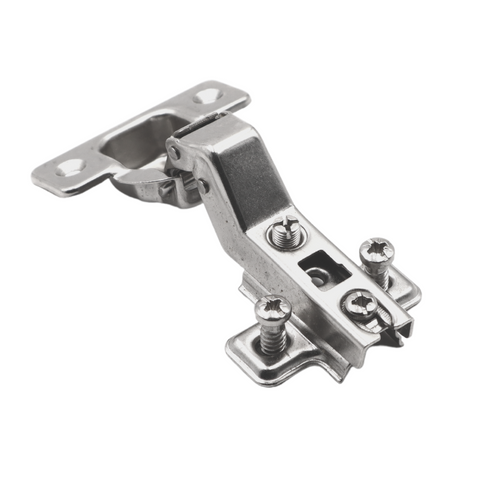
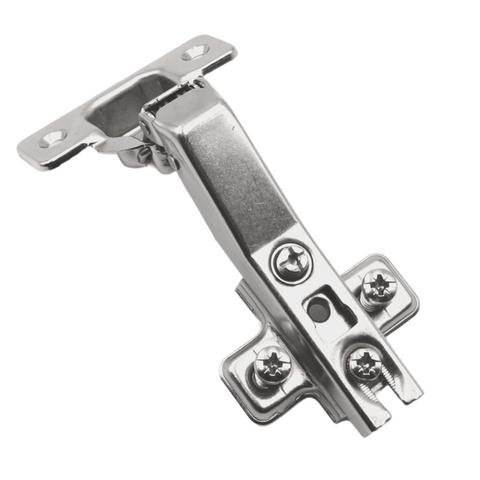
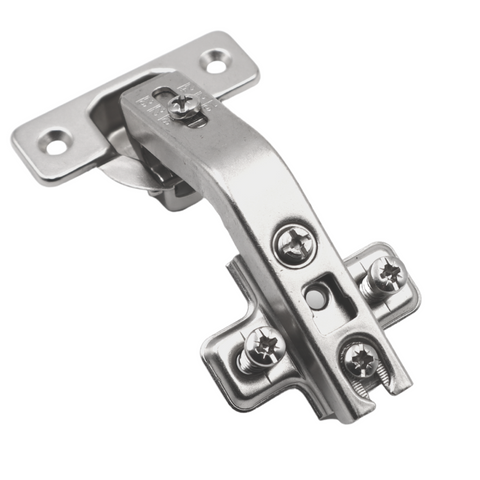
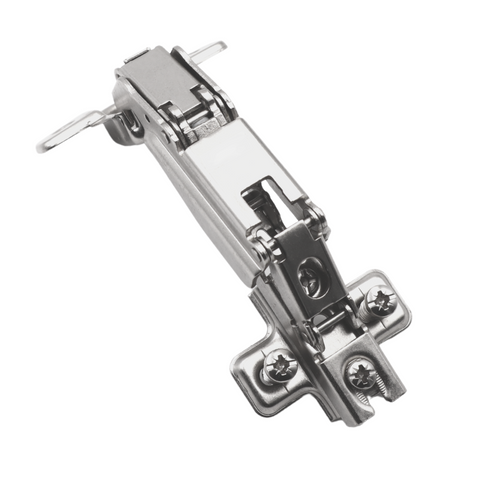
135º Angular Hinge, H2 Mounting Plate with EURO Screws, Corner DoorsRegular price $1.22Unit price / perRegular priceSale price $1.22

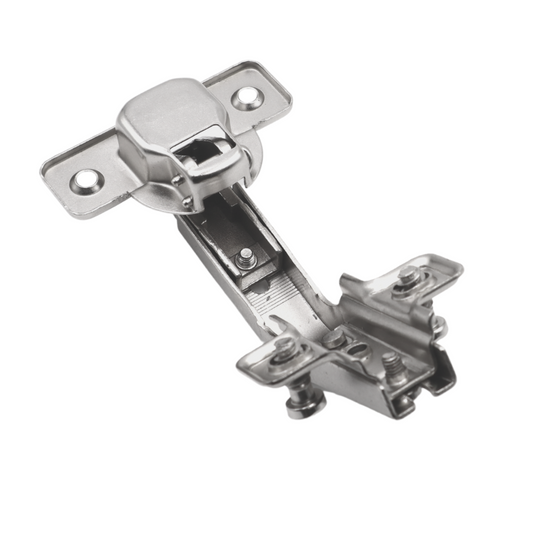
135 degree cabinet hinges(concealed cup hinges) are specialized hardware designed for a maximum opening angle of 135°, primarily used in L-shaped corner cabinets with bi-fold doors. They connect two separate door panels together, allowing the front to fold back completely to ensure barrier-free access to inner storage areas, such as a lazy Susan.
This specific hinge type differs fundamentally from standard hardware. While a classic110 degree cabinet hingeattaches a door directly to the cabinet side, the 135 degree cabinet hinge acts as a connecting element between two movable front panels. For cabinetmakers, kitchen installers, and professional furniture manufacturers, a precise understanding of the kinematics and installation parameters of these hinges is essential to guarantee clean reveal gaps and collision-free opening movement.
Kinematics and Application in Corner Cabinets
A135 degree cabinet hingeis used almost exclusively in bi-fold door corner cabinets. Here, the door assembly consists of two separate front panels. The first panel is attached to the cabinet body using wide-angle hinges (often165 degree cabinet hingesor155 degree cabinet hinges). The second panel attaches to the first panel—and this is precisely where the135 degree hingecomes into play.
The 135 degree hinge works like the knee joint of a corner cabinet—it flexibly joins the two door leaves and folds them neatly out of the way at the specified angle during opening. Thanks to this folding mechanism, the entire door assembly swings completely clear of the access area. Without this combination of a 165° cabinet connection and a 135° door-to-door connection, using corner cabinets with rotating carousel shelves would be mechanically impossible.
Specific Material Requirements
Because bi-fold doors exert significant leverage forces on hardware during opening and closing, these135 degree cabinet hingesare built with heavy-duty construction. They are typically made of nickel-plated steel. The nickel plating provides essential corrosion protection, which is particularly required in kitchen and bathroom environments due to ambient humidity and steam.
Dimensions and Drilling Parameters
Proper installation requires exact adherence to hole diameters and drilling patterns. The hardware industry has established fixed standards for these parameters, which can be accurately transferred to the door panel using ahinge drilling template.
Hinge Cup Diameter
The standard cup diameter for a 135 degree cabinet hinge is1-3/8 in (35 mm). This is the most common size in modern cabinetmaking, providing a sufficiently large surface area to absorb the dynamic loads of the folding door. For specialized, very thin, or light doors, a1 in (26 mm) hinge cupexists, though it is rarely used for 135° applications on heavy MDF or solid wood kitchen doors due to lower load capacity. When working with standard door thicknesses from 5/8 in to 7/8 in (16 mm to 22 mm), opt for regular35 mm cabinet hinges.
Hinge Cup Drilling Depth
The cup hole in the door front must be deep enough to receive the hinge cup flush, without breaking through the face of the door. For a 1-3/8 in (35 mm) hinge, the required drilling depth is typically between7/16 in and 29/64 in (11.3 mm and 11.5 mm). On a standard 5/8 in (16 mm) particleboard panel, less than 1/4 in (5 mm) of material remains—making a precise Forstner bit with a depth stop essential.
Drilling Pattern (Screw Hole Spacing)
In addition to the main 1-3/8 in (35 mm) hole, the hinge cup is fixed to the door with two side screws. The most common drilling patterns (center-to-center distance between mounting screws) are:
- 1-25/32 in (45 mm)(common for Blum or Grass)
- 1-7/8 in (48 mm)(common for Hettich, e.g., when replacing a135 degree Hettich hinge)
- 2-1/16 in (52 mm)(standard dimension for many European manufacturers)
Before replacing broken hinges, always verify the center-to-center distance between the small mounting screws with a caliper to prevent compatibility issues.
Door Mounting Types and Reveal Gaps
The choice of crank (the bend in the hinge arm) determines how the door rests on the cabinet body or adjacent door when closed. Bi-fold doors in corner cabinets have unique geometric requirements, making an understanding of mounting types essential.
Full Overlay
In a classicfull overlayinstallation, the door covers almost the entire cabinet side. The hinge arm is straight (uncranked). This style is used on standard cabinet doors. You can find corresponding hardware underfull overlay cabinet hinges.
Half Overlay (Dual Overlay)
Ahalf overlayis used when two doors share a single central side panel. The hinge arm has a slight crank (usually 3/8 in (9.5 mm)), covering only half of the side panel edge. For these builds, browse ourhalf overlay cabinet hinges.
Inset
With aninset door, the door panel does not overlay the cabinet carcass, but sits completely flush inside the cabinet opening. The hinge arm has a high crank (usually 5/8 in to 23/32 in (16 mm to 18 mm)). Flush designs like this call forinset cabinet hingesor specialized hinges for inset doors. If you are looking specifically for aninset cabinet door hinge, pay close attention to the maximum arm crank.
Note for 135° bi-fold doors:When connecting two door leaves in a corner cabinet, specialized bi-fold hinges are used. These adapt full overlay geometry but create a unique kinematic path via the mounting plate attached to the adjacent door panel.
Mechanisms: Self-Closing vs. Soft-Close
When selecting 135 degree cabinet hinges, you must distinguish between closing mechanisms. The terms are often confused, but they refer to different mechanical features.
Aself-closing cabinet hingefeatures an integrated spring mechanism. Once the door reaches a certain closing angle (usually around 10° to 15° from full closure), the spring pulls the door tight against the cabinet frame and holds it shut. No magnetic catches or latches are required. However,self-closing hingescan cause doors to slam audibly if not guided by hand.
To prevent slamming, integrated dampeners are used.Soft-close cabinet hingesabsorb the door's momentum via an integrated hydraulic cylinder, allowing the door to close gently and silently over the last few inches.
Important:When mounting a corner bi-fold door, un-dampened 135° hinges are typically recommended, while soft-close operation is handled by the 165° cabinet hinges attached to the frame. Using two soft-close hinge systems on the same bi-fold door assembly can cause them to work against each other, unnaturally slowing or binding the closing cycle.
Mounting Plates and Fastening Hardware
A concealed hinge always consists of two components: the hinge arm with its cup, and the mounting plate (often a cross-shaped plate) attached to the cabinet carcass or second door.
Mounting Plate Height (H-Dimension)
Mounting plates come in various heights, typically labeled asH0, H2, or H4. The number indicates the plate height offset in millimeters. Selecting the right mounting plate directly affects the gap between door panels. AnH2 mounting plateraises the hinge arm by 2 mm (5/64 in). This is often the standard choice for 135° setups to prevent the two door leaves from rubbing together when folded.
Fastening with EURO Screws
Mounting plates can be attached in several ways. The most durable and professional method is usingEURO screws. These specialized screws feature a flat end and deep thread pitch, fitting into pre-drilled holes with an exact diameter of3/16 in (5 mm). Unlike standard wood screws that displace material as they drive in, EURO screws cleanly thread into the 5 mm hole pattern of 32 mm cabinet systems. This guarantees maximum pull-out resistance—a vital factor under the heavy leverage loads of a bi-fold door.
Adjustment and Fine-Tuning (3D Adjustment)
A clean, uniform reveal gap is the hallmark of quality cabinetry. Learninghow to adjust cabinet hingesrequires a bit of patience and an understanding of the 3D adjustment screws on the hinge arm. Dedicatedcabinet hinge adjustment screwsallow precise corrections across all three dimensional axes:
- Side Adjustment (Overlay Adjustment):The front screw on the hinge arm. Turning this screw shifts the door horizontally left or right. Adjustment range is typically+/- 5/64 in (+/- 2 mm), aligning the vertical reveal gap between doors parallel.
- Depth Adjustment:The rear screw (often an eccentric screw). It moves the door closer to or further away from the cabinet face. Adjustment range is approx.+1/8 in / -5/64 in (+3 mm / -2 mm). This adjusts the clearance between the door and cabinet edge, preventing binding during opening.
- Height Adjustment:Adjusted at the mounting plate rather than the hinge arm. Loosening the mounting screws lets you slide the entire plate and door up or down along elongated slot holes (typically+/- 5/64 in (+/- 2 mm)).
Systematics of Opening Angles in Cabinetry
The 135° opening angle fills a very specific niche. To properly identify differentcabinet hinge typesandconcealed hinge styles, it helps to review standard opening angle categories:
- Angled Hinges for Angled Cabinets:30 degree cabinet hingesand45 degree cabinet hingesare designed for angled cabinet builds (e.g., corner units or sloped ceilings).
- Blind Corner Hinges:90 degree cabinet hingesare frequently used for blind corner panels. (Note: Terms like90 degree hingesorflat angle 90 degree hingesoften refer to these blind panel applications).
- Standard Applications:Our generalcabinet hingescollection is dominated by 110° hinges—the industry standard for straight base cabinets, dressers, and wall cabinets.
- Wide Angle:For complete interior access (such as pull-out drawers), 155° or 165° wide-angle hinges are used.
- Specialized Styles:Terms like180 degree hingesdescribe specialty hardware that allows doors to open completely flat against adjacent walls. For standard concealed cup hinges, however, 165° is the practical maximum limit.
Featured Products for 135 Degree Applications
When building or repairing corner cabinet bi-fold doors, using precisely engineered hardware makes all the difference. A core component for these setups is our 135° Corner Cabinet Hinge Cup, H2 Mounting Plate with Pre-installed EURO Screws for Bi-Fold Doors.
This hinge features an un-dampened design, making it the ideal partner for soft-close wide-angle hinges on the cabinet body. The included H2 mounting plate provides the exact offset spacing needed between adjacent door leaves. Factory pre-installed EURO screws ensure fast, reliable installation into standard 5 mm system holes, offering maximum pull-out resistance under dynamic loads. Featuring a standard 1-3/8 in (35 mm) cup diameter, it drops right into existing door cutouts for easy retrofitting.
---
FAQ – Frequently Asked Questions About 135 Degree Cabinet Hinges
1. Can I use a 135° hinge on a standard single cabinet door?
No. The movement kinematics of 135 degree cabinet hinges are specifically engineered to join two moving door panels (bi-fold doors) or for specific angled applications. For a standard cabinet door attached directly to a straight side panel, you need a standard 110° hinge or a 165° wide-angle hinge.
2. What hinge cup diameter do I need for a 135 degree cabinet hinge?
The standard industry diameter for these hinges is1-3/8 in (35 mm). Always measure the cup hole in your cabinet door before ordering replacements. A1 in (26 mm) hinge cuplacks the structural strength needed for heavy corner bi-fold doors.
3. Why should a 135 degree hinge be un-dampened (non-soft-close)?
Corner bi-fold door assemblies rely on two hinge types working in tandem: wide-angle hinges (frame to primary door) and 135° hinges (primary door to secondary door). If both hinge sets feature built-in soft-close dampeners, the mechanisms will resist each other during closure. This causes doors to close excessively slowly or bind mid-way. Soft-close dampening should be handled exclusively by the wide-angle frame hinges.
4. What does "H2" mean on a mounting plate?
The H-dimension indicates the height offset of the mounting plate. An H2 plate is 2 mm (5/64 in) taller than a flat H0 plate. On 135° bi-fold assemblies, H2 plates are standard because they provide necessary clearance between folded door edges to prevent rubbing.
5. What is the strongest way to mount the hinge plate?
For heavy bi-fold doors subjected to continuous leverage, mounting plates withEURO screwsinstalled in pre-drilled 3/16 in (5 mm) holes offer the strongest hold. The deep, blunt threads lock securely into cabinet composite materials, offering far higher pull-out strength than standard pointed wood screws.