
30 Degree Cabinet Hinges
Popular Subcategories
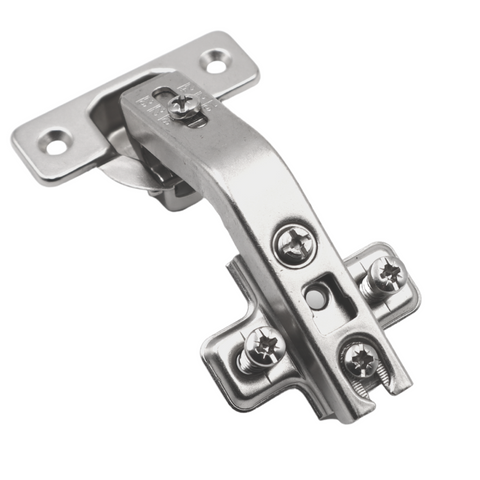
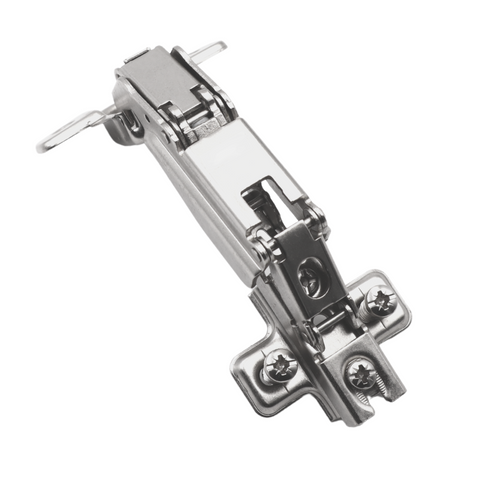
-
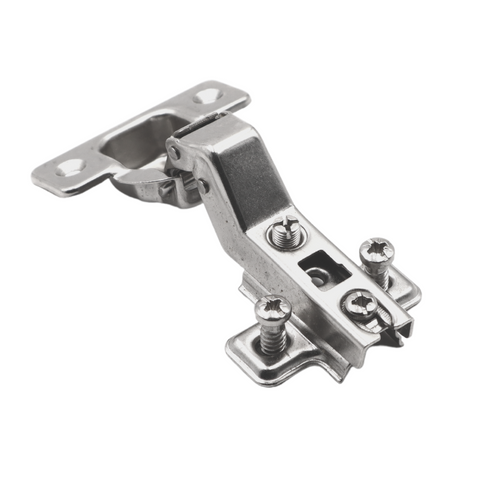
+30º Hinge, H2 Mounting Plate with EURO Screws, Angled DoorsRegular price $0.94Unit price / perRegular priceSale price $0.94
-
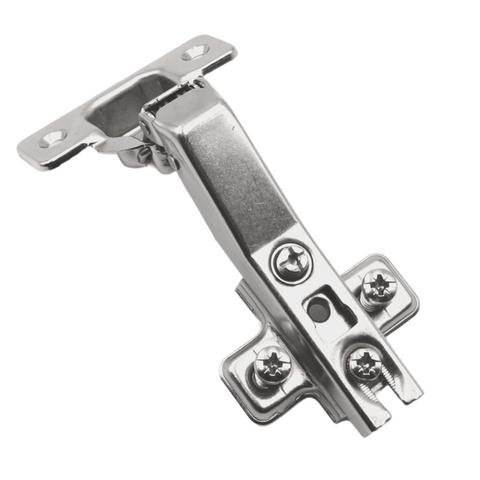
+30º Soft-Close Hinge, H2 Mounting Plate with EURO Screws, Angled DoorsRegular price $3.10Unit price / perRegular priceSale price $3.10

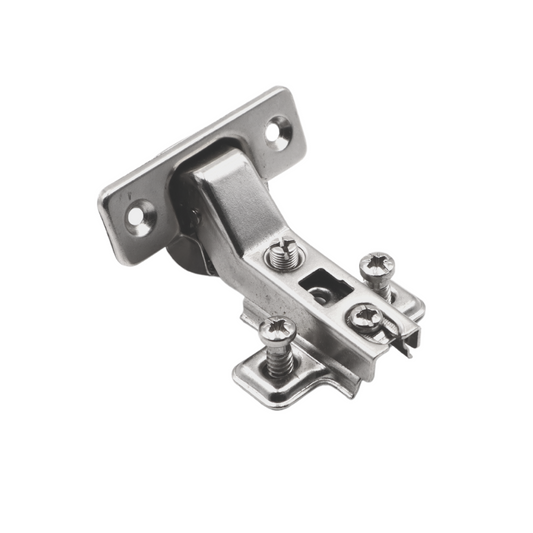

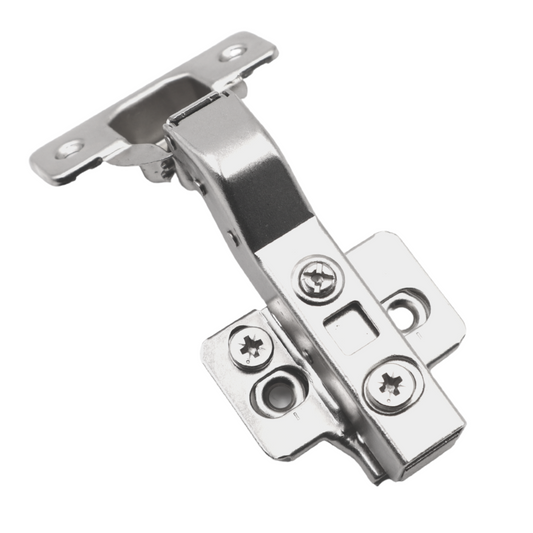
30 degree cabinet hinges(concealed cup hinges) are specialized furniture hardware engineered for cabinet carcasses with angled fronts. They ensure precise closing when the cabinet side panel and the closed door do not form a standard 90-degree angle, but instead sit at a +30° angle relative to one another. This specific geometry requires exact mechanical alignment between the hinge arm and the mounting plate to prevent door edge collision during opening and to guarantee an even reveal.
A 30 degree cabinet hinge performs much like an athlete's knee joint: it must absorb lever forces precisely at an unusual angle while guaranteeing complete stability throughout its entire motion. For professional cabinetmaking, interior fitting, and custom casework installation, understanding the exact dimensions and compatibility of thesecabinet hingesis essential.
Technical Specifications and Dimensional Guidelines
The design of angled hinges differs significantly from standard hinges around the articulated arm, yet shares standardized mounting dimensions in the cabinet body and door front.
- Cup Diameter:The industry standard for theseconcealed hingesrequires a1-3/8 in (35 mm)bore hole. For lighter or narrow fronts, versions with a1 in (26 mm)diameter are occasionally available. The mortise diameter must be kept exact to prevent tear-out under load.
- Boring Depth:The cup hole typically requires a drilling depth of7/16 in - 1/2 in (11.5 mm - 12.5 mm). Door thickness should therefore be at least5/8 in (16 mm), while hinges are regularly designed for material thicknesses up to7/8 in (22 mm).
- Line Hole Spacing (System 32):Securing the mounting plate to the cabinet carcass follows the established System 32 standard. The distance from the front system hole to the cabinet front edge is a standard1-7/16 in (37 mm).
- Cup Boring Distance (C-Dimension):The distance from the edge of the door to the edge of the 1-3/8 in (35 mm) hole typically ranges between1/8 in - 9/32 in (3 mm - 7 mm), depending on the required overlay.
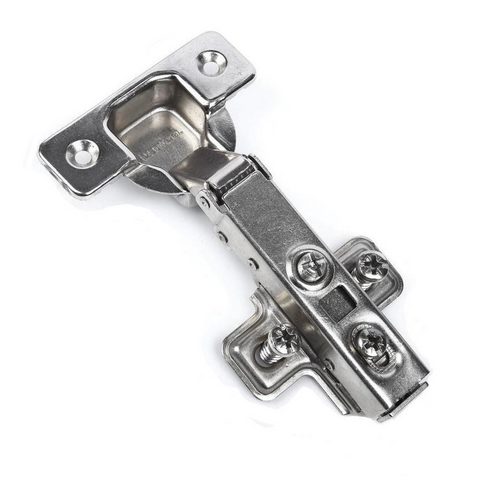
If you are looking for classic dimensions for standard applications, browse our35 mm concealed hingesor standardconcealed hinges / cabinet hinges.
Applications for +30 Degree Angled Hinges
The need for a 30-degree angle primarily arises in custom cabinet construction. While classic90 degree cabinet hingesare designed for right-angled carcasses, 30-degree hinges are utilized in the following scenarios:
- Pentagonal Corner Cabinets:In kitchens or bedrooms where the door front runs diagonally across a corner.
- Sloped Ceiling Cabinets:When the carcass is adapted to a roof pitch and the front meets the side wall at a corresponding angle.
- Bay Window and Polygonal Furniture:Custom built-ins designed to match complex room architecture.
For alternative geometries, other specialized hinges must be calculated, such as45 degree cabinet hingesor, for wide obtuse angles,135 degree cabinet hinges.
Selection Criteria: Overlay Types and Hinge Crank
The position of the door relative to the cabinet frame determines the required crank (bend of the hinge arm). Cranked or heavily cranked hinges alter the door overlay. Three main overlay types are available:
Full Overlay
When closed, the door covers almost the entire edge face of the cabinet side wall. The hinge arm is straight (uncranked). Installers usefull overlay concealed hingesfor this standard application.
Half Overlay (Dual / Twin Application)
When two doors share a single central side wall (e.g., at a material thickness of 3/4 in (19 mm)), each door must cover just under half of the edge face so they do not collide. The hinge arm features a slight crank. Suitable hardware can be found underhalf overlay concealed hinges.
Inset
The door does not lay on top of the cabinet wall, but sits flush inside the cabinet opening. The hinge arm has a heavy crank. Inset 30 degree cabinet hinges require a precise reveal gap. For these setups,inset concealed hingesor hinges for inset doors are installed.
Mechanics: Soft-Close Dampening and Closing Technology
Moderncabinet hingesfeature integrated mechanical components to control the closing speed.
Onsoft-close cabinet hinges, a hydraulic cylinder is built directly into the hinge cup or articulated arm. This catches the kinetic energy of the closing door starting at an angle of approx.30°, gently and silently pulling the front flush against the cabinet body. The system operates with defined resistance. Theseconcealed hinges / soft-close cabinet hingesprotect the material and prevent heavy MDF or solid wood doors from slamming shut.
Important planning note: Soft-close mechanisms should not be combined with push-to-open (tip-on) systems. Push-to-open requires self-opening or un-sprung hinges—ideally with a free-running function or reverse spring—so the catch latch can push the door open successfully.
Installation, Hardware, and Adjustment
Installing 30 degree cabinet hinges demands accuracy. Aconcealed hinge drilling jigis essential for precise positioning of the 1-3/8 in (35 mm) cup bore, as well as the two 3/16 in (5 mm) holes for the cup mounting dowels.
The Mounting Plate (Face Frame / Cruciform Plate)
The mounting plate forms the secure link between the cabinet side panel and the hinge arm. A widely used variant is the H2 mounting plate. The designation "H2" stands for a build height of3/32 in (2 mm). This height directly factors into calculating the door overlay. Fastening is usually carried out via pre-assembled Euro screws (diameter3/16 in (5 mm)) that grip directly into System 32 line holes, or via standard wood screws.
3D Adjustment (Adjusting Cabinet Hinges)
Once clipped on (often using toolless clip-on technology), the door reveals must be adjusted. Every professionalfurniture hingeoffers 3-way adjustment via eccentric screws:
- Depth Adjustment:Moves the door closer to or further from the cabinet (typically+3/32 in / -3/32 in (+2 mm / -2 mm)). Regulates the gap between the door and cabinet front edge.
- Height Adjustment:Performed via the mounting plate (typically+3/32 in / -3/32 in (+2 mm / -2 mm)). Aligns the door vertically.
- Overlay / Side Adjustment:The primarycabinet hinge adjustment screwon the hinge arm. It shifts the door left or right, adjusting the gap between double doors.
If screw holes in an older cabinet carcass are stripped or torn out, acabinet hinge repair plateis used. This metal repair plate covers damaged wood and provides new threaded holes to securely mount the hinge plate.
Selected 30 Degree Components in Detail
To implement +30-degree angles, specialized components are available to match this cabinet geometry precisely:
- Standard Un-dampened System:The +30º Concealed Cabinet Hinge with H2 Mounting Plate and EURO Screws for corner cabinets is the classic solution for doors without soft-close requirements or for use alongside push-to-open hardware. The H2 plate ensures proper spacing on standard side panels.
- Soft-Close System:The +30º Soft-Close Concealed Cabinet Hinge with H2 Mounting Plate for corner cabinets integrates a hydraulic damper directly into the hinge body. Designed for heavy door fronts, it reduces mechanical strain on cabinet joints during closing.
FAQ – Frequently Asked Technical Questions
What are the most common types of cabinet hinges?Classification is primarily based on opening angle and overlay style. Standard hinges open to95°or110°. For interior roll-out drawers, wide-angle hinges are required, such as155 degree cabinet hingesor165 degree cabinet hinges. Hardware is also categorized by cabinet geometry (e.g., 30-degree or 45-degree angled hinges).
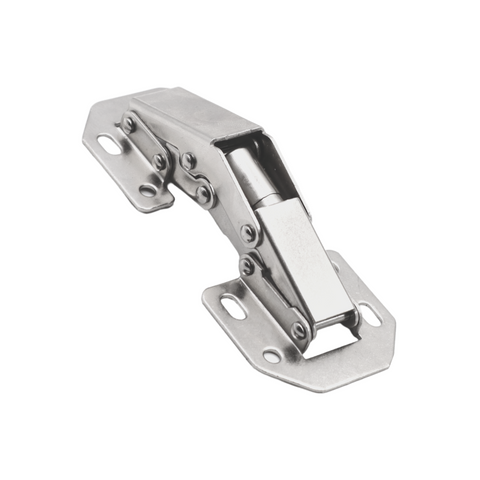
Are there cabinet hinges without a cup?Yes. When door thickness does not allow for a 1-3/8 in (35 mm) cup bore (e.g., on thin panels under19/32 in (15 mm)), surface-mount hinges or flat slip-on hinges are used. These screw directly onto the surface without routing, but typically offer fewer adjustment options and lower load capacities than true 30 degree cabinet hinges.
Can I use a 30-degree hinge on a standard cabinet door?No. A 30 degree cabinet hinge is designed exclusively for carcasses where the side walls meet the front at a 30-degree angle. For a standard right-angled cabinet body with a door opening to 110 degrees, you must use a110 degree cabinet hinge.
How do I measure concealed hinge cup diameter?Thehinge cup diameteris measured across the widest point of the cylindrical hinge cup. In 95% of cabinet applications, this measures1-3/8 in (35 mm). Older models or specialty furniture (e.g., light medicine cabinets) often use1 in (26 mm). Always verify this dimension with calipers prior to routing.
Related System Components
For custom opening angles and specialized cabinet designs, installation planning requires specific hinge types. The following categories cover additional geometries and opening radiuses: