
45 Degree Cabinet Hinges
Popular Subcategories
-
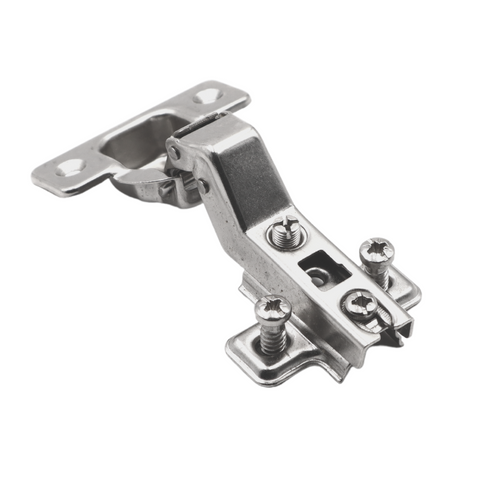
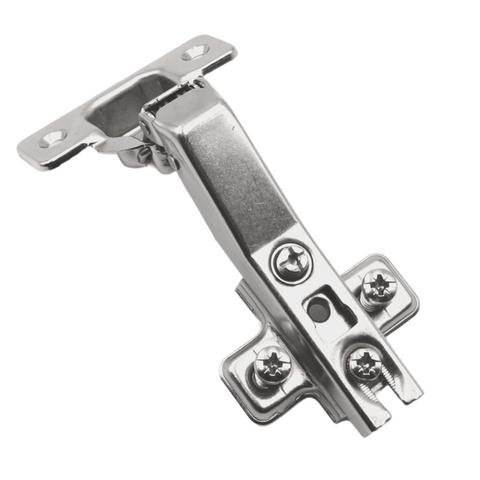
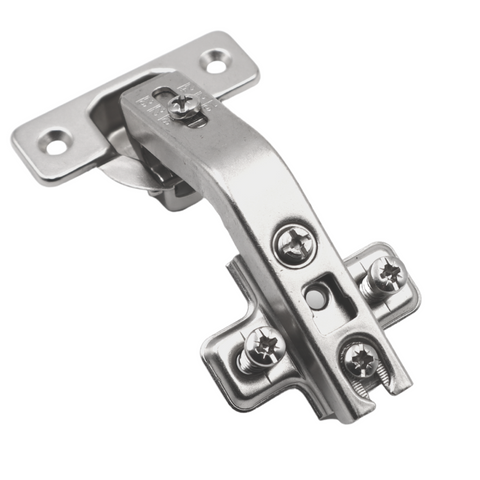
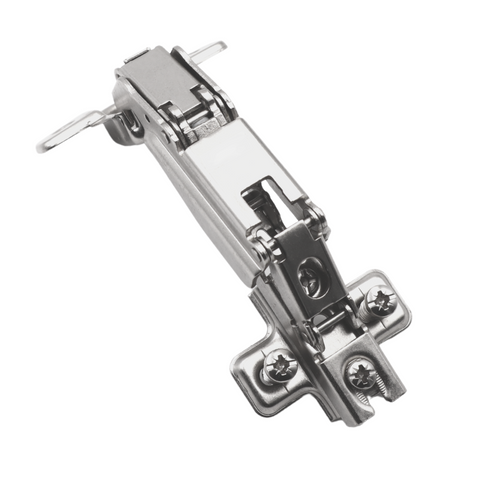
+45º Hinge, H2 Mounting Plate with EURO Screws, Angled DoorsRegular price $1.01Unit price / perRegular priceSale price $1.01
-
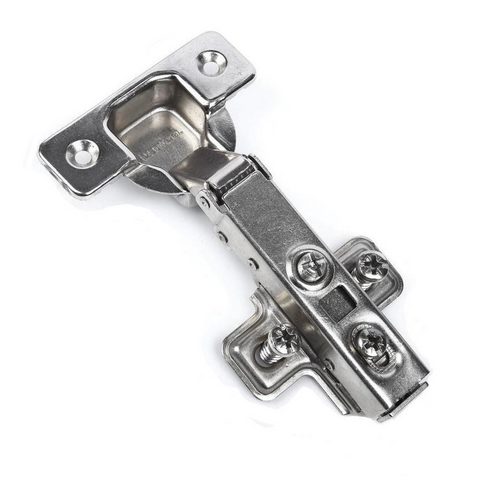
+45º Soft-Close Hinge, H2 Mounting Plate with EURO Screws, Angled DoorsRegular price $3.18Unit price / perRegular priceSale price $3.18

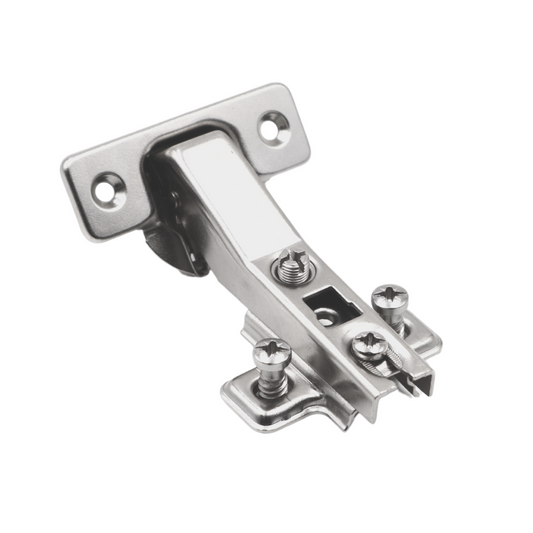

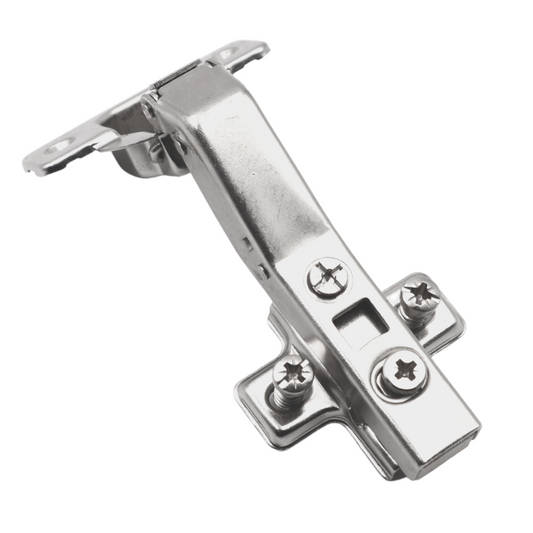
45 degree cabinet hinges(also known as angled concealed hinges) are specialized furniture hardware designed specifically for cabinet carcasses with mitered or angled side panels. They are used when the cabinet door sits at a precise 45° angle relative to the cabinet side in the closed position.
This specific angled position requires a modified kinematic hinge arm to ensure a collision-free opening of the door. In professional cabinetmaking and architectural millwork, these hardware solutions are indispensable for corner units, angled attic cabinets, or polygonal kitchen islands.
Geometry and Applications in Cabinetmaking
A standard45 degree cabinet hinge for corner unitssolves a geometric challenge that does not occur with traditional right-angled cabinets. When the side panel of a cabinet (such as a45 degree kitchen cabinet) is angled in its floor plan, regular 90-degree hinges fail to align or block the door when attempting to open it. The45 degree hingebridges this exact angular difference.
Typical applications for a45 degree concealed cabinet hingeinclude:
- Diagonal Corner Cabinets:Frequently installed in L-shaped or U-shaped kitchen layouts where the cabinet front runs diagonally across the corner.
- Attic & Sloped-Ceiling Furniture:When the cabinet carcass is adapted to the slope of a roofline and the front closes at a 45-degree angle.
- Bathroom Vanities:Polygonal vanity bases featuring angled edges for improved ergonomics and style.
The correct industry terminology for this design is often45 degree angled cabinet hingesor angled cup hinges. They must be strictly distinguished from hardware used for folding doors or lazy susan cabinets, which typically require135 degree cabinet hingesor even165 degree cabinet hinges.
Technical Specifications and Dimensions
For proper installation of 45 degree cabinet hinges, the dimensions of thehinge cup boringand screw hole pattern must be precise. These fittings are based on standardized industrial furniture manufacturing specs.
- Cup Diameter:Standardized at1-3/8 in (35 mm). This requires the use of a matching Forstner bit. Corresponding35 mm cabinet hingesrepresent the industry standard for robust, long-lasting cabinet doors.
- Boring Depth:The mortise depth for the hinge cup generally needs to be0.45 in to 0.47 in (11.5 mm to 12 mm). With a standard door thickness of5/8 in to 3/4 in (16 mm to 19 mm), ample material thickness remains intact behind the recess.
- Cup Distance (C-Dimension):The distance from the edge of the door to the rim of the 1-3/8 in (35 mm) hole. For 45 degree hinges, this value typically ranges between1/8 in and 9/32 in (3 mm and 7 mm), depending on door thickness and desired reveal.
- Material:The hinges are constructed from nickel-plated steel. This protective surface treatment guards against corrosion, making them highly suitable for high-humidity environments like kitchens and bathrooms.
To ensure exact positioning of the bored holes, using ahinge drilling jigis highly recommended. A detailedtechnical dimension drawingfrom the manufacturer provides precise measurements for the drilling pattern.
Mechanics: Soft-Close Buffering and Closing Action
When selecting 45 degree cabinet hinges, you can choose between self-closing (un-buffered) models and integrated soft-close mechanisms.
Asoft-close cabinet hingefeatures a hydraulic dampener integrated directly into the hinge arm or hinge cup. This cylinder absorbs the kinetic energy of the closing door starting at an angle of roughly 20° to 30°, pulling it gently and silently flush against the cabinet frame.Soft-close cabinet hingessignificantly reduce mechanical stress on the cabinet carcass while preventing harsh wood-on-wood slamming.
For lighter doors or frameless cabinet builds using push-to-open (tip-on) latches, un-buffered (standard) hinges are required. A soft-close mechanism would counteract the ejection force of the push latch and prevent proper operation.
Installation and Adjustment
The connection between the cabinet side panel and the hinge arm is established via the mounting plate (cruciform plate). The 45 degree hinges featured here utilize anH2 mounting plate. The "H2" designation indicates that the base plate features a height/off-set of0.08 in (2 mm). This offset distance is crucial for achieving the correct door overlay relative to the angled cabinet panel.
On these models, the mounting plate attaches to the cabinet box via pre-installedEuro screws. These heavy-duty screws feature a3/16 in (5 mm)diameter and are specifically designed for standardized System 32 hole patterns in particle board and MDF. They provide substantially higher pull-out resistance than standard wood screws (spax) because their blunt threads seat firmly in pre-drilled 5 mm holes.
3D Micro-Adjustment
Adjusting door reveals via three-dimensional adjustment screws is like fine-tuning a mechanical watch — fractions of an inch determine seamless operation and perfect visual alignment across your cabinet fronts.
To perform propercabinet hinge adjustment, the fittings include several screws located directly on the hinge arm:
- Depth Adjustment:An eccentric screw or slotted screw regulates the gap between the door and cabinet box (typically+1/8 in / -5/64 in (+3 mm / -2 mm)). This controls the distance between the back of the door and the cabinet face.
- Side-to-Side Adjustment:The front-facingcabinet hinge adjustment screwtilts the door left or right for exact overlay alignment. The typical adjustment range is±5/64 in (±2 mm).
- Height Adjustment:Performed directly on the H2 mounting plate. By loosening the Euro screws, the plate can be adjusted vertically within its slotted holes by±5/64 in (±2 mm)before tightening back down.
Featured Products in This Category
This category features precision-engineered hardware tailored specifically for 45-degree angled mounting. Both options are built for professional cabinetmaking and differ primarily in their closing action.
Soft-Close Version
The +45º Soft-Close Angled Cabinet Hinge with H2 Mounting Plate and EURO Screws for corner cabinets is the ultimate hardware solution for modern cabinetry. Its built-in hydraulic dampener guarantees smooth, silent closing. It comes complete with the matching 0.08 in (2 mm) mounting plate and pre-installed Euro screws. The cup size features the industry-standard1-3/8 in (35 mm)diameter. Perfect for heavy MDF or solid wood kitchen cabinet doors.
Standard / Un-Buffered Version
The +45º Angled Cabinet Hinge with H2 Mounting Plate and EURO Screws features a traditional spring catch without hydraulic braking. It securely holds the door closed against the cabinet body. This design is preferred for very light cabinet doors or when adding push-to-open latches and clip-on dampeners.
Comparison to Other Hinge Overlay Types
When designing custom cabinets, both the wall angle and the overlay style must be considered. While 45 degree cabinet hinges serve specialized angled builds, standard 90-degree cabinet structures fall into three main categories:
- Full Overlay Cabinet Hinges: The door fully covers the edge of the cabinet side panel.
- Half Overlay Cabinet Hinges: Two adjacent doors share a single central cabinet side panel.
- Inset Cabinet Hinges: The door sits fully flush inside the cabinet opening, leaving the front edges of the cabinet sides completely visible. These can also be found under Inset Door Cabinet Hinges.
FAQ – Frequently Asked Technical Questions
Can I replace a broken "FGV Hinge QS 45" with these hinges?
If your existing hinge uses a1-3/8 in (35 mm)cup hole, direct mechanical replacement is usually seamless. Make sure to remove the old mounting plate and swap in the included H2 plate, as clip-on mechanisms vary between hardware manufacturers. The location of the Euro screws (System 32 spacing) generally aligns directly with existing cabinet hole patterns.
What is the difference between a 45 degree hinge and a 135 degree hinge?
A 45 degree hinge is used when the cabinet box itself is angled along the front edge (the door sits at a 45-degree angle to the side panel). Conversely, a 135 degree hinge is typically used on folding corner doors (like bi-fold lazy susans) where two door panels are hinged together and require a wider opening swing.
Can I mix soft-close and standard hinges on the same cabinet door?
Yes, this is a common practice on very light or small cabinet doors to reduce overall spring resistance or lower project costs. For a door requiring two hinges, you can install one +45º soft-close hinge on top and one +45º un-buffered hinge on the bottom. The dampening strength of a single hydraulic cylinder is often sufficient for lightweight fronts.
What drill bit size do I need for installation?
Boring the hinge cup into the door requires a1-3/8 in (35 mm)Forstner bit or specialized cabinet router bit. A standard twist drill bit is unsuitable because a flat-bottom blind hole is necessary to properly seat the cup. Always test your boring depth on a piece of scrap wood first to prevent drilling through the front face of the door.
Related Cabinet Hardware Categories
If your custom furniture project calls for alternative mounting angles or swing kinematics, explore our full range of specialized concealed hinges. Choosing the right angle is essential for long-term cabinet performance:
- Concealed Cabinet Hinges– Our main category covering all standard overlay types.
- 30 Degree Cabinet Hinges– Designed for shallower angled cabinet carcasses.
- 90 Degree Cabinet Hinges– For blind corner cabinets and specialized face-frame joints.
- 110 Degree Cabinet Hinges– The standard opening angle for everyday home and office cabinetry.
- 155 Degree Cabinet Hinges– Wide-angle zero-protrusion hinges, ideal for cabinets with internal pull-out drawers.