
Wohnwand Modern
-
Wall Unit VISTE - Living Room Furniture Set - Scandi / Truffle / White GlossRegular price $719.99Unit price / perRegular priceSale price $719.99

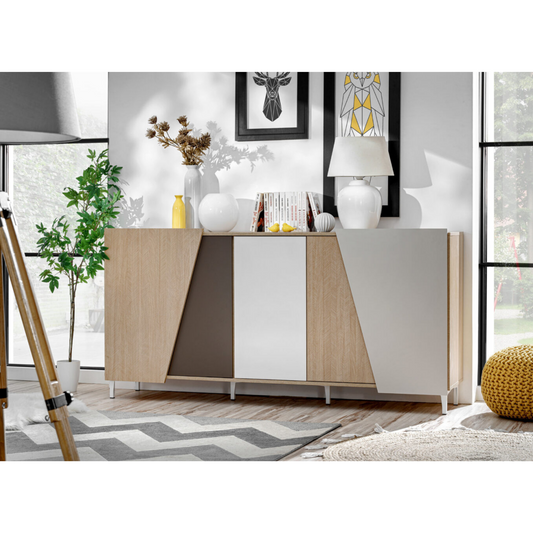
A modern wall unit is a modular living room furniture set defined by clean lines, handleless fronts, and a dynamic mix of floor-standing and wall-mounted elements.
Unlike the bulky, solid entertainment centers of past decades, amodern wall unitfeatures an airy, open structure. It typically consists of a central TV lowboard console, flanked by display cabinets or floating wall cabinets, and complemented by accent wall shelves. This design maximizes storage while maintaining a light, spacious feel in the room. For the DIYer, assembling the unit in separate modules keeps installation straightforward, though it requires precise wall alignment.
Construction and Materials: The Foundation of Modern Living Room Cabinets
A modernliving room wall unitutilizes engineered wood panels that ensure dimensional stability and tight tolerances during DIY assembly.
The Cabinet Carcass: Particle Board and Melamine
The core structure of most cabinet modules is constructed fromparticle board(chipboard) with a typical thickness of 19/32 in to 23/32 in (15 mm to 18 mm). These panels are finished with a durable melamine resin coating. Melamine is scratch-resistant, liquid-repellent, and easy to clean. Edges are sealed industrially with heavy-duty ABS edge banding (typically 1/64 in to 3/64 in (0.5 mm to 1.0 mm) thick) to protect against moisture and impact. On natural wood finishes like theWohnwand Wood Modern, the grain is realistically reproduced through the textured melamine layer.
Cabinet Fronts: MDF and Surface Finishes
Visible door fronts and drawer faces are frequently made fromMDF(Medium-Density Fiberboard). MDF allows for cleanly routed edges and offers a smoother surface profile than standard particle board. For a clean look like theWohnwand White, these MDF doors are thermoformed with high-gloss foil or finished with a smooth matte lacquer. Models like theWohnwand FUNNY PLUS - Wohnzimmer-Möbel-Set - White Matt / White Glossmix matte cabinet carcasses with high-gloss fronts to create visual depth.
A striking contrast is achieved by pairing dark tones with warm wood grains, such as in theWohnwand FAME - Wohnzimmer- Möbel-Set - Black / Gold. Here, premium surface finishes define the room's entire ambiance.
Cabinet Hardware Technology: The Mechanical Heart of Modern Furniture
The functionality and longevity of any quality wall unit depend heavily on its concealed hardware systems. For installers, hinge adjustments and runner load ratings are crucial details.
Concealed Cup Hinges (Cabinet Hinges)
Wall-mounted cabinet doors and glass display doors are mounted usingconcealed European cup hinges. The standard cup drill diameter for the hinge body in the door is1-3/8 in (35 mm). The opening angle for standard living room furniture is usually110°. Pay close attention to the overlay type during assembly:
- Full Overlay:The door completely covers the front edge of the cabinet side panel (most common on single display cabinets).
- Half Overlay (Dual):Two doors share a single central partition wall (common on wider sideboards).
- Inset:The door rests flush inside the cabinet frame opening.
Modern hinges feature 3D spatial adjustment. Aligning the door gaps on a wall unit is like tuning an instrument—a single millimeter of variance at the hinge throws off the entire front profile. Adjustments are made via three screws on the hinge arm: height, depth, and side-to-side overlay.
Drawer Slides
TV lowboards use heavy-duty slide systems engineered to support the weight of media equipment and accessories.
- Ball-Bearing Slides:These side-mount telescopic runners attach directly to the drawer box. They frequently offerfull extension, allowing 100% access to the drawer interior. Load capacities typically range from 55 lbs to 77 lbs (25 kg to 35 kg).
- Undermount Slides:Hidden beneath the drawer box, these concealed runners offer a sleek, hardware-free appearance, making them ideal for high-end handleless designs.
Closing Mechanisms: Soft-Close vs. Push-to-Open
Amodern wall unitusually relies on handleless fronts. Two distinct mechanical principles are used, which must not be confused during installation or hardware replacement:
- Push-to-Open (Tip-On):Pressing the front triggers a spring latch that pops the door or drawer open by an inch or two. A magnetic catch or mechanical touch latch holds the door closed.
- Soft-Close (Damped):An integrated hydraulic damper catches the door in the final inches of travel, pulling it softly and silently shut.
Installation Tip:Push-to-Open requires hingeswithoutself-closing springs (un-sprung hinges), whereas Soft-Close relies on hingeswithbuilt-in springs. These two mechanisms cannot be combined on the same door.
Space Planning and Dimensioning
Before installing amodern media wall unit, precise wall measurements are essential. Modular components can be mounted closer together or spaced wider apart depending on room dimensions.
The TV Lowboard Console
The lowboard forms the anchor of the set. Standard cabinet depths range from 15-3/4 in to 17-3/4 in (40 cm to 45 cm) to comfortably accommodate AV receivers and gaming consoles. Standard height ranges from 11-13/16 in to 17-3/4 in (30 cm to 45 cm). When selecting width, consider your TV screen size. A 65-inch television measures roughly 57 in (145 cm) in actual width. Visually, the lowboard should extend at least 6 in to 8 in (15 cm to 20 cm) beyond the TV frame on each side. A console from our Lowboard Modern line spanning 70-7/8 in to 78-3/4 in (180 cm to 200 cm) is recommended.
Wall Cabinets and Floating Display Units
Floating elements, such as those featured in aWohnwand Hängendset, are typically mounted so their top edge aligns with door frames or window lines. Maintain a clearance of 15-3/4 in to 23-5/8 in (40 cm to 60 cm) between the top of the lowboard and the bottom of the floating cabinets to accommodate the television and decorative accents.
Step-by-Step DIY Assembly Guide
Assembling amodern designer wall unitrequires a systematic approach. Allow roughly 4 to 6 hours to build and mount a full 4- to 5-piece system.
Required Tools
- Cordless driver with bit sets (PZ2for wood screws,PHfor hardware brackets,TXfor structural screws).
- Spirit level (at least 32 in (80 cm), ideally 48 in (120 cm)).
- Tape measure and pencil.
- Hammer drill or rotary hammer (for masonry wall mounting).
- Rubber mallet (for seating wooden dowels).
Step 1: Assembling the Cabinet Carcass
Frame assembly relies oncam lock and connecting bolt fasteners(often called Minifix knock-down hardware) paired with wooden dowels (typically 5/16 in x 1-3/16 in (8 x 30 mm)).
- Apply a small drop of wood glue to the dowels and tap them into the pre-drilled side panel holes with a rubber mallet.
- Thread the connecting steel studs (bolts) into the designated 3/16 in (5 mm) system holes.
- Fit the panels together and insert the circular cam lock housings (typically 19/32 in (15 mm) diameter) into the face routings.
- Turn the cam locks roughly 180° clockwise with a screwdriver (PZ2) until the joint pulls rigid and square.
Step 2: Attaching the Back Panels
Thin hardboard back panels (typically 3/32 in to 1/8 in (2.5 mm to 3 mm)) provide crucial racking resistance and structural rigidity. Always measure the diagonal dimensions across the cabinet box before fastening. If both diagonal measurements match to the fraction of an inch, the cabinet frame is perfectly square (90°). Secure the back panel using panel pins/nails or smallwood screws(e.g., #4 x 5/8 in (3 x 15 mm)).
Step 3: Wall Mounting (Critical Step)
For modern floating wall cabinets, wall construction dictates the required anchors. Included standard expansion plugs are generally intended for solid masonry or concrete.
- Concrete / Solid Brick:Use 5/16 in or 3/8 in (8 mm or 10 mm) heavy-duty nylon wall plugs.
- Drywall / Stud Walls:Toggle bolts or heavy-duty metal cavity anchors are mandatory. A fully loaded floating cabinet packed with glassware or books can easily weigh 66 lbs to 88 lbs (30 kg to 40 kg).
Mount continuous suspension hanging rails perfectly level on the wall. The cabinets then hook onto the rail via adjustable cabinet suspension brackets mounted inside the upper corners. Internal adjustment screws allow fine-tuning of height and depth by a few millimeters to compensate for uneven drywall or plaster.
Step 4: Hanging Fronts and Adjusting Door Gaps
Finally, snap the hinge arms onto the frame mounting plates using quick-release clip-on technology. Adjust the 3D hinge screws to achieve uniform panel gaps (reveals) of approximately 1/16 in to 1/8 in (2 mm to 3 mm) across all door fronts.
Popular Modern Design Configurations
Our selection ofpremium modern living room furniturecovers various material and color combinations to suit modern interiors.
- Scandinavian Contrast:Models like theWohnwand SOLIDO - Wohnzimmer-Möbel-Set - Black Matt / Artisan Oakpair dark matte carcasses with warm, textured oak finishes, softening harsh lines and creating a cozy contemporary home environment.
- Classic Minimalism:Crisp white fronts, featured on theWohnwand SWITCH - Wohnzimmer-Möbel-Set - White matt / White glänzend, bounce natural light around the room to make small living rooms feel spacious. While high-gloss surfaces show smudges, they wipe clean effortlessly with a soft microfiber or cotton cloth.
- Industrial & Textured Finishes:Muted grays paired with weathered wood grains, seen on theVERO - Wohnzimmer-Möbel-Set - Esche Gray / Oak Coast Evoke, complement polished concrete floors and dark hardwood flooring.
Expandability and Cable Management
A trulyminimalist wall unithides power cords and media cables out of sight. Modern TV consoles feature integrated cable grommets and cutouts (typically 2-3/8 in (60 mm) diameter) in the back panel or top deck. DIY Tip: If adding extra home theater components, drill custom wire pass-throughs into melamine particle board using a hole saw attachment on your cordless drill. Apply painter's tape over the target spot first to prevent top-layer chipping.
If you need additional storage, expand your layout with a matching standalone Kommode Modern accent chest in the same finish.
FAQ: Frequently Asked Questions About Modern Wall Units
What type of wall is required to install floating wall cabinets?Floating cabinets can be installed on almost any wall provided the correct anchor hardware is used. For concrete or brick, standard 5/16 in (8 mm) nylon anchors suffice. For hollow drywall installation, use heavy-duty toggle bolts or anchor directly into internal wood studs (CW metal studs).
How do I properly clean and care for high-gloss fronts?Use only soft cotton or specialized lint-free furniture cloths. Avoid abrasive microfiber towels on high-gloss finishes like the Wohnwand White Hochglanz, as micro-particles can dull the surface over time. Use mild dish soap diluted in water rather than harsh chemical cleaners.
Can I retrofit integrated LED lighting later?Yes. Most glass shelf lighting systems utilize clip-on LED channels that slide directly onto the rear edge of 3/16 in to 5/16 in (5 mm to 8 mm) tempered glass shelves. Cables run down behind the back panel to a floor-level power transformer.
What is the difference between melamine composite and solid wood?Modern modular wall units use melamine-laminated particle board. Unlike solid wood, composite wood panels will not warp, twist, or check with ambient humidity changes, offering exceptional dimensional stability and scratch resistance without requiring recurring oil or wax treatments.
What is the load rating of a TV lowboard console?A floor-standing TV console made from 5/8 in (16 mm) particle board with vertical partition supports easily holds modern big-screen televisions. The top surface is typically rated for static loads of 66 lbs to 110 lbs (30 kg to 50 kg). Floating TV stands are limited by wall construction and hanging hardware, typically supporting 33 lbs to 55 lbs (15 kg to 25 kg) per unit.
Related Categories for Your Living Room
- TV Wohnwand
- Wohnwand Black
- Wohnwand White
- Wohnwand Wood Modern
- Lowboard Modern
- Wohnwand Betonoptik
- Wohnwand Hochglanz
- Wohnwand Mit Vitrine
- Designer Wohnwand
- Anthracite Wohnwand
- Wohnwand Gray
Frequently Asked Questions
Can the modern wall unit cabinets be combined with my existing IKEA furniture?
Yes, our modular units are compatible with IKEA cabinet systems provided they use the same standard grid dimensions. Our wall units are built around standard 32 mm cabinet system spacing. For a direct cabinet-to-cabinet connection, use standard cabinet connector bolts (32 mm hole pattern). Check your cabinet frame dimensions beforehand to ensure flush alignment.
Do these modern wall units feature push-to-open latches or traditional handles?
Our modern wall units come standard with handleless push-to-open hardware to emphasize clean, minimalist lines. If preferred, you can install traditional cabinet handles. The door panels provide ample mounting space; when retrofitting handles, choose a standard center-to-center drilling distance (e.g., 5-1/16 in or 6-5/16 in (128 mm or 160 mm)).
How much weight can the floating wall cabinets hold, and what mounting hardware is required?
When properly installed, floating wall modules support up to 33 lbs (15 kg) per cabinet. Use heavy-duty wall hangers and continuous hanging suspension rails for mounting. Note: Included wall plugs are intended for solid masonry. For drywall installation, heavy-duty hollow-wall anchors or toggle bolts are required to safely support the load.
Are the gas struts on lift-up flap doors suitable replacements for Blum lift mechanism hardware?
Yes, our gas spring struts serve as direct replacement hardware for standard Blum-style lift mechanisms on drop-down or lift-up doors. Be sure to select the correct force rating (e.g., 60N, 80N, or 100N) matching your door panel weight. Installation uses standard mounting plates that align cleanly with standard 32 mm system drilling patterns.
Can I retrofit the glass shelves in the wall unit with LED lighting?
Yes, retrofitting LED glass edge lighting is quick and simple. The tempered glass shelves have a standard thickness of 3/16 in to 5/16 in (5 mm to 8 mm), allowing standard clip-on LED channel clips to slide directly onto the rear edge. Ensure you leave roughly 19/32 in (15 mm) of clearance behind the cabinet carcass to route power cables cleanly out of sight.