
Threaded Inserts
Popular Subcategories
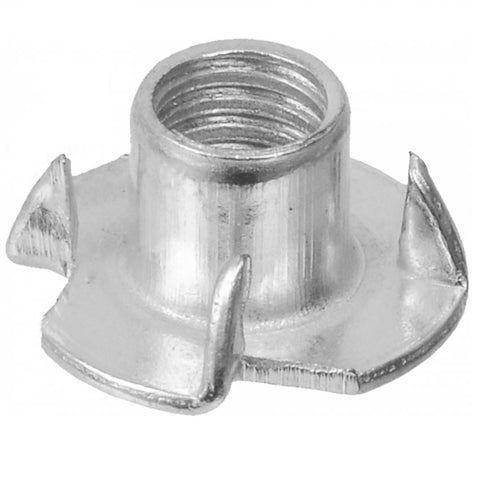
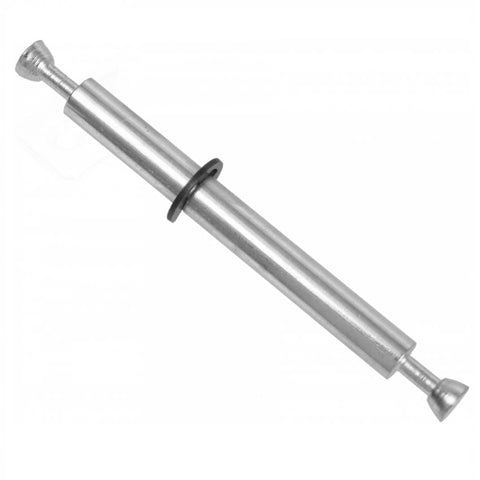
-
M6 threaded insert 5/16x1/2 inch - 100 pcsRegular price $4.08Unit price / perRegular priceSale price $4.08
-
M10 threaded insert - White 100 pcsRegular price $2.18Unit price / perRegular priceSale price $2.18
-
Threaded Insert M6 - 5/16 x 1/2 inch (8x13 mm) - 1 PcRegular price $0.10Unit price / perRegular priceSale price $0.10
-
Threaded Insert M10 - White - 1 PcRegular price $0.05Unit price / perRegular priceSale price $0.05
-
M6 threaded insert 5/16x1/2 inch - 1000 pcsRegular price $33.97Unit price / perRegular priceSale price $33.97
-
M6 threaded insert 3/8x1/2 inch - Zinc 1000 pcsRegular price $90.79Unit price / perRegular priceSale price $90.79
-
M6 threaded insert 3/8x1/2 inch - Zinc 100 pcsRegular price $10.90Unit price / perRegular priceSale price $10.90
-
M10 threaded insert - White 1000 pcsRegular price $18.22Unit price / perRegular priceSale price $18.22
-
M6 threaded insert 5/16x3/8 inch - 1000 pcsRegular price $73.37Unit price / perRegular priceSale price $73.37
-
Threaded Insert M6 - 5/16 x 3/8 inch (8x10 mm) - 1 PieceRegular price $0.18Unit price / perRegular priceSale price $0.18
-
Threaded Insert M6 - 3/8 x 1/2 inch (10x13 mm) - 1 PcRegular price $0.08Unit price / perRegular priceSale price $0.08
-
M6 threaded insert 5/16x3/8 inch - 100 pcsRegular price $8.81Unit price / perRegular priceSale price $8.81

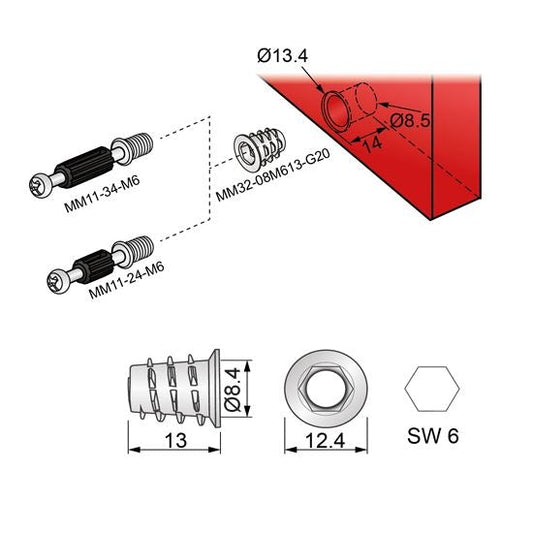


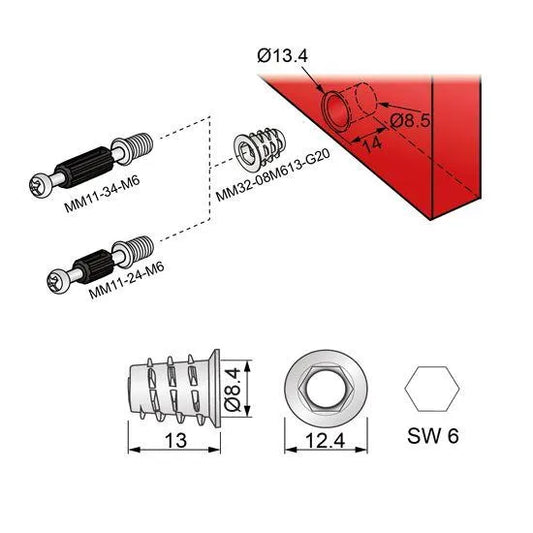

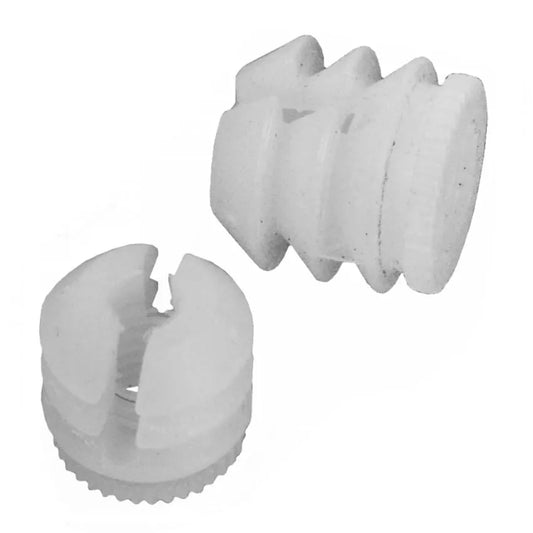

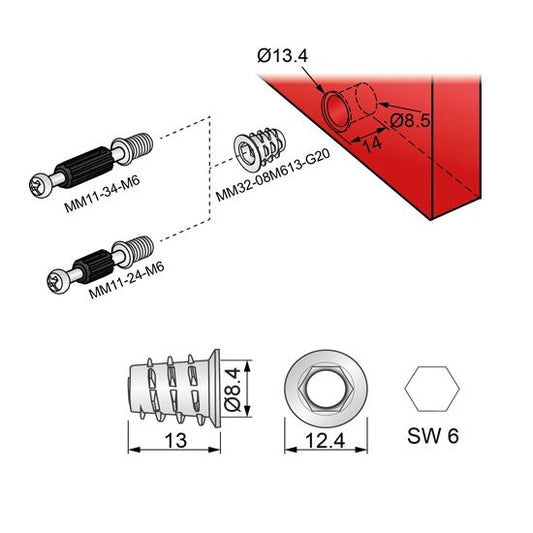

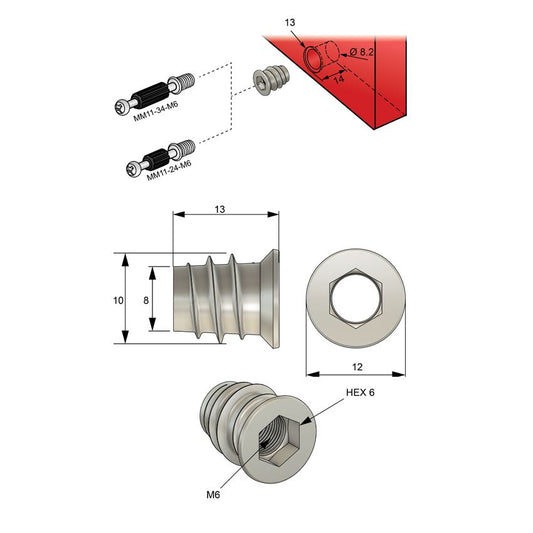

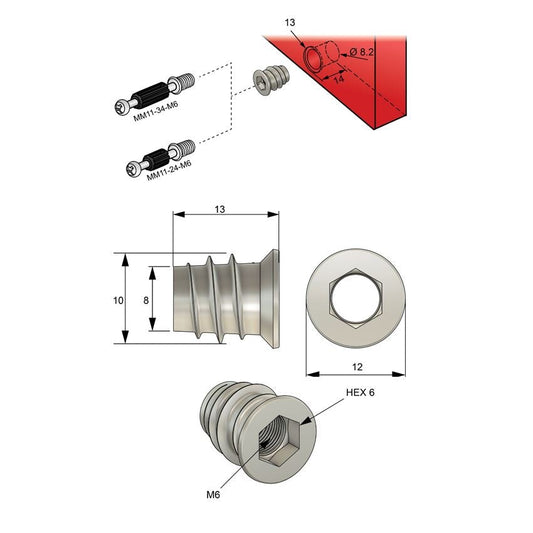

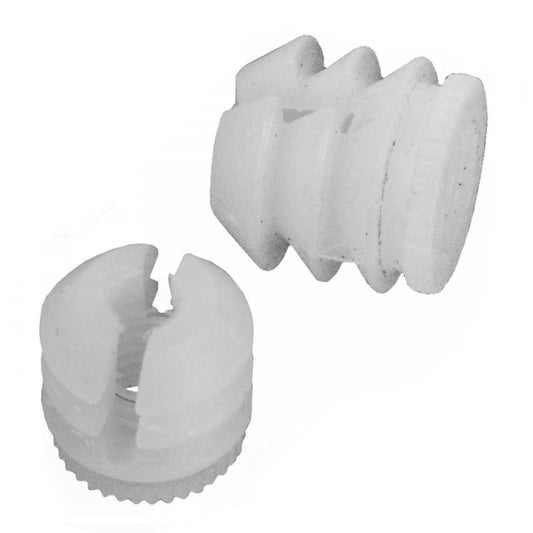

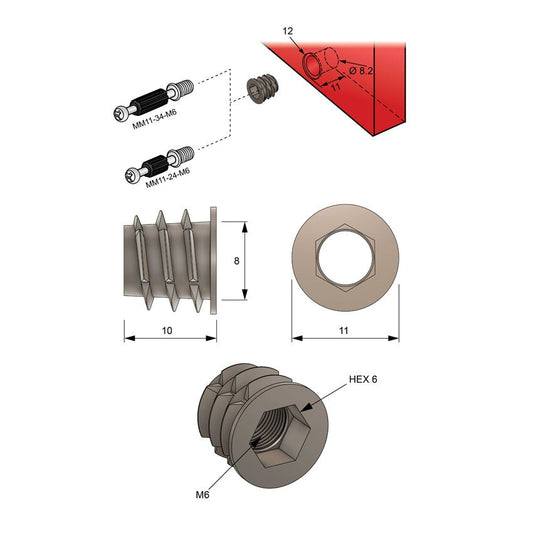


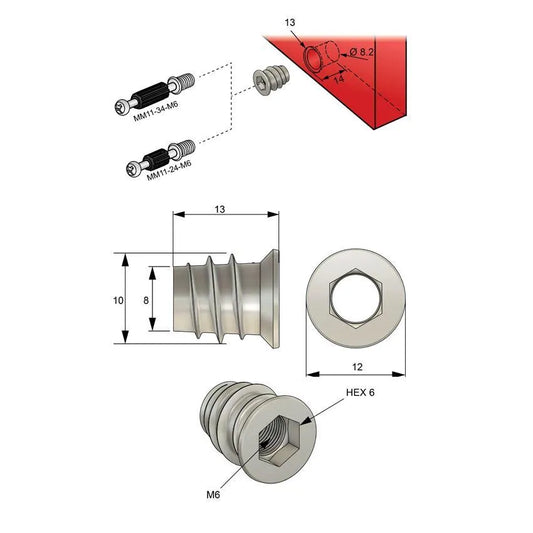

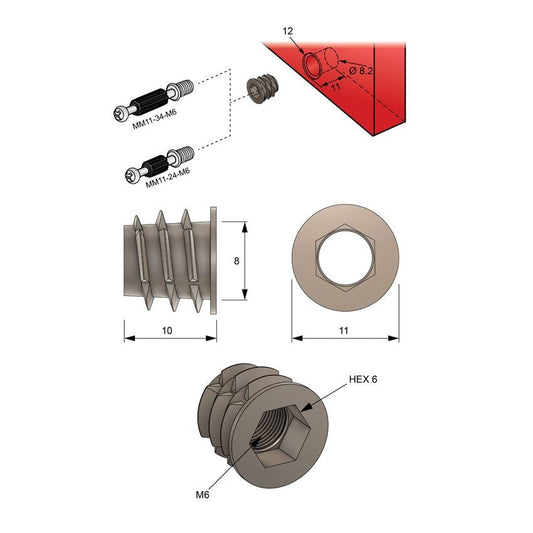
A threaded insert (often referred to as a insert nut, threaded sleeve, or threaded bushing) is a cylindrical fastener that is installed into softer base materials such as wood, particle board, MDF, or plastic to provide a high-load metric internal thread.
In professional cabinetmaking and plastics engineering, these components solve a fundamental mechanical issue: soft materials do not provide sufficient grip for machine screws. Under tensile load, the thread flanks would strip immediately. A threaded insert acts within the material like a deeply rooted foundation, distributing the concentrated pull force of a screw over a large surface area into the soft base material. This creates detachable, permanently load-bearing joints that maintain their holding power even after repeated assembly and disassembly.
Technical Designs and Materials
Choosing the exact insert depends on the base material, the required pull-out strength, and environmental conditions. Threaded inserts differ significantly in their external geometry, material, and anchoring method.
Plastic Threaded Inserts
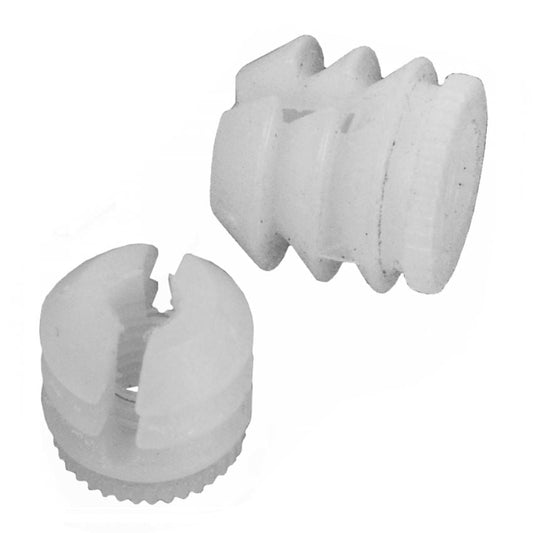
Aplastic threaded insert(typically made of polyamide/nylon) is primarily used where corrosion resistance, electrical insulation, or weight reduction is required. In furniture manufacturing, they often serve as sockets for leveling feet or light connectors. The outer structure is frequently featured with barbs or ridges that wedge into the borehole during driving or press-fitting.
For series production or prototyping, options like theThreaded Insert M10 - White - 100 pcs, or for high volume needs, theThreaded Insert M10 - White - 1000 pcs, are common standards. Thisplastic threaded sleeveis press-fitted into a precisely pre-drilled hole. When the metric screw is driven in, the plastic expands slightly, increasing the positive fit against the hole wall. For smaller assemblies, installers rely on theThreaded Insert M8 - White - 1 pcor stock up with theThreaded Insert M8 - White - 1000 pcs.
Threaded Inserts for Wood and Wood-Based Materials
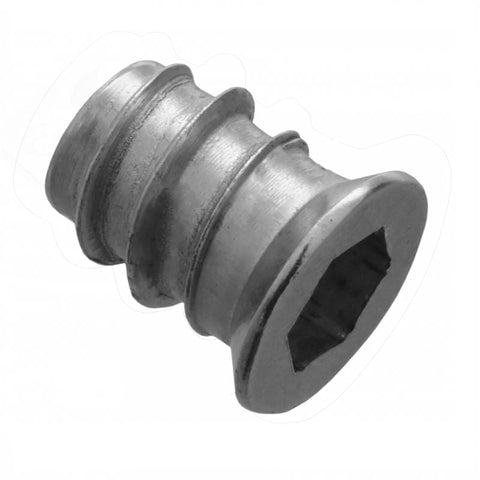
A classicwood threaded insert(frequently referred to as a knife thread insert or Rampa insert) is usually made of steel, brass, or die-cast zinc. It features a coarse, self-tapping external thread and a metric internal thread. When driven into softwood, hardwood, or particle board, the outer crests cut deep into the material, guaranteeing exceptionally high pull-out resistance.
Sizing is defined by the internal thread and external dimensions. AThreaded Insert M6 - 5/16 in x 3/8 in (8x10 mm) - 100 pcshas an M6 internal thread, an outer diameter of 5/16 in (8 mm), and a length of 3/8 in (10 mm). These compact dimensions are ideal for 19/32 in or 23/32 in (15 mm or 18 mm) thick particle board, preventing the insert from breaking through the rear face. For deeper anchoring in solid wood, choose a longer option like theThreaded Insert M6 - 5/16 in x 1/2 in (8x13 mm) - 100 pcsor theThreaded Insert M6 - 5/16 in x 1/2 in (8x13 mm) - 1000 pcs.
Threaded Inserts for Plastic and 3D Printing
When designers need to addthreads in plastic, standard thread-cutting screws quickly reach their limits.Metal threaded inserts for plasticare engineered specifically for thermoplastics. They feature external knurling (typically herringbone or diamond knurling).
Thesethreaded inserts for plasticare not screwed in, but thermally embedded (heat-set) or press-fitted via ultrasonics. The softened plastic flows into the undercuts of the knurling and hardens. This creates a permanent bond that withstands high torque forces. Especially in FDM 3D printing, the3D printing threaded insertis a standard solution for professionally fastening printed enclosures.
Metric Dimensions and Their Applications
The specification of athreaded insertstrictly follows the required ISO metric thread. Each size serves a specific application in furniture making and fixture construction.
M4: Delicate Hardware and Handles
M4 threaded insertsorM4 insert nutsare used with thin material thicknesses and lightweight components. Typical applications include mounting cabinet handles onto thin fronts where through-bolting is visually undesirable, or installing small hinges in plastic enclosures. AnM4 threaded sleeveusually requires a pilot hole diameter of just 3/16 in to 1/4 in (5 mm to 6 mm), minimizing material weakening.
M6: The Standard in Cabinet Construction
The M6 thread is the absolute backbone of furniture assembly. Nearly all cam lock connectors, bed fittings, and heavy hinge mounting plates rely on this size. AnM6 threaded insertoffers the ideal compromise between high tensile strength and moderate space requirements in wood.
The outer diameter should be chosen based on the density of the base material. For soft particle board, a larger outer diameter is recommended to grip more material, such as theThreaded Insert M6 - 13/32 in x 1/2 in (10x13 mm) - 100 pcsor as a single unitThreaded Insert M6 - 13/32 in x 1/2 in (10x13 mm) - 1 pc. For harder solid wood, a narrower core is sufficient, like theThreaded Insert M6 - 5/16 in x 3/8 in (8x10 mm) - 1 pcor in bulk as theThreaded Insert M6 - 5/16 in x 3/8 in (8x10 mm) - 1000 pcs.
M8 and M10: Heavy-Duty Applications and Furniture Feet
When high static or dynamic loads occur, anM8 threaded insertor M10 option is required. This applies especially to the undersides of cabinets, sofas, or heavy dressers where height-adjustable base feet, furniture casters, or leveling mounts are installed.
AnM8 to M6 threaded insert reduceris rarely manufactured as a single component in practice; usually, an M8 insert is anchored in the wood and adapted using a separate grub screw. For direct M10 installation in plastic or lightweight panels, press-in variants like theplastic threaded sleeveare ideal.
Proper Installation of Threaded Inserts
Correct installation determines final load capacity. An insert installed crooked or driven into an incorrectly sized pilot hole loses up to 70% of its mechanical strength.
1. Precise Pilot Drilling
The pilot hole diameter is the most critical parameter. It is determined by the root diameter of the threaded insert (the core dimension without the protruding thread flanks) and the hardness of the base material.
- Softwood / Particle Board:The pilot hole should be slightly smaller than the root diameter. The material yields and compresses during installation. For an insert with a 13/32 in (10 mm) outer diameter (e.g., theThreaded Insert M6 - 13/32 in x 1/2 in (10x13 mm) - 1000 pcs), a 21/64 in to 23/64 in (8.5 mm to 9.0 mm) drill bit is typically correct.
- Hardwood (Oak, Beech):Hardwood barely compresses. If pre-drilled too small, the wood will split during insertion. The drill bit diameter must match the root diameter exactly.
- Plastic:For a press-fitthreaded sleeve for plastic, the pilot hole must strictly meet manufacturer specifications, often within a tolerance of just 0.004 in (0.1 mm).
Additionally, slightly chamfer the rim of the pilot hole using a countersink bit (approx. 1/32 in (1 mm) deep at a 90° angle). This prevents the top layer (such as melamine veneer on particle board) from flaking during insertion.
2. Driving into Wood-Based Materials
Insert nuts usually feature an internal hex (Allen socket) or a continuous slot on the top surface.
- Tool Guidance:The insert must be started at an exact 90° angle to the surface. A drill press (unpowered) with a matching bit secured in the chuck is an excellent fixture for manually driving the insert perpendicular into the wood for the first few turns.
- Installation Depth:The insert should sit flush with the surface or ideally be countersunk 1/64 in to 3/64 in (0.5 mm to 1.0 mm) below the material edge. If the insert protrudes, the attached component will not sit flat, creating a leverage effect that can lead to failure.
3. Thermal Embedding in Plastic
When integratingthreaded inserts for plasticinto thermoplastic components (e.g., ABS, PETG, PC), heat-setting is used.
- Position theplastic threaded insert(typically brass) over the slightly tapered hole.
- Insert a soldering iron equipped with a heat-set installation tip into the internal thread.
- Set the temperature about 50 °F to 70 °F (10 °C to 20 °C) above the melting point of the plastic (approx. 390 °F (200 °C) for PLA, approx. 480 °F (250 °C) for ABS).
- Apply gentle vertical pressure to melt the surrounding plastic. The insert slides smoothly into the component.
- Once flush, remove the tool. The plastic solidifies in seconds, locking the knurling in place with a positive mechanical bond.
4. Press-Fitting Plastic Sleeves
Aplastic threaded insert M4or larger made entirely from plastic is cold-fitted. After pilot drilling, drive the insert—such as theThreaded Insert M6 - 5/16 in x 1/2 in (8x13 mm) - 1 pc—into the hole using a rubber mallet or arbor press. The longitudinal ribs prevent rotation when machine screws are driven in later.
Engineering Advantages in Cabinetmaking
Replacing direct wood screws with threaded inserts elevates furniture quality to industrial standards.
- Disassembly & Reassembly:A wardrobe with hinges fastened directly using 1/8 in (3.5 mm) wood screws can survive at most two moves before the screw holes strip out. With athreaded insert for woodinstalled instead, the M6 machine screw engages an indestructible metal thread. The furniture piece can be assembled and dismantled infinitely.
- Load Distribution:End-grain connections in MDF panels carry an extreme risk of splitting. A long threaded insert spreads the wedge effect of the fastener over a broader surface area, reducing localized stress.
- Tolerance Compensation:Threaded inserts allow the use of metric machine screws, which can be torqued precisely and consistently. This is essential in automated production to guarantee repeatable holding forces.
FAQ – Frequently Asked Questions About Threaded Inserts
How do I determine the correct drill bit size for an M6 threaded insert in wood?It depends on the insert's external diameter, not the M6 internal thread. Measure the root diameter of the insert (the central cylinder excluding the thread crests) with a caliper. In softwood, drill exactly to the root diameter or 1/64 in (0.5 mm) smaller. In hardwood, drill the root diameter plus 1/128 in (0.2 mm).
What is the difference between a screw-in insert nut and a press-in insert sleeve?A screw-in insert nut features a coarse external thread and cuts into the base material (wood) while rotating. A press-in insert sleeve (frequently aplastic threaded sleeve) features a knurled or barbed exterior and is pressed straight into the pilot hole using linear force.
Can stripped screw holes in wood be repaired using threaded inserts?Yes, this is one of the most common repair methods in woodworking. If a hinge screw strips out, drill out the damaged hole cleanly to 5/16 in or 3/8 in (8 mm or 10 mm). Then drive in a suitablewood threaded insert. The hinge mounting plate can then be reattached securely using a metric screw.
Which material is best: brass, steel, or plastic?Steel or zinc alloy provides the highest mechanical load capacity in wood. Brass is preferred forthreaded inserts for plastic(heat-setting) due to its superior thermal conductivity. Aplastic threaded insert(nylon) is ideal for humid environments (rustproof) and applications where weight must be minimized.
How do I prevent threaded inserts from driving in crooked?Use an installation aid. Thread a long machine screw (secured with a jam nut) into the insert. Clamp the shank of the screw into a drill press chuck. By turning the drill chuck manually, guide the insert down at an exact 90° angle into the workpiece.
Why is the melamine coating on my particle board chipping when driving the insert?The coarse external thread forces material upward and outward. To prevent chipping of the hard decorative laminate, always chamfer the rim of the pilot hole with a countersink bit. The chamfer should be slightly wider than the maximum outer diameter of the insert.
Frequently Asked Questions
Can I use these threaded inserts as replacements for stripped threads in IKEA furniture?
Yes, they are excellent replacements for IKEA furniture repairs (such as Pax or Kallax systems). Select the matching metric internal thread size (typically M4 or M6). Drill out the damaged hole cleanly and drive the new insert flush using an Allen wrench.
What pilot hole diameter do I need for an M6 threaded insert?
The required pilot hole size depends on the external thread and the wood material. For a standard M6 insert with a 13/32 in (10 mm) outer diameter, pre-drill with a 21/64 in to 23/64 in (8.5 mm to 9 mm) bit in softwood or particle board. For hardwood, we recommend exactly 3/8 in (9.5 mm) to prevent wood splitting.
Are screw-in insert nuts better suited for MDF or solid wood?
They are ideal for both materials, though they require different thread styles. For MDF and particle board in 32 mm system cabinetry, we recommend inserts with coarse, self-tapping external threads for maximum grip. For hardwood, choose variants with finer cutting threads. Always verify exact pilot hole specifications on the product data sheet.
How do I ensure the threaded insert is driven completely straight into wood?
Ideally, use an unpowered drill press equipped with a driving bit or hex key (Allen wrench). Align the insert at a strict 90-degree angle to the surface. Adding a small drop of wood glue to the external thread can provide extra holding power in soft particle board. Chamfering the hole edge makes square alignment much easier.
Are these insert bushings compatible with Hettich or Blum hinges?
Yes, our threaded inserts are fully compatible with Hettich and suitable for Blum hardware. To securely mount European cup hinges (1-3/8 in (35 mm) cup diameter) or mounting plates with M4 metric screws, simply press or screw the corresponding M4 inserts precisely into standard 32 mm hole patterns.