
Inset cabinet hinges
Popular Subcategories
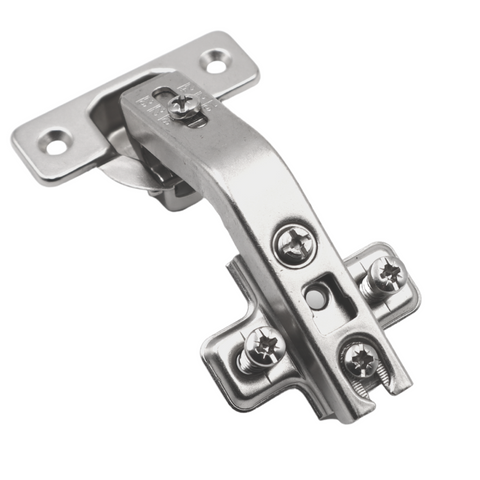
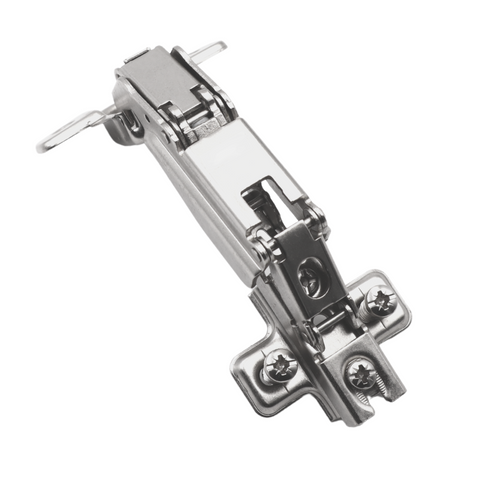
-
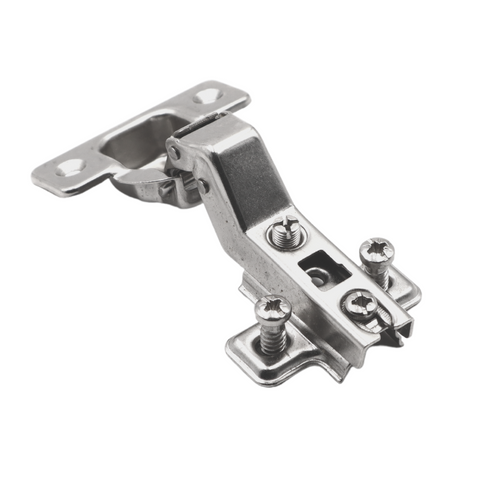
Soft-Close Hinge, H0 Mounting Plate with EURO Screws, Flush DoorsRegular price $1.33Unit price / perRegular priceSale price $1.33
-
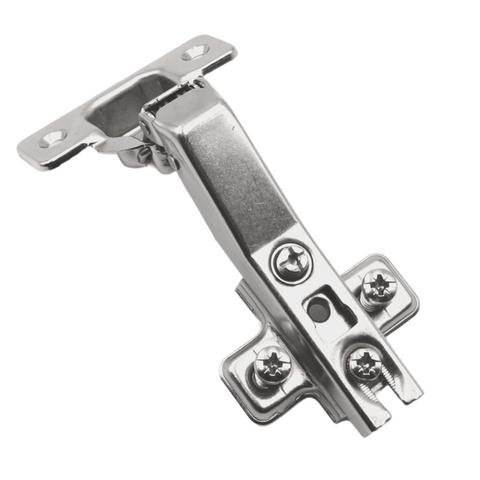
Hinge, H0 Mounting Plate with EURO Screws, Twin DoorsRegular price $0.68Unit price / perRegular priceSale price $0.68
-
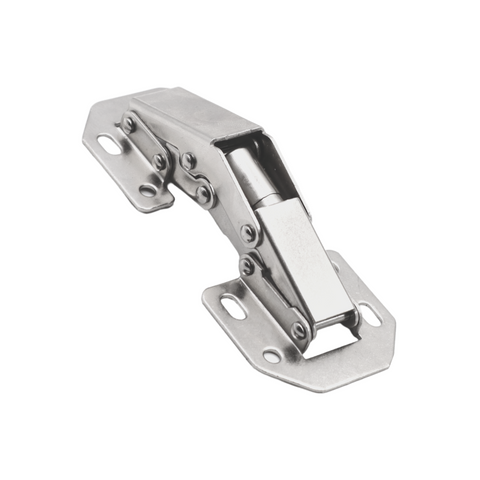
3D 110 Degree Soft-Close Cabinet Hinge, H0 Mounting Plate with EURO Screws, Inset ApplicationRegular price $2.18Unit price / perRegular priceSale price $2.18
-
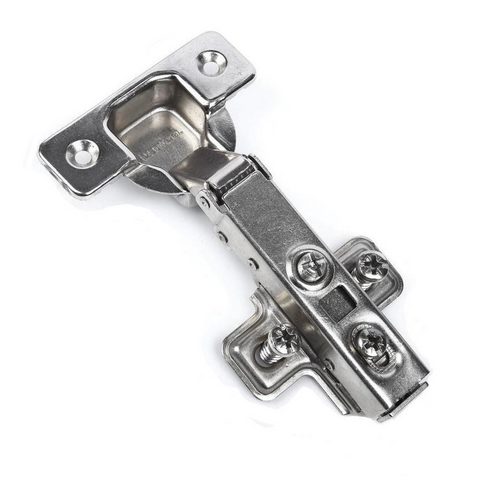
Hinge, H0 Mounting Plate with EURO Screws, Flush DoorsRegular price $0.67Unit price / perRegular priceSale price $0.67
-
Soft-Close Hinge, H0 Mounting Plate with EURO Screws, Twin DoorsRegular price $1.33Unit price / perRegular priceSale price $1.33

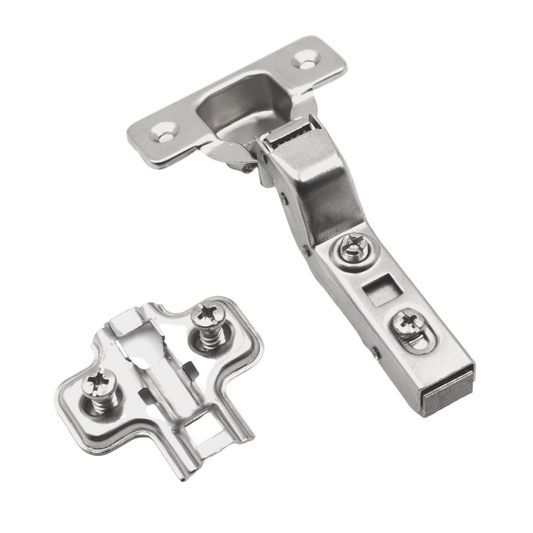

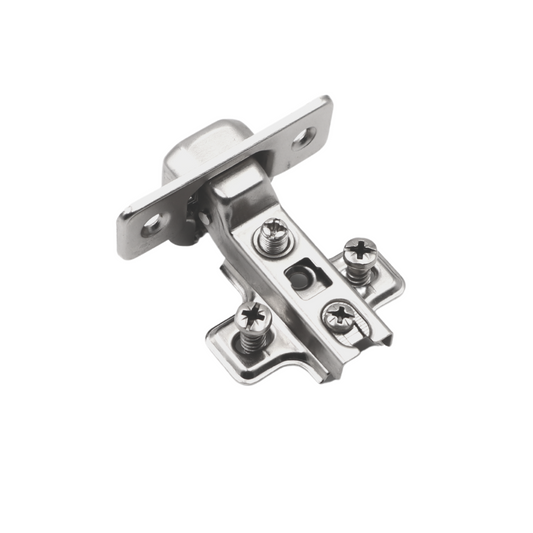

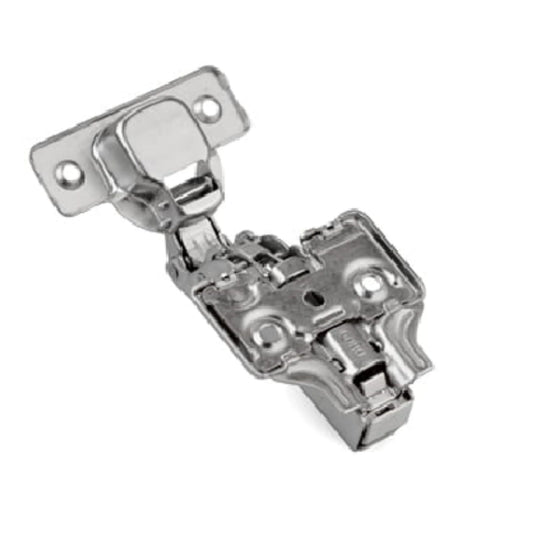

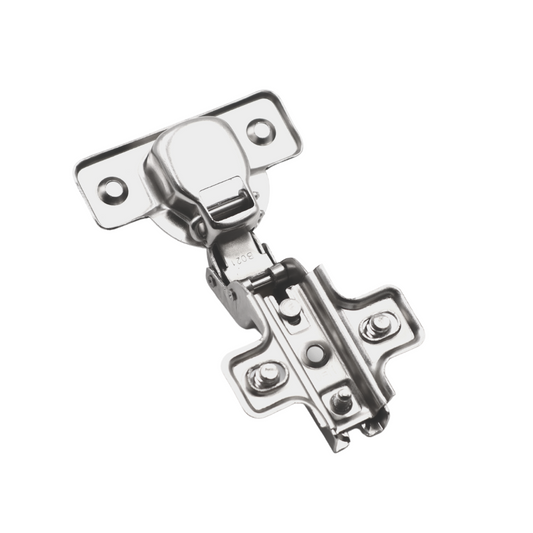

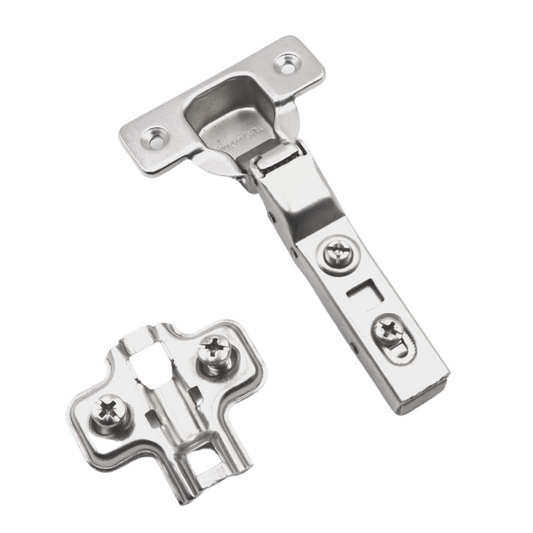
Inset cabinet hingesare full-crank, concealed furniture hinges designed exclusively for inset cabinet doors. With this specific mounting style, the door sits completely flush with the front edges of the cabinet carcass. This means the front edges of the side panels, bottom, and top panel remain fully visible when the door is closed. To mechanically enable this flush position inside the cabinet interior, these hinges feature maximum cranked offset on the hinge arm. Designing and installing inset doors requires precise calculations of reveal dimensions to ensure smooth, collision-free opening motion.
Technical Specifications and How They Work
Aninset hingediffers significantly in its geometry from standard overlay hinges. The articulation of an inset hinge works like a knee joint that retracts deep into the cabinet carcass to swing the door flush into the frame. The hinge arm is steeply curved (full-cranked) so the door does not bind against the inside of the cabinet side wall when opening.
Standard dimensions in the furniture industry for these fittings rely on precise norms. The hinge cup drilling—the recessed mortise in the cabinet door into which the hinge cup is inserted—typically has a diameter of1-3/8 in (35 mm). The depth of this cup hole is usually7/16 in–1/2 in (11.5 mm - 12.5 mm), depending on the door thickness, which ideally ranges between5/8 in–7/8 in (16 mm - 22 mm).
The opening angle defines how far the door can swing open. For standard inset applications, an angle of 110° is the most common solution, as found in the110-Degree Concealed Cabinet Hingescategory. This opening angle provides ample access to the cabinet interior without letting the opened door project too far into the room or block adjacent components.
Types of Inset Cabinet Hinges in Our Range
Depending on your requirements for smooth operation and adjustability, several models are available. Selecting the right mechanism significantly impacts the feel and tactile quality of the finished piece of furniture.
Concealed Hinges with Soft-Close
For silent, gentle closing,soft-close concealed hingesare the go-to choice. A hydraulic cylinder is integrated directly into the hinge cup or hinge arm. When the door is closed, this damper absorbs the kinetic energy and gently pulls the door shut over the last few inches. A classic example of this technology is the110° Soft-Close Inset Cabinet Hinge, H0 Mounting Plate with EURO Screws. Additional models of this design can be found in the overview forSoft-Close Concealed Cabinet Hinges.Important technical note:Soft-close mechanisms must not be confused with touch-latch or push-to-open systems. A soft-close hinge pulls the door shut, whereas handleless push-to-open systems require a spring mechanism to push the door open. These two systems work against each other and cannot be combined in the same hinge.
Un-Damped / Standard Concealed Hinges
For projects utilizing external door dampers or where soft-closing is not desired (for instance, workshop cabinets or small, lightweight drop-down flaps), self-closing un-damped variants are used. A dependable base model is the110° Inset Cabinet Hinge, H0 Mounting Plate with EURO Screws. It provides the same mechanical stability and load capacity but closes at standard speed via an integrated spring mechanism.
Hinges with 3D Adjustment and Cover Caps
For cabinetmakers and installers who demand the highest standards for perfect reveal alignment, hinges with integrated cam adjustment are ideal. The3D 110° Soft-Close Inset Cabinet Hinge, H0 Mounting Plate with EURO Screwsallows continuous, independent adjustment of the door in height, depth, and side-to-side alignment without loosening the mounting screws on the baseplate. For a clean, streamlined look inside the cabinet, models like theSoft-Close Inset Hinge, H0 Baseplate with EURO Screws and Cover Capsconceal the adjustment screws on the hinge arm under sleek metal caps.
Types of Concealed Hinges: Understanding Door Overlay Styles
Selecting the correct hinge stands and falls with the planned door position relative to the cabinet side panel. The three main types ofconcealed cabinet hingesdiffer primarily in the cranked offset of the hinge arm. Using the wrong hinge type will make it impossible to mount or open the door correctly.
- Inset (Full Crank):The door sits completely inside the cabinet frame. The front edge of the side panel remains visible. The hinge arm features a pronounced upward curve. This style is widely searched under terms likeinset cabinet hingesor in the Inset Cabinet Hinges category.
- Full Overlay / Straight Arm (Uncranked):The door rests entirely in front of the side panel, concealing its front edge almost completely. The hinge arm is straight. This is the standard choice for most freestanding cabinets. SeeFull Overlay Cabinet Hinges.
- Half Overlay / Dual (Half Crank):Two doors share a single central partition wall (twin doors). Each door covers only half of the partition wall edge (typically about1/4 in - 5/16 in (7 mm - 8 mm)overlay per door). The hinge arm features a slight curve. An example of this is the110° Soft-Close Half Overlay Cabinet Hinge, H0 Mounting Plate with EURO Screws. For a full overview, visit theHalf Overlay Cabinet Hingescategory.
Installing and Adjusting Inset Cabinet Hinges
When you installinset cabinet hinges, absolute precision is required. Because the door rests inside the cabinet opening, the reveal gaps leave no room for error. The perimeter gap between the door edge and the inner cabinet frame must be completely uniform (typically1/16 in–1/8 in (2 mm - 3 mm)) to prevent binding during swing-out.
1. Drilling the Hinge Cup Hole
To drill holes forinset cabinet hinges, a suitable Forstner bit is essential. The industry standard for cup diameter is1-3/8 in (35 mm). Corresponding fittings can be found in our35mm Concealed Hingescollection. The critical factor is thecup distance(the measurement from the door edge to the rim of the 35 mm hole). For inset doors, this distance is usually between1/8 in–3/16 in (3 mm - 5 mm). Aconcealed hinge drilling jigis an indispensable tool here to repeatedly mark the edge distance and exact position of the screw pilot holes (typically spaced1-3/4 in (45 mm)or2-1/16 in (52 mm)apart).
2. Positioning the Mounting Plate
The mounting plate (baseplate) is attached to the inside face of the cabinet side wall. In professional cabinetry, the standard method is theSystem 32hole pattern (line boring with1-1/4 in (32 mm)hole spacing and a standard setback of1-7/16 in (37 mm)from the front edge). However, for an inset application, the door thickness plus the desired front gap must be added to the standard 37 mm setback.Example:For a door thickness of3/4 in (19 mm)and an inset gap (recess) of1/16 in (2 mm), the baseplate is positioned at2-9/32 in (58 mm)(37 + 19 + 2) from the front cabinet edge instead of 37 mm. The includedEURO screws(typically with a diameter of3/16 in (5 mm)) thread directly into pre-drilled 5 mm line-boring holes, delivering exceptionally high pull-out strength.
3. Aligning the Gaps (3D Adjustment)
Once the hinge arm is clipped or slid onto the mounting plate (H0 designates a0 in (0 mm)plate height/rise), perform fine adjustment using the integrated cams:
- Depth Adjustment:The rear screw on the hinge arm regulates the distance between the door face and the front edge of the cabinet frame. This ensures the door sits perfectly flush.
- Side-to-Side Adjustment:The front screw on the hinge arm shifts the door left or right, allowing you to align vertical reveals parallel with the cabinet sides.
- Height Adjustment:Loosening the mounting screws on the baseplate (or using an eccentric cam built into the plate) allows vertical door positioning, typically by± 1/16 in (± 2 mm).
Frequently Asked Questions (FAQ) About Inset Hinge Installations
What is the exact difference between full overlay and inset cabinet hinges?Full overlay hinges allow the door to sit in front of the cabinet carcass, concealing the front edges of the side walls. With inset hinges, the door sits entirely inside the cabinet frame, leaving the front edges of the cabinet walls visible. Consequently, the arm of an inset hinge features a pronounced upward curve (full crank).
Which drill bit size do I need for concealed cabinet hinges?For the main cup mortise in the door, you need a1-3/8 in (35 mm)Forstner bit. To install the mounting plate with Euro screws inside the cabinet carcass, use a3/16 in (5 mm)wood drill bit.
Why is my inset door rubbing against the cabinet side wall when opening?This happens if the side reveal gap is set too tight or if the hinge cup edge distance was drilled incorrectly. Use the side-adjustment screw on the hinge arm to move the door slightly away from the side wall. Also verify that your door thickness is within range for a 110° opening angle (max. approx.7/8 in (22 mm); thicker doors require specialized wide-angle or thick-door hinges).
Can I use an inset cabinet hinge for a shared center partition?No. When two doors are attached to a single shared middle panel, you must use half overlay hinges (half cranked). An inset hinge would pull the door too far into the center of the opening, leaving no room for a second door on the same wall.
Is a concealed hinge drilling jig necessary?For DIYers and professional installers alike, a drilling template or jig is highly recommended. It guarantees that the distance from the door edge to the cup hole is maintained with high precision and that pilot holes are bored at a perfect 90° angle. A discrepancy of even1/32 in (1 mm)can cause an inset door to bind or fail to open smoothly.
Related Categories and Complementary Hardware
To successfully complete your furniture project or achieve specific opening angles, explore additional specialized hardware in our store. Discover our complete range of mounting solutions in the mainConcealed Cabinet Hingescategory.
If you require hinges for special corner applications, angled cabinets, or wide-angle openings, we offer the following technical configurations:
- 30-Degree Concealed Cabinet Hinges
- 45-Degree Concealed Cabinet Hinges
- 90-Degree Concealed Cabinet Hinges
- 135-Degree Concealed Cabinet Hinges
- 155-Degree Concealed Cabinet Hinges
- 165-Degree Concealed Cabinet Hinges
Choosing the exact matching hinge defines the durability and flawless motion of your cabinetry. Always ensure cup diameter, crank offset, and the corresponding mounting plate are correctly coordinated during planning.