
Barrel Nuts and Bolts
Popular Subcategories
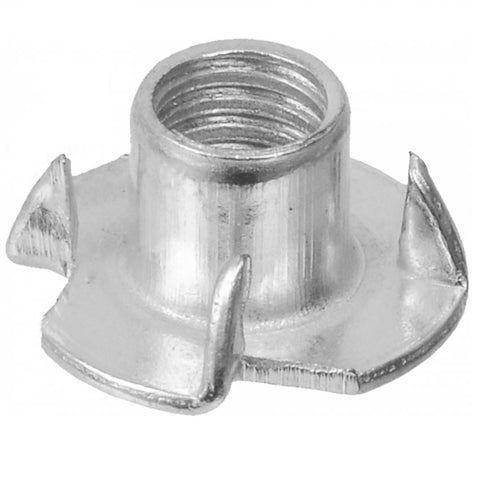
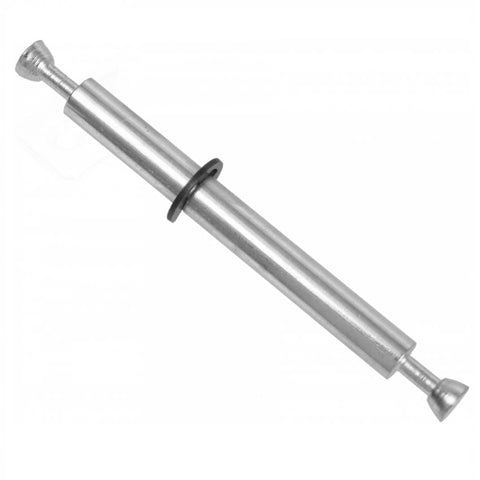
-
Ø8 Screw FasteningRegular price $0.13Unit price / perRegular priceSale price $0.13
-
Ø6 Screw FasteningRegular price $0.08Unit price / perRegular priceSale price $0.08

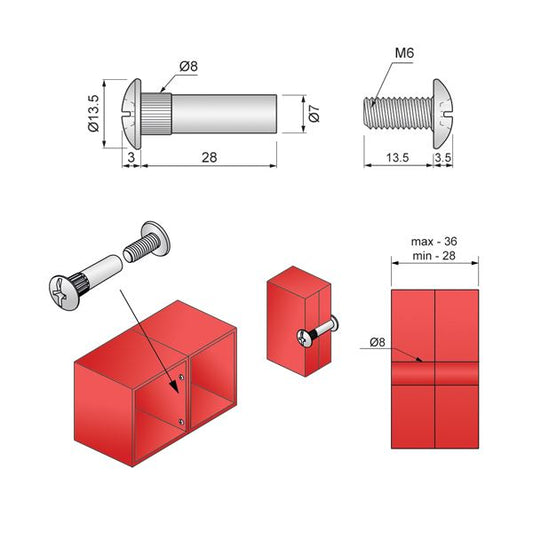

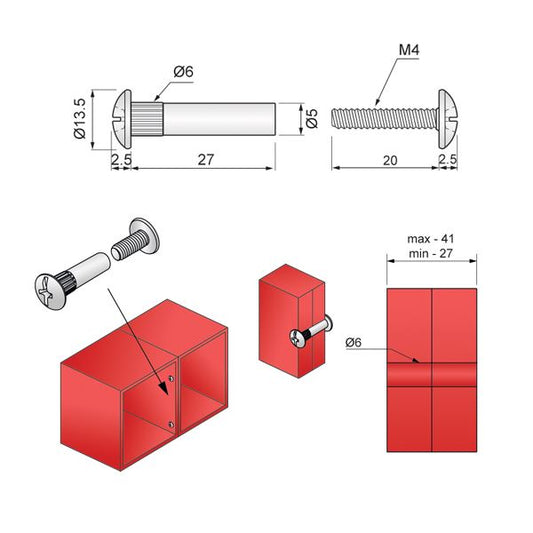
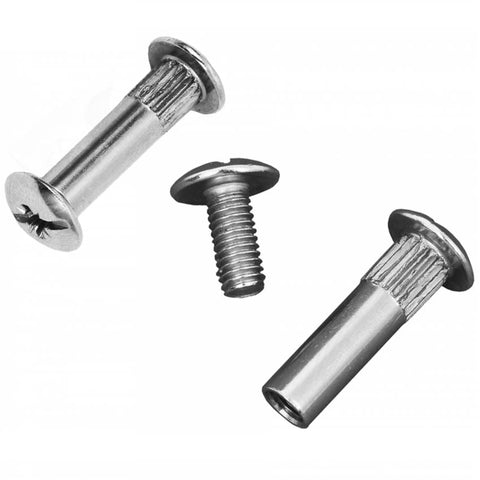
Barrel nuts and boltsare two-part connecting fasteners consisting of a pan head machine screw and a matching internally threaded sleeve. Inserted through a clearance hole from opposite sides and threaded together, this construction creates a double-sided, positive surface clamping force that joins components with rigid torsional stability. In professional cabinet making, furniture assembly, and interior architectural millwork,barrel nuts and boltsserve as the ultimate technical standard for high-tensile connection of cabinet carcasses, filler strips, and door hardware.
The Mechanics of Sleeve Bolts and Connecting Screws
The mechanical principle behindbarrel nuts and boltsdiffers fundamentally from traditional wood screws. While a standard particle board screw cuts its thread directly into the substrate (chipboard, MDF, solid wood) and relies entirely on shear friction within the wood fibers, aconnecting screw with sleevefunctions independently of the panel material's tear-out resistance.
Acting like a portable vice, the low-profile heads of both the bolt and sleeve clamp the workpieces firmly together across their entire surface area. The thread engages exclusively within the internal machine thread of the metal sleeve. This offers major technical advantages:
- Repeatable Demountability:The connection can be tightened and loosened infinitely without stripping the substrate material or sacrificing clamping force.
- High Tensile Strength:Metric ISO machine threads allow significantly higher tightening torque than coarse wood threads.
- Hole Coverage:The wide, low-profile heads (typically measuring 3/8 in to 19/32 in (10 mm to 15 mm) in diameter) neatly conceal any chipping at the edges of the clearance hole.
Technical Specifications and Thread Sizes
Selecting the rightbarrel nuts and boltsdepends strictly on required tensile loads, total material thickness (grip range), and available installation space. Sizing designations (e.g., M4, M6) always refer to the internal ISO metric thread size inside the threaded sleeve, not the sleeve's outer barrel diameter.
M3 and M4 Barrel Nuts and Bolts: Precision for Door Hardware and Thin Panels
SizesM3andM4are the universal standard for architectural door hardware and rosette handles. When installing lever handles, escutcheon plates, or rose trim, these fine threads are almost exclusively used. AnM3 barrel nut and boltor anM4 barrel nut and bolttypically features a sleeve outer diameter of 5/32 in to 3/16 in (4 mm to 5 mm). Designed to fit standard door thickness ranges from 1-17/32 in to 1-25/32 in (39 mm to 45 mm), their grip range is precisely tuned to these dimensions. These mini barrel sleeves are often slotted or Phillips-driven for rapid manual installation.
M5 and M6 Barrel Nuts and Bolts: The Industry Standard for Cabinet Joining
In commercial cabinetry and fine woodworking,M5 barrel nuts and boltsand M6 variants are the benchmark for joining cabinet carcasses side by side. When installing kitchen base units or tall wardrobes flush with one another, professional installers reach for these dimensions. Sleeves in this class typically feature a 5/16 in (8 mm) outer barrel diameter. Standard carcass joining—such as clamping two 23/32 in or 3/4 in (18 mm or 19 mm) side panels—requires a grip range of 1-27/32 in to 1-9/16 in (36 mm to 40 mm). For these applications,M6 barrel nuts and boltsare ideal. They provide massive tensile force to keep heavy cabinet walls tight without gaps over time. The forgiving metric tolerance ofM6 barrel nuts and boltsalso compensates for minor alignment errors during installation.
M8 Barrel Nuts and Bolts: Heavy-Duty and Thick Structural Assemblies
For extreme load-bearing applications, such as thick butcher block countertops, heavy workbenches, or stage platforms, the heavy-dutyM8 barrel nut and boltis required. The outer diameter of these massive sleeves is typically 25/64 in (10 mm). The force transfer capability here is tremendous. If you are joining structural frameworks made of heavy plywood or solid lumber, choosingM8 barrel nuts and boltsis the technically correct path. The wide head design ofM8 barrel nuts and boltsspreads clamping pressure across a broad area, preventing indentation into softwoods.
Understanding Grip Range: Calculating Exact Component Lengths
A critical factor when specifyingsleeve bolts and barrel nutsis the clamping range (usable length). This defines the minimum and maximum material thickness that a specific screw-and-sleeve set can securely join.
The sleeve contains an internal thread that usually does not run all the way to the head, but stops at a defined depth. The machine screw threads into this barrel. For example: if you want to join two panels that are each 3/4 in (19 mm) thick, your total material thickness is 1-1/2 in (38 mm). A set ofbarrel bolts and nutsrated for a grip range of "1-1/4 in to 1-21/32 in (32 mm to 42 mm)" fits perfectly. If you choose a bolt that is too long, the screw will bottom out inside the blind threaded sleeve before the heads seat flush on the wood, leaving a loose connection. If you choose a bolt that is too short, only a few thread turns will engage, severely compromising shear resistance and risking thread stripping under load.
Materials and Decorative Finishes
Becausebarrel nuts and boltsoften remain visible on cabinet interiors, furniture exteriors, or door hardware, aesthetic finish and corrosion resistance are just as important as tensile strength.
- Nickel-Plated Steel:The absolute industry standard in cabinetry. Nickel plating protects carbon steel against oxidation while delivering a bright, neutral silver finish that matches standard hinges and shelf supports. It is the most common finish forM6 barrel nuts and boltsinside cabinets.
- Brass Threaded Sleeves & Bolts:Solid brass or brass-plated steel is frequently specified for antique restoration, fine furniture making, or to match traditional brass door handles.
- Stainless Steel Barrel Nuts and Bolts:For wet locations (bathroom vanity units), outdoor furniture, or commercial interior fit-outs (laboratory furniture), stainless steel (304 / 316 grade) is mandatory. Heavy-dutyM8 barrel nuts and boltsmade of stainless steel offer maximum long-term durability in harsh environments.
- Black Oxide / Black Zinc:Designed for modern loft aesthetics and industrial-style furniture, black coated fasteners create an attractive contrast against light woods such as white oak.
Professional Installation: Step-by-Step Guide
Installingsleeve bolts and connecting barrel nutsrequires precise drilling. Because the sleeve barrel must fit snugly inside the bore hole to resist shear forces, selecting the correct drill bit diameter is essential.
1. Choosing the Right Tool and Hole Diameter
The drill bit size must match the outer sleeve barrel diameter exactly—not the internal thread size!
- For anM4 barrel nut and bolt(barrel OD typically 13/64 in (5 mm)), always use a 13/64 in (5 mm) drill bit.
- ForM6 barrel nuts and bolts(barrel OD typically 5/16 in (8 mm)), use a 5/16 in (8 mm) drill bit.
- ForM8 barrel nuts and bolts(barrel OD typically 25/64 in (10 mm)), use a 25/64 in (10 mm) drill bit.
Use only sharpbrad point wood drill bitswith spurs. Standard twist metal bits will cause tear-out on delicate melamine coatings or veneered surfaces.
2. Drilling the Clearance Hole
Clamp the two carcass panels firmly together using F-clamps so they sit perfectly flush. Place a scrap piece of hardwood or particle board tightly against the drill bit exit side. Drill through both panels at a true 90° angle directly into the scrap backing block. The backing piece prevents tear-out on the rear face when the tip of the bit breaks through.
3. Inserting and Tightening the Assembly
Push the sleeve barrel into the hole from one side. It should slide smoothly with light pressure, without requiring force. Insert the bolt from the opposite side. Pay attention to drive types: use the exact driver bit required. Never mix up aPZ2 (Pozidriv)bit with aPH2 (Phillips)bit, as driver slipping under torque will strip the head. Hex socket (Allen) orTorx (TX)drives offer superior torque transfer, which is especially important for larger dimensions likeM8 barrel nuts and bolts. Tighten firm by hand. When using a cordless screwdriver, set the clutch low to avoid over-torqueing the metric threads.
Avoiding Common Installation Mistakes
Even with simple hardware likebarrel nuts and bolts, minor mistakes can compromise structural stability.
- Incorrect Bore Diameter:Drilling a hole just 3/64 in (1 mm) too large (e.g., 23/64 in (9 mm) instead of 5/16 in (8 mm) forM6 barrel nuts and bolts) causes radial slop. The sleeve cannot support shear loads, allowing the screw to bend and panels to slip out of alignment over time.
- Spinning Barrel Sleeve:If thread friction is high, the sleeve may spin inside the hole before the joint fully clamps down. Solution: Most sleeve heads feature a screwdriver slot or cross-recess. Counter-hold the sleeve head with a second screwdriver while driving the screw from the other side.
- Excessive Torque:On smaller sizes like anM3 barrel nut and bolt, over-tightening can easily strip small metric threads. Torque should be applied carefully by hand.
Specific Application Fields in Detail
Cabinet Making and Custom Joinery
Standard32mm system cabinet drillingutilizes a uniform hole diameter of 13/64 in (5 mm). When connecting modular cabinets using pre-drilled shelf pin holes, specializedconnecting screws with sleevesare used where the sleeve barrel measures exactly 13/64 in (5 mm) (typically featuring an M4 thread). For custom carcass connections placed outside existing hole grids, trade professionals rely on heavy-dutyM6 barrel nuts and boltswith a 5/16 in (8 mm) barrel diameter.
Interior Door Hardware and Escutcheons
When installing interior door handles, hardware kits rely heavily on sleeve bolt sets. Because standard wood screws cannot grab securely in hollow-core or tubular chipboard doors,barrel sleeve boltsbridge the internal void, tightly clamping the rosettes or backplates to both exterior faces of the door panel. For door hardware,M4 barrel nuts and boltsare the universal industry norm.
Signage and Architectural Glass Mounting
When mounting acrylic corporate signs or glass panels, polished low-profilebarrel nuts and capsare used. In these visual applications, hardware serves as a decorative feature. Soft rubber or nylon protective washers must be inserted between the metal sleeve head and the glass to prevent tension cracking.
---
Frequently Asked Questions (FAQ) About Barrel Nuts and Bolts
What is the difference between a barrel nut and bolt and a standard cabinet screw?
A standard wood or cabinet assembly screw (such as a Confirmat screw) cuts its threads directly into the wood panel. Abarrel nut and boltconsists of two separate metal parts (a threaded sleeve nut and a machine bolt) that pass completely through a drilled clearance hole to thread into each other. It clamps the wood between two solid metal heads, providing far superior tensile strength and unlimited reusability.
What drill bit size do I need for an M4 barrel nut and bolt?
That depends on the outer diameter of the sleeve barrel. The callout "M4" refers only to the internal machine thread. Most M4 sleeve barrels have an outer diameter of 13/64 in (5 mm). In that case, you need a 13/64 in (5 mm) brad point wood bit. Always verify the sleeve barrel outer diameter using a caliper before drilling.
How do I measure the required length for connecting sleeve bolts?
Add together the total thickness of the two workpieces you are joining. For example, if you are joining two 3/4 in (19 mm) particle board side walls, your total thickness is 1-1/2 in (38 mm). Look forbarrel nuts and boltsspecified for a grip range that covers this total thickness (e.g., grip range 1-3/8 in to 1-3/4 in (35 mm to 45 mm)).
Can I shorten a sleeve bolt or the threaded sleeve itself?
The bolt can technically be cut down using a hacksaw, provided you clean the lead thread with a file afterward so it threads smoothly into the sleeve. However, you should never shorten the threaded sleeve itself, as this removes critical internal thread engagement depth. Always choose the correct grip range from the start.
What should I do if the sleeve spins while I tighten the bolt?
Most sleeve heads feature a drive recess (slotted, Phillips, or Pozidriv). Insert a matching screwdriver into the sleeve head on one side to counter-hold it firmly while tightening the bolt from the opposite side.
Are M8 barrel nuts and bolts suitable for standard cabinet assembly?
For standard kitchen or closet cabinets, M8 hardware is oversized;M6 barrel nuts and boltsare plenty strong. Heavy-dutyM8 barrel nuts and boltsare designed for massive timber framing, thick butcher block countertops, heavy workbenches, or stair building where intense shear and tensile loads occur.
Are stainless steel barrel nuts and bolts available for outdoor use?
Yes. For outdoor furniture, marine applications, or high-humidity environments, you must usestainless steel barrel nuts and bolts(304 / 316 grade). Standard nickel-plated carbon steel will eventually corrode when exposed to persistent moisture.
Frequently Asked Questions
Which barrel nuts and bolts do I need to connect two cabinets together?
You need barrel nuts and bolts with a grip range matching your total combined panel thickness (e.g., 1-1/4 in to 1-7/16 in (32 mm to 36 mm) for two 23/32 in (18 mm) panels). Our M4 barrel nuts and bolts fit standard cabinet systems like IKEA Pax or Faktum. Make sure to use a 13/64 in (5 mm) drill bit (32mm system grid) for a stable, flush fit.
What drill bit diameter do I need to install barrel nuts and bolts?
Standard hole drilling requires 13/64 in (5 mm) for M4 metric threads or 5/16 in (8 mm) for M6 metric threads. This matches the common 32mm system hole pattern used in cabinet manufacturing. If replacing existing hardware in custom cabinets, measure your bore hole precisely to prevent chipboard tear-out.
What does grip range mean for barrel nuts and bolts and how do I measure it?
Grip range specifies the minimum and maximum total material thickness that can be clamped securely. Measure both cabinet panels together (e.g., 5/8 in + 5/8 in = 1-1/4 in (16 mm + 16 mm = 32 mm)). Choose a hardware set rated for a range of 1-7/32 in to 1-37/64 in (31 mm to 40 mm). The internal thread of the sleeve allows stepless adjustment within that range.
Are these connecting bolts suitable as replacements for lost kitchen cabinet hardware?
Yes, they are ideal direct replacements for European and domestic cabinet systems as long as the technical dimensions match. Check your required thread size (typically M4) and overall grip length. Our truss head and pan head barrel nuts cleanly cover clearance holes and provide high mechanical tensile strength for cabinet carcasses.
Should I choose flat head countersunk or low-profile pan head barrel nuts and bolts?
Choose low-profile pan or truss head bolts for standard straight-drilled clearance holes (such as 32mm hole lines), as the flat underside seats directly on the panel surface to cover rough hole edges. Countersunk barrel nuts require a pre-beveled countersink hole in the wood for a flush surface finish. Both styles are compatible with major cabinet hardware lines.