
Designer Wohnwand
-
Wall Unit CLIF - Living Room Furniture Set - San Remo Oak / Anthracite GreyRegular price $529.99Unit price / perRegular priceSale price $529.99
-
Wall Unit VISTE - Living Room Furniture Set - Scandi / Truffle / White GlossRegular price $719.99Unit price / perRegular priceSale price $719.99

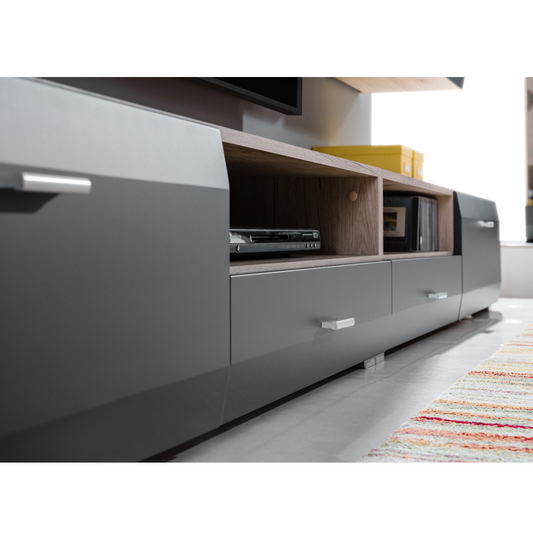

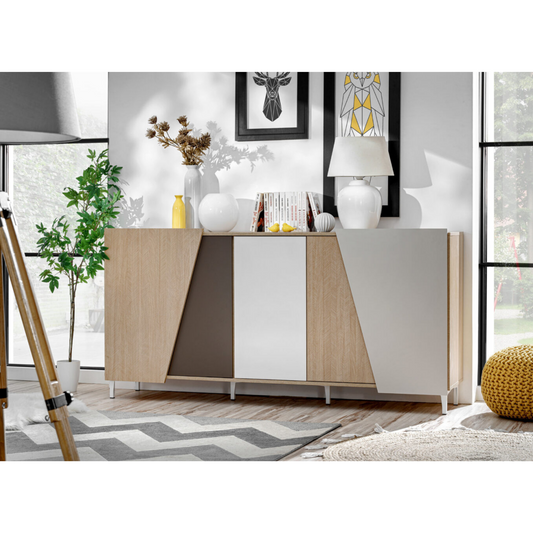
A designer wall unit is a multi-piece living room furniture set designed primarily as a media center and storage solution, featuring a sleek, cohesive design language.
The traditionalwall unithas evolved from a massive, bulky cabinet into a flexible modular system. For DIYers, this means maximum versatility in room planning, though it also requires precision during assembly and mounting. A modern designer wall unit typically consists of a TV console, hanging or floor-standing display cabinets, wall shelves, and closed storage cabinets.
Structure and Construction Types
Modernwall unitsare built on a modular system. This simplifies transport and assembly, as the furniture is delivered in manageable packages that can be built step-by-step.
Floor-Standing vs. Wall-Mounted Modules
When designing your layout, you can choose between floor-standing and wall-mounted units.
- Floor-standing modules:These rest on furniture feet or a solid plinth base. Height-adjustable leveling feet (often featuring anM8thread) compensate for uneven floors up to 5/8 in (15 mm).
- Wall-mounted modules:A floating orwall-mounted wall unitcreates a lightweight, airy look and makes cleaning the floor underneath effortless. Installation requires a solid load-bearing wall (masonry or concrete) and heavy-duty wall anchors.
Combining both systems is typical for amodern wall unitsetup. The TV console often rests on the floor, while glass cabinets and shelves are arranged asymmetrically on the wall above.
Materials and Finishes
The durability and visual appeal of a designer wall unit depend heavily on the core substrates and surface coatings used.
Core Substrates
- Particleboard (Chipboard):The standard substrate in cabinet making. Wood chips are compressed with resin binders under heat and high pressure. Wall units typically utilize panels with a thickness of 5/8 in (16 mm) or 3/4 in (18 mm).
- MDF (Medium-Density Fiberboard):Finer and denser than particleboard. MDF is ideal for routed front panels, decorative profiles, or as a smooth base for high-gloss foils and lacquers.
Finishes and Coatings
The exterior surface defines the aesthetic. A durablemelamine resin coatingmakes surfaces scratch-resistant and water-repellent. High-end wall units often combine contrasting textures. A popular example showcasing matte and glossy contrast is theFUNNY PLUS Entertainment Center - White Matte / White Gloss. If you prefer darker tones, aMatte Black Wall Unitabsorbs light and adds a sophisticated tone.
Woodgrain finishes, such as those on aSonoma Oak Wall Unit, use synchronized embossing (embossed-in-register) to recreate the tactile feel of real wood. Metalic accents offer a luxurious touch, as seen on theFAME Entertainment Center - Black / Gold.
Planning and Measuring Your Room
Thorough planning is crucial—inaccurate measurements can throw off the alignment of the entire unit. Measure your available space precisely before choosing a model.
Space Requirements and TV Sizing
The center of aTV wall unitis the television itself. The lowboard console should be at least 8 in to 12 in (20 cm to 30 cm) wider than the TV screen to create proportional balance.
- Depth:Standard media consoles feature a depth of 16 in to 20 in (40 cm to 50 cm), offering plenty of space for AV receivers, soundbars, or gaming consoles.
- Height:The optimal console height ranges from 14 in to 18 in (35 cm to 45 cm), ensuring the center of the TV screen rests at eye level when seated.
For compact spaces, asmall wall unitmaximizes vertical storage without overwhelming the floor plan.
Cable Management
A designer wall unit loses its clean aesthetic if cables hang down loose. Plan your cable runs before mounting. Many TV units include pre-drilled cable pass-through grommets (typically 2-3/8 in (60 mm) in diameter) in the back panel or top board. For wall-mounted TVs, an in-wall cable conduit is recommended.
Cabinet Hardware in Designer Wall Units
High-quality wall units are defined as much by their internal hardware as their external looks. Understanding cabinet hardware ensures a smooth assembly process for any DIYer.
Hinges and Cup Hinges
Cabinet and glass doors are mounted usingEuropean concealed cup hinges. The standard door front cup drill diameter is1-3/8 in (35 mm).
- Opening angle:Standard cabinet doors utilize hinges with a110°opening angle.
- Overlay type:If the door covers the full edge of the cabinet side panel, afull overlay hingeis required. If two doors share a central partition wall, ahalf overlay (dual overlay) hingeis used.
- Damping:Modern hinges feature built-insoft-closemechanisms. An integrated hydraulic damper catches the door in the final inches of movement and pulls it shut silently.
Drawer Slides
A wall unit built for deep storage relies on sturdy drawer slides.
- Ball-bearing slides:Side-mounted metal telescopic slides are highly durable and support weight capacities between 33 lbs and 66 lbs (15 kg to 30 kg), depending on the specification.
- Undermount slides:Preferred in high-end designer furniture, as the slides remain completely hidden underneath the drawer box.
- Extension type:Afull-extension slideallows the drawer to open 100% out of the cabinet body. Apartial-extension slidestops at around 75%.
Important planning note:Soft-close(cushioned closing action) andpush-to-open(touch-release opening for handleless fronts) use entirely different mechanical principles. Push-to-open relies on a spring-loaded ejector mechanism that pushes the door or drawer open upon contact.
Flap Stays and Gas Struts
Many TV lowboards feature downward-opening flap doors instead of standard hinged doors. These rely ongas strutsor mechanical flap stays. Gas spring force is measured inNewtons (N). Depending on the weight of the MDF door, struts rated at 60 N, 80 N, or 120 N are required. A strut that is too strong will cause the door to snap open aggressively, while one that is too weak won't support the door weight.
Assembly: Tools and Preparation
Building a designer wall unit requires a systematic approach. Assembling an average unit consisting of four or five modules takes an experienced DIYer around 3 to 5 hours.
Required Tools
- Cordless drill/driver with adjustable clutch
- Bits:PZ2(Pozidriv) for standardwood and chipboard screws(e.g., #8 x 5/8 in (4 x 16 mm) hardware screws) andTX(Torx) for longer cabinet connector screws.
- Spirit level (at least 24 in (60 cm) long)
- Tape measure and pencil
- Hammer drill and masonry bits (1/4 in / 5/16 in / 3/8 in (6 mm / 8 mm / 10 mm)) for wall installation
Cabinet Box Assembly
Cabinet carcasses are typically joined usingcam lock fasteners(cam and pin connectors) and wooden dowels (typically 5/16 x 1-3/16 in (8 x 30 mm)). Dowels provide precise alignment, while the cam lock pulls the panels tightly together. Ensure back panels are attached square (measure diagonals!) before screwing or nailing them down. The back panel provides essential diagonal rigidity to keep the cabinet from racking.
Wall-Mounting Upper Cabinets
Securing floating modules—such as those found in the SWITCH Entertainment Center - Matte White / Gloss White—is the most critical assembly step.
- Determine the wall composition (concrete, brick, aerated concrete, drywall).
- For solid masonry walls, use standard expansion anchors (5/16 in or 3/8 in (8 mm or 10 mm)) with heavy-duty lag bolts.
- For hollow drywall/stud walls, specialized hollow-wall toggle bolts or heavy-duty anchors are required. Always check the load capacity of drywall anchors.
- Cabinets are usually hung on a heavy-duty metal wall suspension rail. This suspension track must be installed perfectly level.
- Once mounted, the internal cabinet suspension brackets can be fine-tuned vertically and horizontally using two adjustment screws.
Popular Interior Styles and Layouts
A designer living room wall unit sets the stylistic tone for the entire space. Select finishes that complement your flooring and wall colors.
- Industrial Style:Defined by dark tones and raw textures. AConcrete-Look Wall Unitor anAnthracite Wall Unitpairs perfectly with exposed brick walls and black metal accents.
- Minimalism:Streamlined layouts with clean, handleless fronts. A High-Gloss White Wall Unit is a classic choice, as its reflective surfaces reflect light and make rooms feel larger.
- Scandinavian / Natural:Warm wood tones create a welcoming atmosphere. AWooden Wall Unitwith oak or beech elements brings organic warmth into the living space.
FAQ – Frequently Asked Questions About Designer Wall Units
How do I align cabinet doors precisely?
Alignment is handled directly on theconcealed cup hinge. It features three separate adjustment screws for full 3D alignment. The front screw controls side-to-side alignment (gap adjustment). The rear screw adjusts the depth distance between the door and cabinet carcass. Vertical height adjustment is done via the mounting screws on the hinge baseplate attached to the cabinet wall.
Can I place a floor-standing wall unit over radiant underfloor heating?
Floor-standing furniture can safely be installed over floors with radiant heating systems. However, choose units raised on small plinth feet (approx. 5/8 in to 3/4 in (15 mm to 20 mm) high) to allow warm air to circulate underneath and prevent heat buildup.
How do I properly clean high-gloss fronts?
Never use microfiber cloths on high-gloss surfaces, as they contain micro-abrasives that cause fine scratches. Instead, use a soft cotton cloth dampened with warm water and a small drop of mild liquid dish soap. Avoid abrasive scrubbers and harsh chemical cleaners.
What does the "32 mm System" specification mean for shelving?
System 32 (32 mm system) is a universal standard in European cabinet manufacturing. It means that lines of pre-drilled holes forshelf support pegs(typically 3/16 in (5 mm) drill holes) are spaced precisely 1-1/4 in (32 mm) apart vertically. This allows precise, customizable height adjustments for adjustable shelves inside cabinets and display units.
What is the weight capacity of a TV console unit?
A standard lowboard media console constructed from 5/8 in (16 mm) particleboard easily supports a continuous top load of 66 lbs to 88 lbs (30 kg to 40 kg). This is more than sufficient for modern flat-screen televisions. If placing exceptionally heavy items (such as large glass aquariums) on top, the upper panel must be supported underneath by an internal vertical center divider.