
Cabinet Pull Handles
-
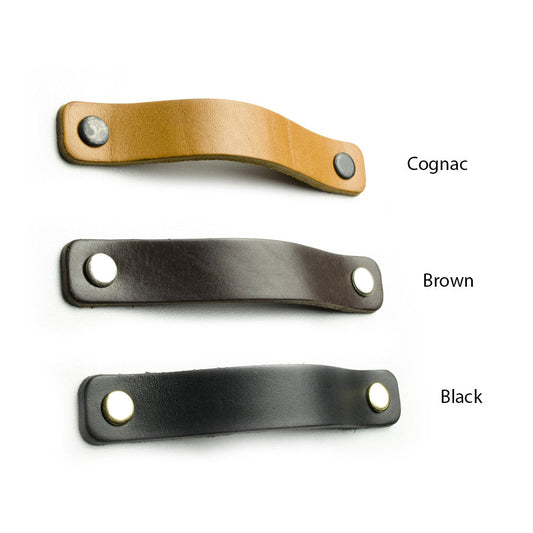
Leather handle rectangular 96mm - 160mmRegular price $9.80Unit price / perRegular priceSale price $9.80
-
Pull handle brushed steel - 5-7/8 inchRegular price $1.73Unit price / perRegular priceSale price $1.73
-
Pull handle brushed steel - 7-7/8 inchRegular price $1.78Unit price / perRegular priceSale price $1.78
-
Pull handle brushed steel - 13-3/4 inchRegular price $2.05Unit price / perRegular priceSale price $2.05
-
Pull handle brushed steel - 17-11/16 inchRegular price $2.23Unit price / perRegular priceSale price $2.23
-
Pull handle brushed steel - 19-11/16 inchRegular price $2.30Unit price / perRegular priceSale price $2.30
-
Pull handle brushed steel - 21-5/8 inchRegular price $2.39Unit price / perRegular priceSale price $2.39
-
Pull handle brushed steel - 25-9/16 inchRegular price $2.56Unit price / perRegular priceSale price $2.56
-
Pull handle brushed steel - 27-3/8 inchRegular price $2.62Unit price / perRegular priceSale price $2.62
-
Pull handle brushed steel - 15-3/4 inchRegular price $2.14Unit price / perRegular priceSale price $2.14
-
Pull handle brushed steel - 23-5/8 inchRegular price $2.47Unit price / perRegular priceSale price $2.47
-
Leather handle rounded 96mm - 128mmRegular price $9.80Unit price / perRegular priceSale price $9.80
-
Pull handle brushed steel - 9-13/16 inchRegular price $1.98Unit price / perRegular priceSale price $1.98
-
Stainless Steel Style Bar Pull - 5-1/16 inch (128 mm) (7-3/8 inch / 188 mm Overall Length) - Matte BlackRegular price $2.28Unit price / perRegular priceSale price $2.28
-
Pull handle brushed steel - 11-13/16 inchRegular price $1.97Unit price / perRegular priceSale price $1.97


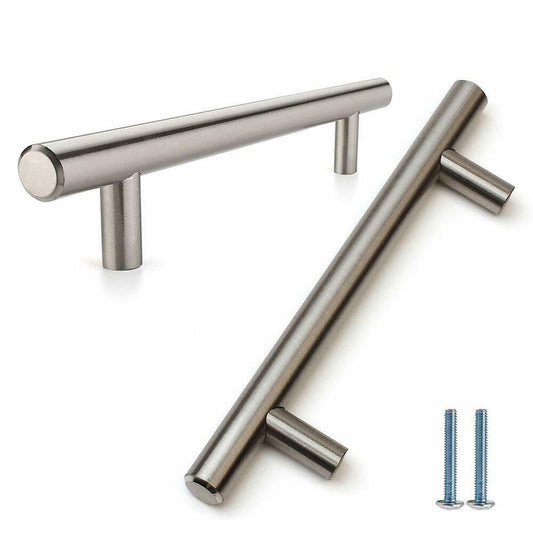

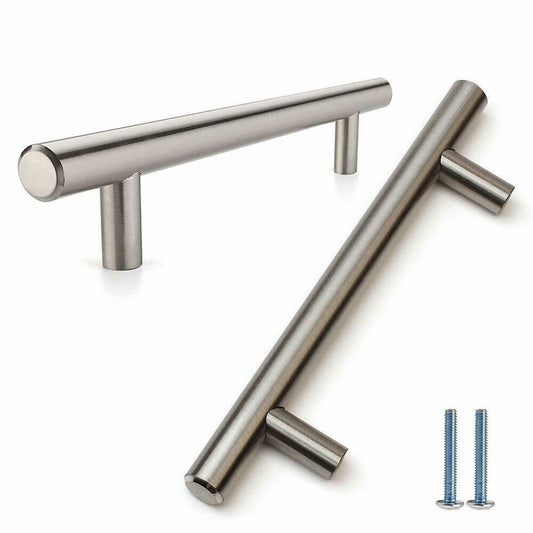

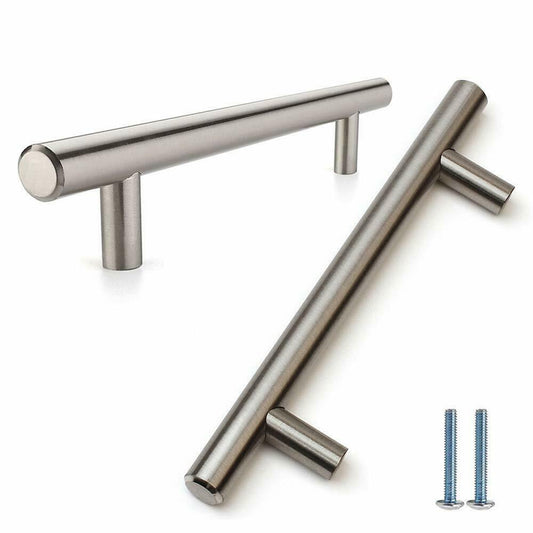

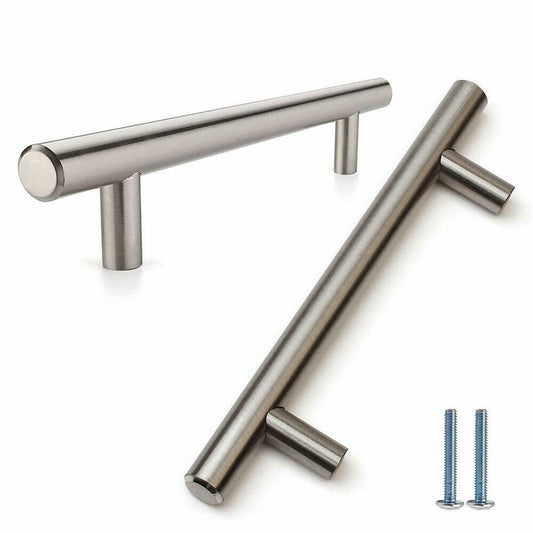

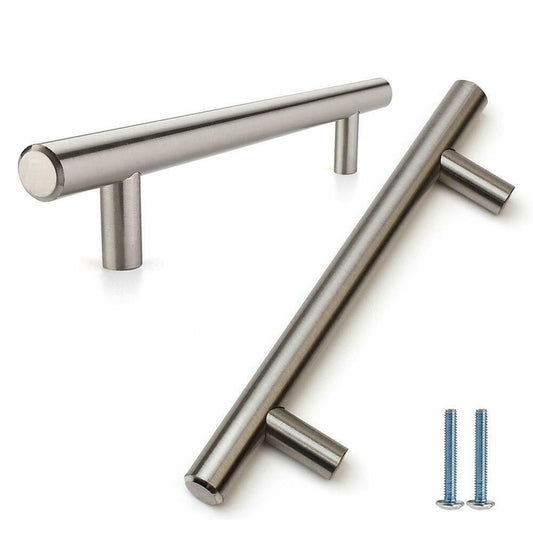

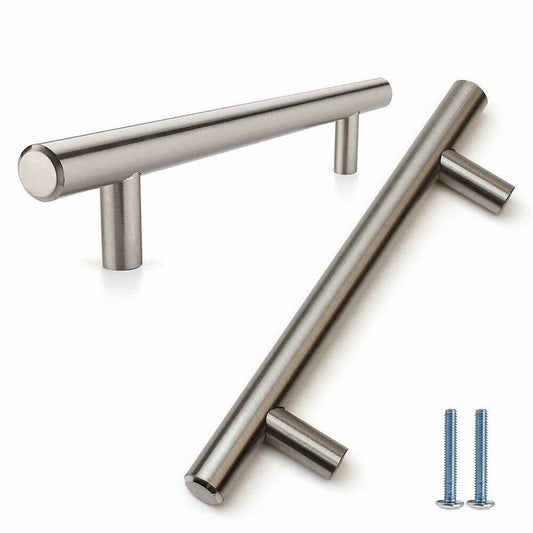

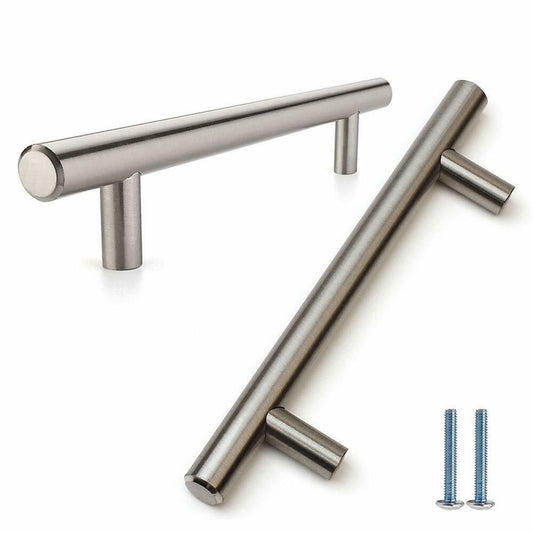

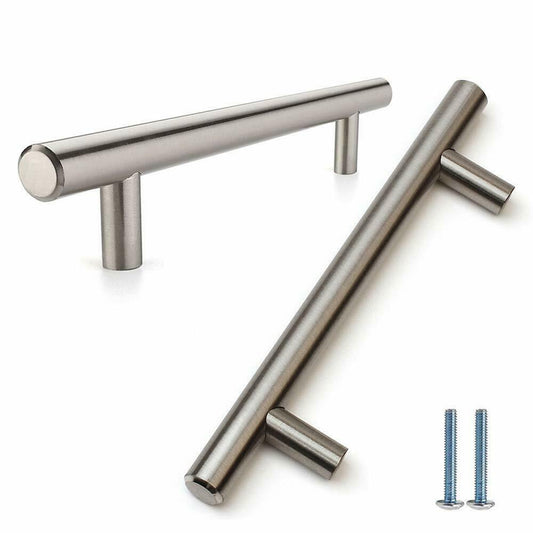

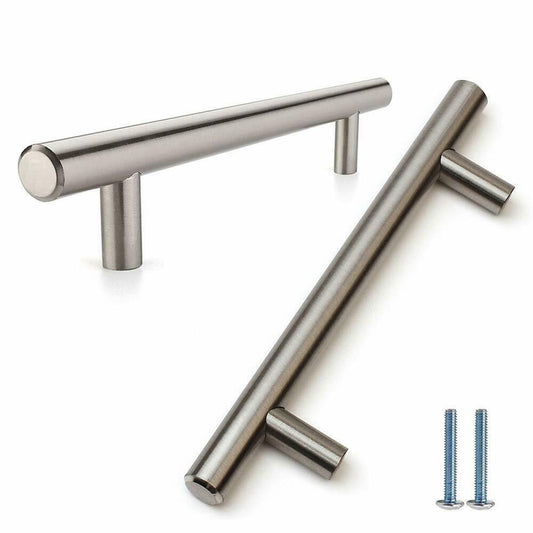

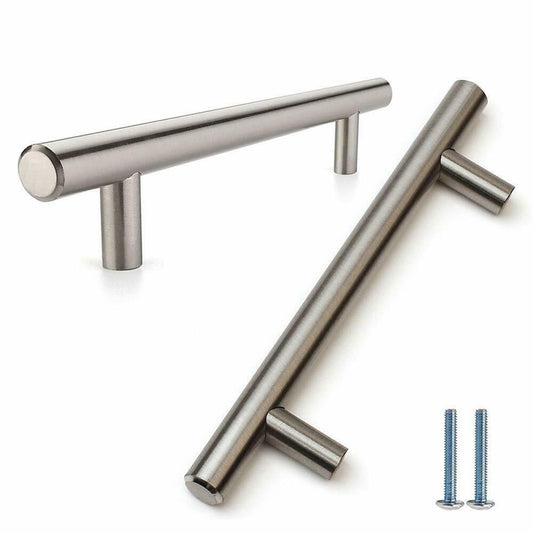


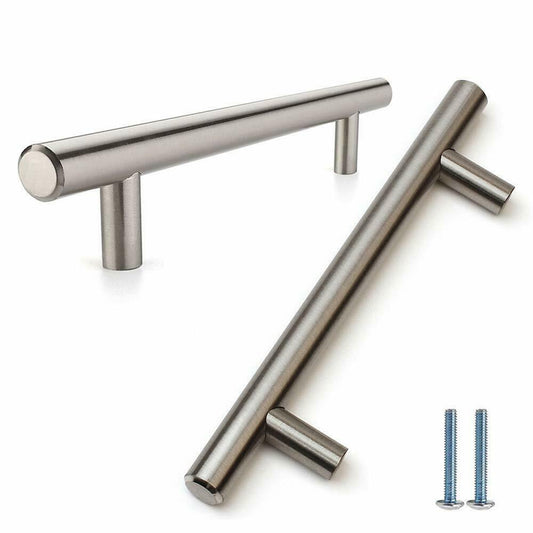


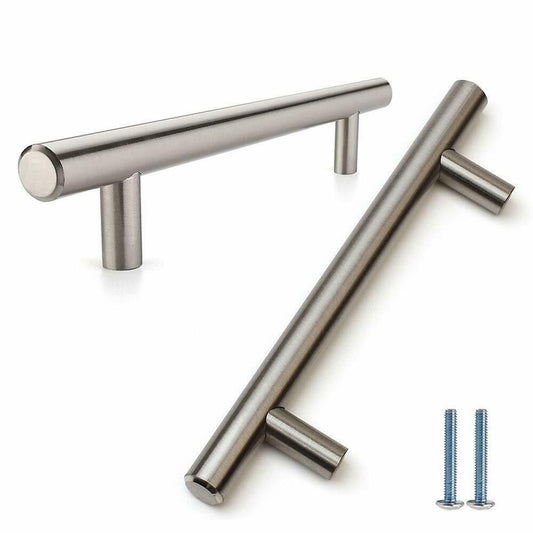
Bar pull handlesare linear, typically cylindrical furniture handles consisting of a continuous pull bar and two or more mounting bases. Unlike conventional bow handles, the ends of the bar extend beyond the posts on this design. This construction delivers exceptional mechanical stability and enables even force distribution when opening heavy pull-outs. In furniture manufacturing and interior fitting, they serve as the standard for modern, flush-fitting cabinet fronts.
Construction Principle and System 32
The technical foundation for mounting furniture handles in Europe and worldwide standard manufacturing isSystem 32. This dimensional grid defines hole spacing in multiples of 1-1/4 in (32 mm). When planning or replacingcabinet pull handles, making a strict distinction between two dimensions is essential: thecenter-to-center distance (C-C)and theoverall length.
Center-to-center distance describes the exact measurement from the center of the left threaded hole to the center of the right threaded hole. Overall length is the physical external dimension of the handle bar. On a classic bar pull handle, the overall length is always larger than the center-to-center distance.
Typical System 32 center-to-center hole spacings used on standard cabinet carcasses:
- 3-3/4 in (96 mm): For narrow drawers (e.g., apothecary cabinets). Perfectly suited: theStainless Steel Bar Pull Handle - 3-3/4 in (96 mm) [5-7/8 in (150 mm) Overall Length].
- 5-1/16 in (128 mm): The standard size for classic kitchen drawers. An example is theStainless Steel Bar Pull Handle - 5-1/16 in (128 mm) [7-7/8 in (200 mm) Overall Length].
- 6-5/16 in (160 mm): For wider pull-outs and tall cabinet doors. TheStainless Steel Bar Pull Handle - 6-5/16 in (160 mm) [9-7/8 in (250 mm) Overall Length]is frequently selected here.
- 7-9/16 in to 17-11/16 in (192 mm to 448 mm): For heavy pot drawers, floor-to-ceiling wardrobe doors, or as towel bars on kitchen islands.
On a heavy drawer, cabinet pull handles act much like a truck's steering wheel—they evenly distribute pulling force across the entire front without warping core materials (like particleboard or MDF) or pulling out screws.
Materials and Surface Finishes
The choice of material determines corrosion resistance, tactile feel, and mechanical load capacity.
Stainless Steel Cabinet Pull Handles
Stainless steel cabinet pull handlesare the industry standard for high-moisture spaces like kitchens and bathrooms. Stainless steel resists water vapor, cooking fats, and weak acids (e.g., fruit acids). The surface is typically brushed (satin/matte), which minimizes fingerprints and diffuses light reflections.
For carpenters and installers, the torsional rigidity of stainless steel is critical. Starting at lengths of 11-13/16 in (300 mm), leverage forces occur during asymmetrical pulling (when off-center). Solid stainless steel tubes absorb this torsion. Examples of long, twist-resistant models:
- Stainless Steel Bar Pull Handle - 12-5/8 in (320 mm) [19-11/16 in (500 mm) Overall Length]
- Stainless Steel Bar Pull Handle - 13-7/8 in (352 mm) [21-5/8 in (550 mm) Overall Length]
- Stainless Steel Bar Pull Handle - 15-1/8 in (384 mm) [23-5/8 in (600 mm) Overall Length]
Black and Coated Finishes
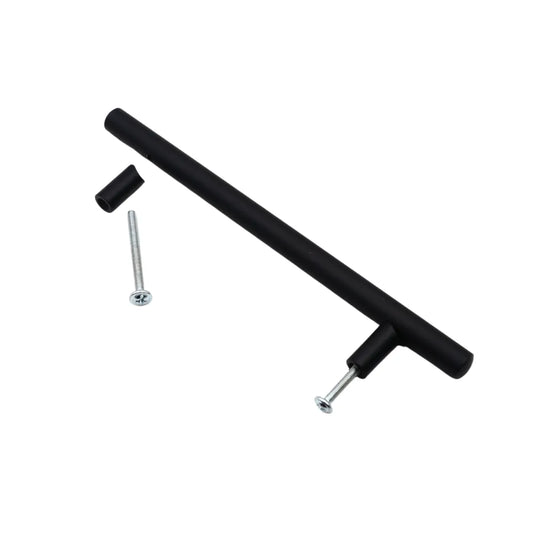
Powder-coated hardware is preferred for dark cabinet fronts or to create a bold contrast on lighter wood finishes (like oak). Ablack bar pull handlefeatures a baked-on finish that is scratch-resistant and won't peel. Technically, dimensions match uncoated models exactly, as seen on theStainless Steel Bar Pull Handle - 5-1/16 in (128 mm) [7-7/16 in (188 mm) Overall Length] - Black.
Leather Handles as a Tactile Alternative
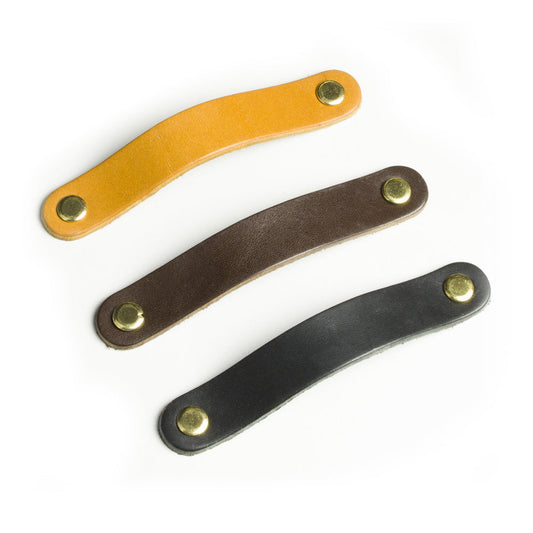
In living rooms or entryways, alternative materials are increasingly used to soften the rigid metal aesthetic. These include leather pulls secured with metallic decorative caps or screws. They require a softer pull force and offer flexible tactile appeal.
- Rectangular Leather Handle 3-3/4 in / 5-1/16 in / 6-5/16 in (96 mm / 128 mm / 160 mm)
- Round Leather Handle 3-3/4 in / 5-1/16 in (96 mm / 128 mm)
Ergonomics: Diameter and Hand Clearance
Along with center-to-center spacing, the bar cross-section is a key spec for ergonomics. Searching for 1/2 in (12 mm) stainless steel cabinet pull handles points to the standard bar diameter of 1/2 in (12 mm). This profile delivers an optimal balance between a sleek look and sufficient contact area for finger joints. Thicker 9/16 in (14 mm) diameter versions are installed on extra-heavy fronts or commercial fixtures (e.g., restaurant kitchens), reducing pressure on the hand under heavy pulling loads.
Thehand clearance(the distance between the back of the handle bar and the cabinet face) averages 1-3/16 in to 1-3/8 in (30 mm - 35 mm) on standard bar pulls. This projection guarantees that users with larger hands won't scrape their knuckles against the cabinet front.
Applications and Front Compatibility
Kitchen Cabinet Pull Handles
When installing kitchen cabinetry, bar-stylekitchen cabinet pull handlesare the top choice. Kitchen drawers frequently utilize full-extension slides rated for 66 lbs to 110 lbs (30 kg to 50 kg). Opening a fully loaded pot drawer demands an initial pull force of up to 10.1 lbf (45 N) to overcome soft-close damper resistance.
For wide drawer boxes (e.g., 35-7/16 in or 47-1/4 in [90 cm or 120 cm]), appropriately long cabinet pull handles must be specified to prevent drawer slides from racking or binding. Rule of thumb: handle length should span roughly one-third to one-half of the drawer width. Ideal for oversized drawers:
- Stainless Steel Bar Pull Handle - 16-3/8 in (416 mm) [25-9/16 in (650 mm) Overall Length]
- Stainless Steel Bar Pull Handle - 17-11/16 in (448 mm) [27-3/8 in (695 mm) Overall Length]
Additionally, extended handle ends often double as convenient dish towel racks in kitchen setups.
Drawer Bar Pulls vs. Stainless Steel Grab Handles
Terminology requires clarity. While "stainless steel furniture handles" or "hardware pulls" are broad general terms,drawer bar pullsspecifically designate this design with extended bar ends. Recessed flush pulls, on the other hand, are mortised hardware flush-mounted into routed pockets—requiring a completely different installation process. Bar pulls are surface-mounted cabinet pull handles.
Technical Installation Guide for Cabinet Pull Handles
Proper installation is paramount for long-term connection strength between pull and panel. A hole spacing error of just 1/16 in (1.5 mm) creates thread strain, causing stripped screws or sheared handle threads over time.
Tools Required
- Cordless drill/driver
- 1/8 in or 3/16 in (4 mm or 4.5 mm) wood drill bit (with brad point)
- Phillips screwdriver (PZ2 or PH2, matching included hardware)
- Tape measure, combination square, or professional drilling template
- Painter's tape
1. Measuring and Marking
Determine center-to-center spacing (e.g., 7-9/16 in (192 mm) on theStainless Steel Bar Pull Handle - 7-9/16 in (192 mm) [11-13/16 in (300 mm) Overall Length]). Apply painter's tape to the panel front. This prevents melamine or veneer chipping during drilling and makes pencil lines easily visible. Mark hole centers perfectly level (for drawers) or plumb (for cabinet doors).
2. Drilling Holes
Use a sharp brad-point bit. For standard M4 machine screws, a 3/16 in (4.5 mm) hole diameter is ideal. This 1/64 in clearance allowance compensates for slight measuring variations without letting the screw head slip through.Crucial tip:Hold a scrap wood block tightly against the back of the door while drilling through. This backing block prevents the bit from blowing out the cabinet interior finish upon exit.
3. Fastening Hardware
Furniture handles are secured from behind the door front. Standard metric machine screws (M4) are supplied. Required screw length equals cabinet front thickness plus handle thread engagement depth.
- For standard 5/8 in or 3/4 in (16 mm or 19 mm) particleboard panels, M4 x 7/8 in (22 mm) or M4 x 1 in (25 mm) screws are typically specified.
- Hand-tighten screws with a manual driver. Avoid using a power driver for final turns; excessive torque can strip out interior base threads or cause thread galling.
Handling Double Fronts
For drawers with a separate inner drawer box front plus an applied decorative drawer face, combine total material thicknesses. For example, if combined thickness is 1-1/4 in (32 mm) [5/8 in (16 mm) box + 5/8 in (16 mm) face], use M4 x 1-9/16 in (40 mm) screws.
Common Handle Lengths and Specific Applications
The wide variety of overall lengths enables precise alignment with architectural module dimensions.
- Compact Sizes [3-3/4 in to 6-5/16 in (96 mm - 160 mm)]: Ideal for bathroom vanities, nightstands, or upper cutlery drawers.
- Medium Sizes [7-9/16 in to 11-5/16 in (192 mm - 288 mm)]: Standard for wall cabinets, office credenzas, and sideboards. Popular selections include theStainless Steel Bar Pull Handle - 10-1/16 in (256 mm) [15-3/4 in (400 mm) Overall Length]and theStainless Steel Bar Pull Handle - 11-5/16 in (288 mm) [17-11/16 in (450 mm) Overall Length].
- Long Sizes [12-5/8 in (320 mm) and up]: Designed for tall pantry doors, heavy under-oven pull-outs, or as continuous accent handles across multiple panels. For versatility, see theStainless Steel Bar Pull Handle Multi-Pack - 3-3/4 in to 15-1/8 in (96 mm - 384 mm).
Maintenance, Cleaning, and Troubleshooting
Stainless steel cabinet pull handles are low maintenance, but require basic care in daily use to maintain performance and appearance.
Cleaning:Avoid abrasive cleaners or steel wool, which ruin brushed surface grain structures and leave raw metal vulnerable to corrosion. A microfiber cloth with warm water and mild dish soap is all that's needed. For tough grease films onkitchen cabinet pull handles, use dedicated stainless steel cleaner applied along the direction of the brushed finish.
Troubleshooting: Loose HandlesIf cabinet pull handles loosen after thousands of pull cycles, compressions in soft core wood under the screw head are usually responsible.
- Solution 1:Carefully retighten screws using a manual screwdriver.
- Solution 2:Place an M4 flat washer behind the inner screw head. This increases surface area and prevents screw head sinkage into soft MDF or particleboard cores.
- Solution 3:If female post threads strip out internally, replace the pull. Chasing or re-tapping M4 threads on thin-walled mounting posts is generally unfeasible.
FAQ – Frequently Asked Technical Questions
How do I correctly measure center-to-center distance on existing cabinet pull handles?Do not measure total end-to-end length. Measure from the center of the left screw head to the center of the right screw head on the inside of the cabinet door. Alternatively, measure clear inside distance between holes and add one hole diameter [approx. 3/16 in (5 mm)]. The resulting number will align with standard System 32 increments like 5-1/16 in (128 mm), 6-5/16 in (160 mm), or 7-9/16 in (192 mm).
Can bar pull handles be mounted both vertically and horizontally?Yes. Mechanically, operation is identical. Horizontal mounting is standard for drawers and lift-up doors; vertical orientation is used on hinged swinging doors, wardrobe fronts, or integrated refrigerator panels. On full-height doors, pull handles are typically centered vertically around 41-5/16 in (1050 mm) above finished floor height for ideal ergonomics.
What screws are required for mounting cabinet pull handles?Standard M4 thread pan-head machine screws are required. Countersunk wood screws are unsuitable because taper heads wedge into panel holes, risking veneer splits under tension.
What is the difference between solid stainless steel and stainless steel finish?A solidstainless steel cabinet pull handleconsists of stainless steel throughout. It is heavy, twist-resistant, and inherently rustproof. Hardware marked "stainless steel finish" is constructed from lighter aluminum alloys or die-cast zinc (Zamak) with surface plating. If surface plating chips, base metals can oxidize over time.
Are cabinet pull handles compatible with push-to-open latches?Technically, cabinet pull handles can be attached to touch-latch fronts (e.g., purely as design accents or towel bars). However, this defeats the clean look of handleless fronts. For drawers with traditional roller, ball-bearing, or soft-close undermount slides, manual pull handles are mandatory to manually overcome soft-close spring damper resistance.
Can I replace a 5-1/16 in (128 mm) pull with a 6-5/16 in (160 mm) pull?Only if you drill new mounting holes. Center-to-center spacing is fixed. Replacing a 5-1/16 in (128 mm) pull with a larger model like theStainless Steel Bar Pull Handle - 8-13/16 in (224 mm) [13-3/4 in (350 mm) Overall Length]requires filling original holes with wood putty or cover caps, then layout-marking and drilling new 8-13/16 in (224 mm) hole centers.