
Side mount drawer slides
Popular Subcategories


-
Set of Ball Bearing Slides (left and right), H17Regular price From $1.01Unit price / perRegular priceSale price From $1.01
-
Set of Ball Bearing Slides (left and right), H27Regular price From $1.61Unit price / perRegular priceSale price From $1.61
-
Set of Ball Bearing Slides (left and right), H35Regular price From $2.69Unit price / perRegular priceSale price From $2.69
-
Set of Soft-Close Undermount Slides (left and right), Full ExtensionRegular price From $18.32Unit price / perRegular priceSale price From $18.32
-
Set of Soft-Close Ball Bearing Slides (left and right), H45Regular price From $9.59Unit price / perRegular priceSale price From $9.59
-
Set of Soft-Close Undermount Slides (left and right), 3/4 ExtensionRegular price From $13.62Unit price / perRegular priceSale price From $13.62
-
Set of Push-to-Open Undermount Slides (left and right), Full ExtensionRegular price From $20.53Unit price / perRegular priceSale price From $20.53
-
Set of Ball Bearing Slides (left and right), H30Regular price From $2.88Unit price / perRegular priceSale price From $2.88
-
Set of POM Roller Slides WhiteRegular price From $1.56Unit price / perRegular priceSale price From $1.56
-
Set of Soft-Close Undermount Slides (left and right)Regular price From $7.44Unit price / perRegular priceSale price From $7.44
-
Push-to-Open + Soft Close Ball Bearing Slides (left and right), H45 - 22 inchRegular price $21.66Unit price / perRegular priceSale price $21.66
-
Set of Push-to-Open + Soft Close Ball Bearing Slides (left and right), H45Regular price From $14.69Unit price / perRegular priceSale price From $14.69
-
Set of Ball Bearing Slides (left and right), H53Regular price From $31.32Unit price / perRegular priceSale price From $31.32
-
Set of Ball Bearing Slides (left and right), H45Regular price From $4.27Unit price / perRegular priceSale price From $4.27
-
Pull-Out Wire Basket Drawer with H45 Full Extension Slides - ChromeRegular price From $17.46Unit price / perRegular priceSale price From $17.46
-
Soft-Close Undermount Slides (left and right), Full Extension - 10-5/8 inchRegular price $19.99Unit price / perRegular priceSale price $19.99
-
1 Set Ball Bearing Heavy Duty Drawer Slides with Lock, H53Regular price From $12.80Unit price / perRegular priceSale price From $12.80
-
Push-to-Open + Soft Close Ball Bearing Slides (left and right), H45 - 24 inchRegular price $22.76Unit price / perRegular priceSale price $22.76
-
Push-to-Open + Soft Close Ball Bearing Slides (left and right), H45 - 20 inchRegular price $20.22Unit price / perRegular priceSale price $20.22
-
Push-to-Open + Soft Close Ball Bearing Slides (left and right), H45 - 18 inchRegular price $18.88Unit price / perRegular priceSale price $18.88
-
Push-to-Open + Soft Close Ball Bearing Slides (left and right), H45 - 16 inchRegular price $18.88Unit price / perRegular priceSale price $18.88





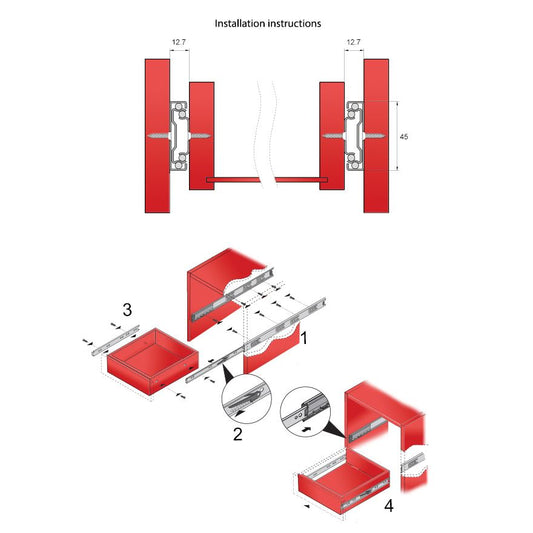

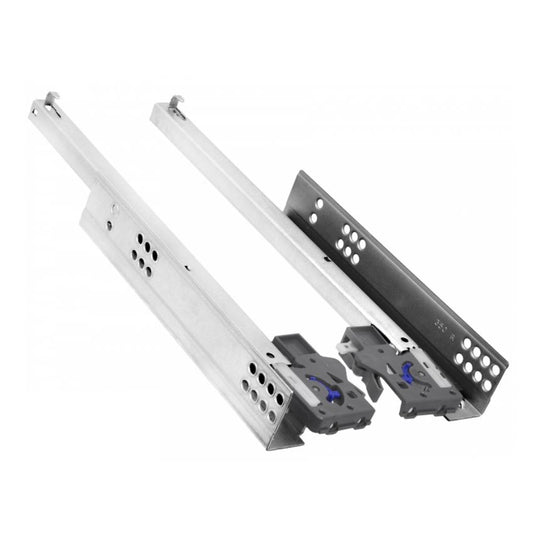

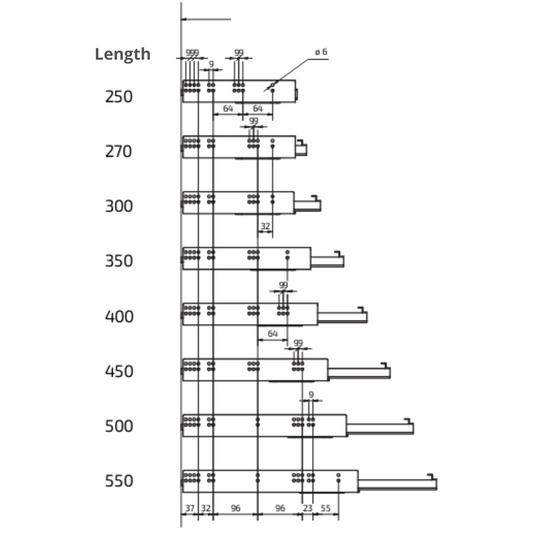

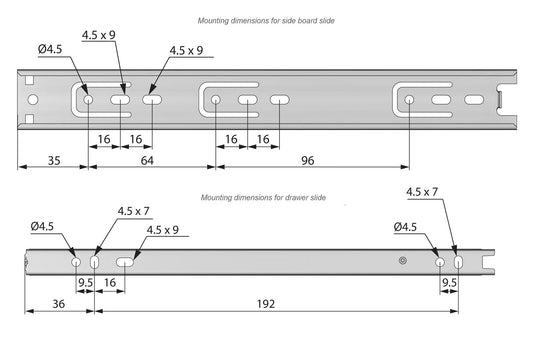

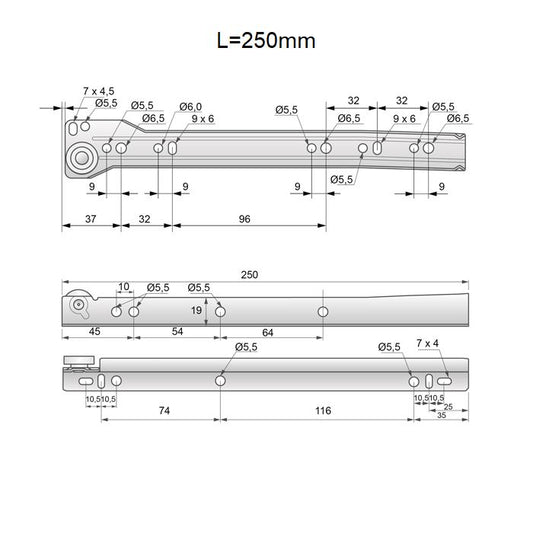


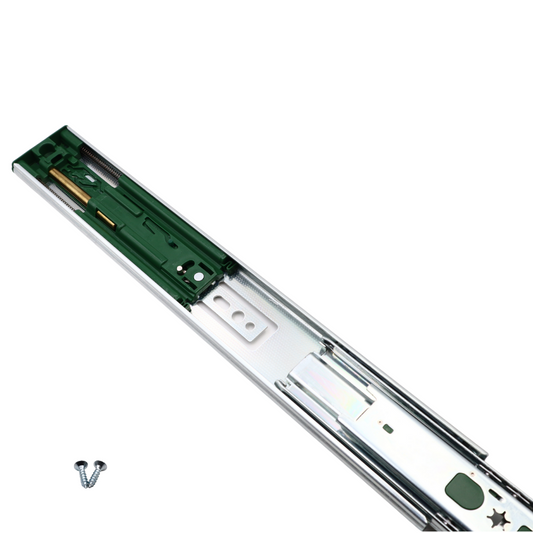

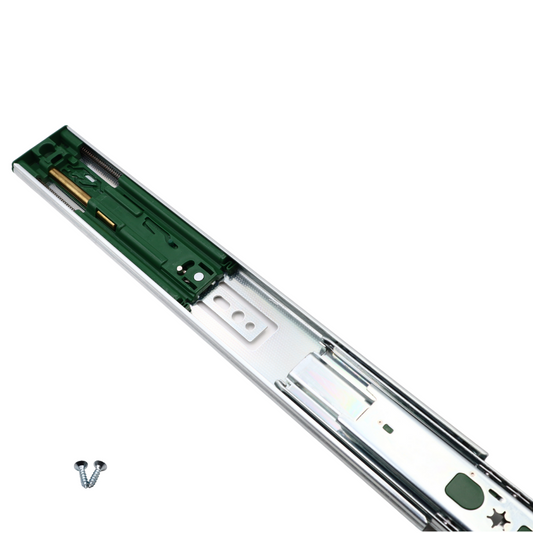

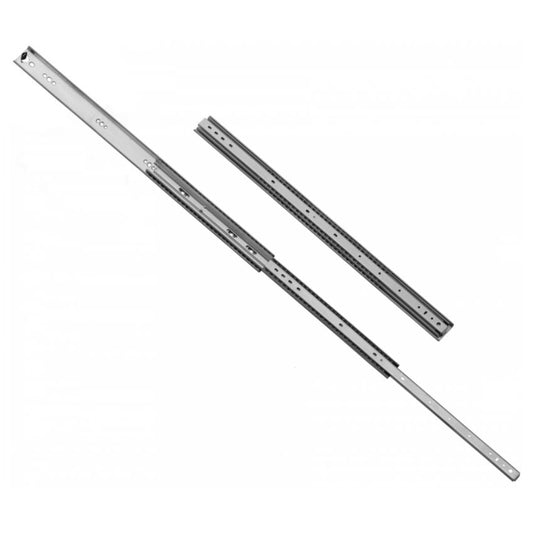







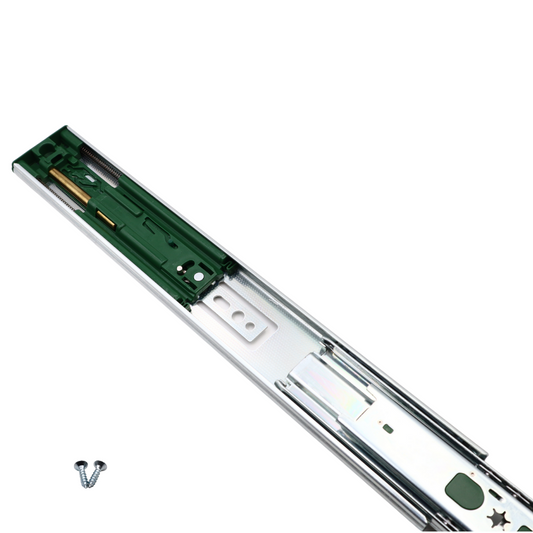

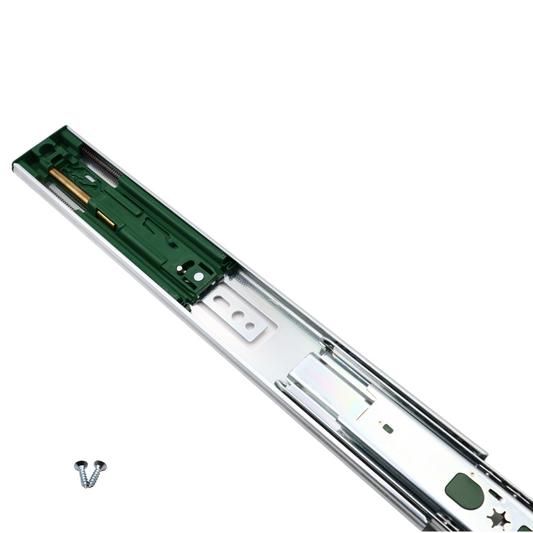
Side mount drawer slidesare mechanical metal or plastic guiding components that enable smooth, low-friction opening and closing of movable cabinet elements in furniture. They define the motion quality, maximum load capacity, and functional ergonomics of any drawer system.
When designing furniture, repairing, or retrofitting existing cabinets, selecting the exact side mount drawer slides is critical. Specifications range from simple plastic roller slides to highly complex, ball-bearing telescopic systems with integrated dampening and release mechanisms. This technical guide details the mechanical differences, correct sizing, and installation parameters for cabinetmakers, installers, and experienced woodworkers.
Fundamental Slide Types
The basis of any drawer movement is the mechanical principle of friction reduction. In hardware technology, three primary slide systems have established themselves, differing fundamentally in design, mounting position, and running performance.
Ball-Bearing Slides (Telescopic Slides)
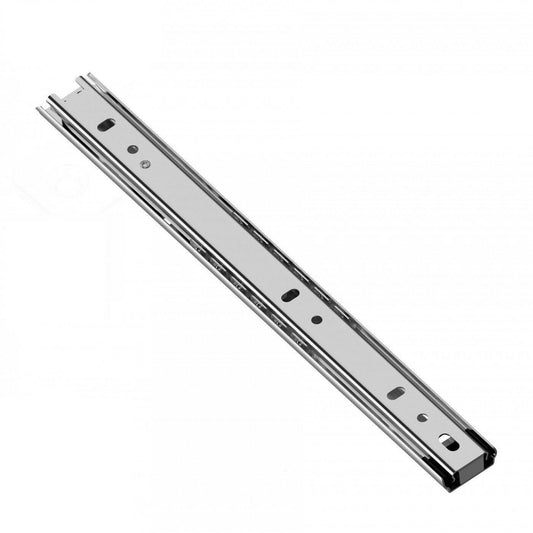
Theball-bearing slideis the most robust and widely used system for heavy loads and precise running characteristics. It consists of two to three interlocking steel profiles. Ball cages containing small steel balls roll between these profiles. They act as the running gear of the furniture, translating the static load of the contents into a fluid, horizontal motion.
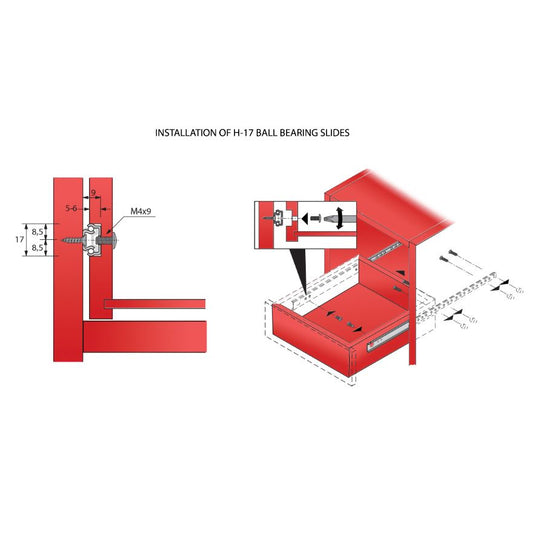
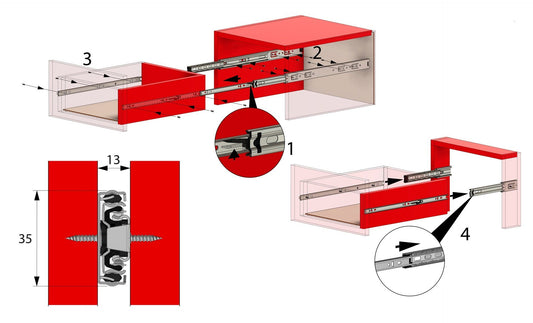
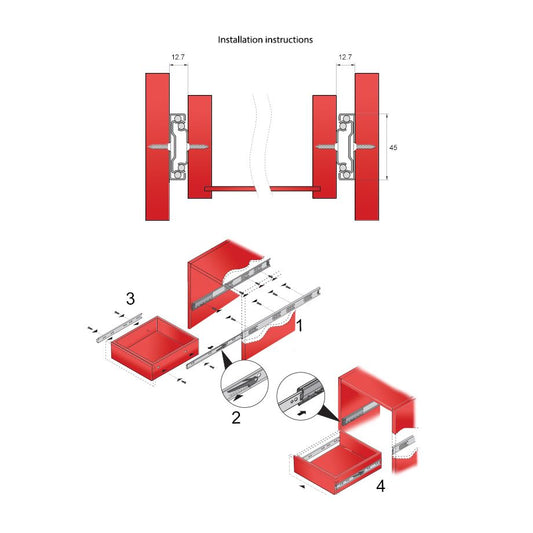
Ball-bearing slides are typically screwed laterally to the drawer side and inner cabinet wall as side mount drawer slides. A critical parameter during construction is side clearance: standard ball-bearing slides require exactly 1/2 in (12.7 mm) of space on each side. They are available in various profile heights, typically H17 (for light loads), H45 (the industry standard), and H53 (for heavy-duty applications). A classic standard model for cabinetmaking is1 set ball-bearing slide drawer slides, H45.
Undermount Slides
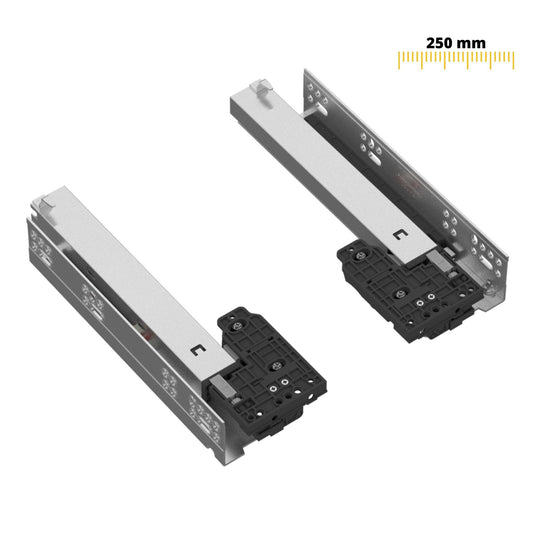
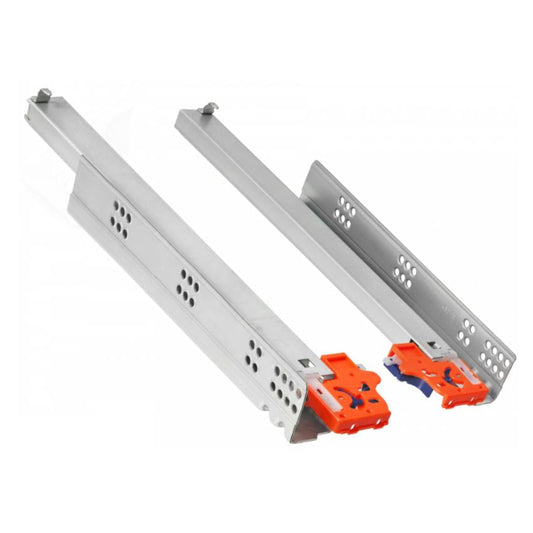
For high-end cabinetry and modern kitchen drawers, theundermount slideis today's standard. The slide system is installed concealed beneath the drawer bottom rather than on the sides. As a result, the slide hardware remains invisible when opened, preserving the refined aesthetic of wooden drawer boxes.
Beyond aesthetics, undermount slides offer superior running performance. The load is transferred directly downward, minimizing lateral twisting. Additionally, these systems feature special locking devices attached to the drawer front that allow tool-free 3D adjustment (height, side, tilt) of reveal gaps. A typical system for premium interior fitting isSoft-Close undermount drawer slides 450mm.
Roller Slides
Theroller slideis the most traditional and technically straightforward option. It consists of two epoxy-coated steel profiles per side that glide against each other on plastic rollers (usually nylon). They feature an asymmetrical design: one profile attaches to the cabinet, and the other mounts to the lower side edge of the drawer.
Roller slides tolerate larger dimensional variations in cabinet construction (up to 5/64 in (2.0 mm)) and are extremely easy to install. However, they offer lower lateral stability and weight capacity compared to ball-bearing systems. They are primarily suitable for light bedroom dressers or basic office furniture. A wide selection of these essential fittings can be found in thedrawer slides roller slidecategory.
Extension Types: Full Extension vs. Partial Extension
The extension length defines how far the drawer extends out of the cabinet. This decision significantly impacts the ergonomics and accessibility of the storage space.
Full Extension
Afull extension slideallows the drawer to extend 100% of its installed depth out of the cabinet. This means if the slide is 19-11/16 in (500 mm) long, the travel length is also 19-11/16 in (500 mm). When fully open, the rear panel of the drawer aligns flush with the front edge of the cabinet.
This is achieved through a three-piece telescopic principle (cabinet member, intermediate member, drawer member). Full extension side mount drawer slides are essential for kitchen drawers to make the rearmost area fully accessible, as well as for filing drawers. Mechanical stress on the cabinet screws is highest here because the lever arm is fully extended. For projects requiring maximum access,drawer slides vollauszugare the only professional choice.
Partial Extension
With apartial extension slide, a portion of the drawer (usually about 20% to 25% of its total length) remains inside the cabinet. A 15-3/4 in (400 mm) slide provides a travel length of only about 11-13/16 in to 12-5/8 in (300 mm to 320 mm).
Partial extension slides feature a two-piece design. They are mechanically simpler, more cost-effective, and significantly reduce leverage on the cabinet body. This prevents tipping in lightweight, freestanding furniture such as a small chest of drawers that is not anchored to the wall.
Over-Extension
Over-extension is a specialized variation where the drawer extends further than its installed length (e.g., a 19-11/16 in (500 mm) slide with a 21-5/8 in (550 mm) travel length). This is required in specific industrial applications or for cabinets with deep countertop overhangs to guarantee complete top-down access.
Special Mechanical Features: Soft-Close and Opening Systems
Modern side mount drawer slides are rarely just passive gliding elements. They are equipped with active mechanical components that control operating convenience. It is essential to clearly distinguish how these systems function.
Soft-Close (Dampening)
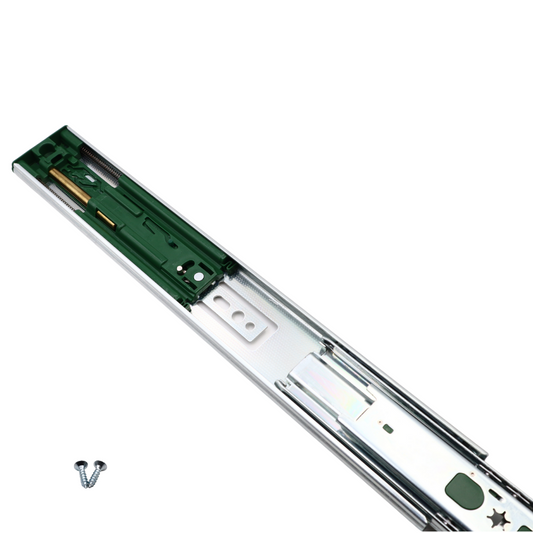
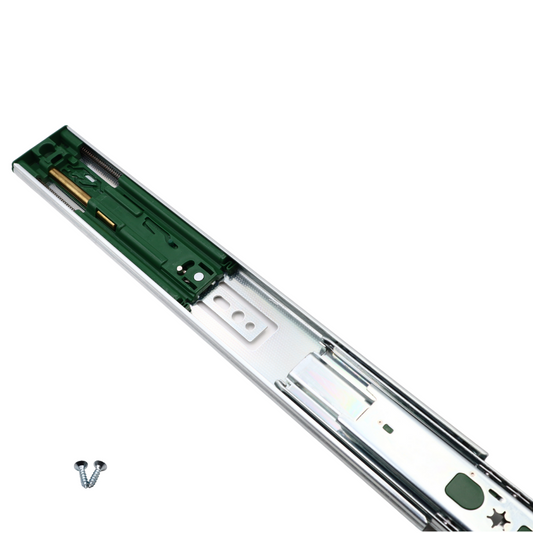
Thesoft-close systemcombines a hydraulic or pneumatic dampening mechanism with a tension spring. When the drawer is pushed closed, an activator catches during the final 1-3/16 in to 1-31/32 in (30 mm to 50 mm) of travel. The spring actively pulls the drawer inward (self-closing mechanism), while the damper (a small cylinder) absorbs the kinetic energy. The result is a smooth, quiet closure regardless of the force applied.
This technology protects materials, keeps contents from shifting, and is standard when retrofitting kitchen drawers. Matching systems can be found in the overview fordrawer slides with dampfung.
Push-to-Open (Tip-On)
Thepush-to-open systemoperates as the exact mechanical opposite of soft-close, enabling handleless drawer fronts. A spring-loaded plunger is tensioned and latched when the drawer closes. When the user applies light pressure to the closed front, the latch releases, and spring force pushes the drawer open a few inches so it can be grasped.
Important for designers: A pure push-to-open system cannot feature soft-closing action, as closing requires firm pressure to re-arm the spring for the next opening cycle. For handleless designs, consult thedrawer slides push to opencategory.
Hybrid Systems
Modern hardware engineering now offers complex hybrid solutions combining both functions. Here, the drawer opens via pressure (push-to-open), but closes firmly, with a damper absorbing the impact in the final inches while simultaneously tensioning the release spring. An example of this advanced mechanism is thePush-to-Open + Soft Close ball-bearing slide drawer slides, 450mm - H45.
Self-Closing Mechanism
A simpler variation without dampening is a basicself-closing feature. Here, a spring or angled track simply pulls the drawer shut and holds it closed during the last few inches, preventing it from resting open. This is common in roller slides or specializeddrawer slides with Selbsteinzug.
Sizing: Lengths, Heights, and Load Capacity
Selecting correct dimensions is a mathematical process accounting for cabinet size, material weight, and intended use.
Nominal Length
Slide length (nominal length) must match the interior cabinet depth. The slide should always be slightly shorter than the clear internal cabinet depth to allow room for the back panel and mounting tolerances. Standard increments usually follow 1-31/32 in (50 mm) steps. Options range from short runners for bathroom vanity drawers, likedrawer slides 250 mm, to standard kitchen sizes (typicallydrawer slides 500 mm), up to extra-long versions for deep platform storage or pull-out pantries, likedrawer slides 1000 mm.
Profile Height for Ball-Bearing Slides
The height of the slide profile correlates directly with stability:
- H17 (21/32 in (17 mm)):For light, small drawers (e.g., jewelry boxes, keyboard trays). Load capacity typically up to 22 lbs (10 kg).
- H35 (1-3/8 in (35 mm)):Medium loads, frequently used in office furniture.
- H45 (1-25/32 in (45 mm)):The primary standard in cabinetmaking. These slides typically support between 66 lbs and 99 lbs (30 kg and 45 kg).
- H53 (2-3/32 in (53 mm)):Engineered for heavy-duty applications.
Load Capacity and Heavy-Duty Applications
Dynamic load capacity indicates how much weight the drawer and its contents can support in motion without deforming the profiles or dislodging balls from the cage. While standard side mount drawer slides are rated for 55 lbs to 99 lbs (25 kg to 45 kg), workshop storage, custom vehicle conversions, or pantry pull-outs require specializeddrawer slides schwerlast. These massive steel slides can support 176 lbs (80 kg), 220 lbs (100 kg), or even up to 286 lbs (130 kg). For extreme lengths and weight ratings, such as thedrawer slides Full extension 1500mm - H53 (1 set), perfectly square cabinet installation is required, as minor racking or misalignment can cause ball cages to bind.
Technical Installation and Adjustment
The longevity of side mount drawer slides depends 90% on installation accuracy. Even high-end undermount slides will fail if cabinet tolerances are missed.
System 32
In standard cabinet manufacturing, hardware mounts usingSystem 32grid spacing. This means cabinet side panel holes are spaced exactly 1-1/4 in (32 mm) apart center-to-center. The distance from the front cabinet edge to the first hole row is standardly 1-29/32 in (37 mm). Virtually all guide rails feature mounting slots tailored to this hole pattern.
Screw Selection
Securing hardware into engineered wood (particle board, MDF, plywood) requires specific fasteners:
- Euro Screws:Featuring a 1/4 in (6.3 mm) thread diameter and blunt end, these thread directly into pre-drilled 13/64 in (5 mm) holes. They provide maximum pull-out resistance and precisely locate side mount drawer slides via specialized flat heads.
- Wood/Chipboard Screws:When Euro screws are not used, standard wood screws with a 1/8 in or 5/32 in (3.5 mm or 4.0 mm) diameter are used. Drive style should ideally beTX (Torx)orPZ (Pozidriv)for optimal torque transfer. The screw head must sit flush (flat head or low-profile truss head) so it does not rub against moving slide profiles.
Calculating Drawer Box Width
For side mount drawer slides, calculating drawer box exterior width is strictly mathematical:Inside cabinet opening width minus (2 × slide thickness).Because standard H45 side mount drawer slides are precisely 1/2 in (12.7 mm) thick per side, the drawer box must be built exactly 1 in (25.4 mm) narrower than the internal cabinet opening. If built even 3/64 in (1 mm) too wide, the slides will bind; if built too narrow, ball cages may dislodge.
For undermount slides, drawer box width calculations depend on side panel thickness (typically 5/8 in or 3/4 in (16 mm or 19 mm)). Manufacturer specification sheets must be consulted, as notch and clearance dimensions vary by model.
Common Installation Pitfalls
If a drawer system sticks, rubs, or fails to catch the soft-close mechanism after installation, look for these common assembly errors:
- Out-of-Square Cabinet:If the cabinet carcass is not assembled at precise 90° angles, internal measurements taper or widen toward the back. The slides will run out of parallel, causing binding.
- Protruding Screw Heads:If screws are driven off-center or feature tall heads, the sliding inner member will scrape audibly against the fastener heads during operation.
- Debris in Slide Tracks:Sawdust from workshop environments can settle into greased ball tracks. This degrades self-lubricating properties and creates a grinding sound. Mount slides only after all cutting and sanding operations are complete.
- Incorrect Push-to-Open Gap:If the drawer front sits tight against the cabinet face frame, the plunger lacks room to depress. Push-to-Open systems require a front-to-cabinet activation gap of approx. 5/64 in to 1/8 in (2.0 mm to 3.0 mm).
FAQ – Frequently Asked Technical Questions
What is the difference between a roller slide and a ball-bearing side mount drawer slide?
Roller slides rely on plastic wheels riding in a metal profile, offering greater installation tolerance but supporting less weight (typically up to 44 lbs (20 kg)) and often limited to partial extension. Ball-bearing side mount drawer slides utilize steel balls retained in a cage, delivering high precision, higher load capacity (55 lbs to 286 lbs (30 kg to 130 kg)), and full extension capabilities.
Can I upgrade existing partial extension slides to full extension slides?
Mechanically yes, provided side clearance (the space between drawer box and cabinet wall) matches. If transitioning from roller slides to ball-bearing side mount drawer slides, verify that the drawer box allows enough side clearance (typically 1/2 in (12.7 mm) per side). Note that cabinet hole locations may also change.
Why is my soft-close drawer not closing completely?
This usually occurs when the activator mechanism on the drawer slide becomes unhooked from the spring drive. Pull the drawer out firmly to full extension until you hear an audible click, then push it fully closed. This typically resets and resynchronizes the mechanism. Overloading or an unlevel cabinet frame can also cause binding.
How do I calculate the correct slide length for my project?
Measure the clear internal depth of your cabinet box. Subtract at least 3/8 in to 19/32 in (10 mm to 15 mm). The result dictates your maximum slide nominal length. Example: For a cabinet depth of 20-9/32 in (515 mm), select a 19-11/16 in (500 mm) slide length.
Can push-to-open and soft-close features be combined using separate components?
No, in their basic forms they oppose each other mechanically. Push-to-open requires an outward spring force to launch the front. Soft-close requires an inward spring force to pull the front shut. Combining both features requires specialized hybrid side mount drawer slides engineered with synchronized dual-action mechanisms.
How should I maintain and lubricate ball-bearing side mount drawer slides?
Ball-bearing slides come factory-lubricated with high-viscosity grease for long service life. Never wash them with harsh solvents (like brake cleaner) or spray them with penetrating oil (like WD-40), as this strips away protective grease. To clean dirt or debris, wipe tracks gently with a clean, dry cloth.