
Dual Trash Can Pull Out
Popular Subcategories


-
Pull-Out Kitchen Waste Bin - 2x20L - 15-3/4 inch CabinetRegular price $134.10Unit price / perRegular priceSale price $134.10
-
Dual Trash Can Pull Out - 2x15L or 2x20L - 23-5/8 inch (60 cm) Kitchen CabinetRegular price From $103.22Unit price / perRegular priceSale price From $103.22
-
Pull Out Kitchen Recycling Bins - 2x15L or 2x20L - 19-11/16 inch Base CabinetRegular price From $100.66Unit price / perRegular priceSale price From $100.66
-
Pull Out Cabinet Recycling Bins Soft-Close 4x15L or 4x20L - 31-1/2 inch Kitchen CabinetRegular price From $130.44Unit price / perRegular priceSale price From $130.44
-
Cabinet Recycling Bins Soft-Close 3 x 4 gal + 1 x 1.6 gal - 23-5/8 inch Base CabinetRegular price $184.24Unit price / perRegular priceSale price $184.24
-
Cabinet Recycling Bins Soft-Close 3 x 4 gal + 3 x 1.6 gal - 23-5/8 inch Base CabinetRegular price $227.23Unit price / perRegular priceSale price $227.23
-
Cabinet Recycling Bins 2 x 4 Gal - 17-3/4 inch, D = 18-7/8 inch H = 12-5/8 inch Kitchen Cabinet - Anthracite GrayRegular price $99.18Unit price / perRegular priceSale price $99.18

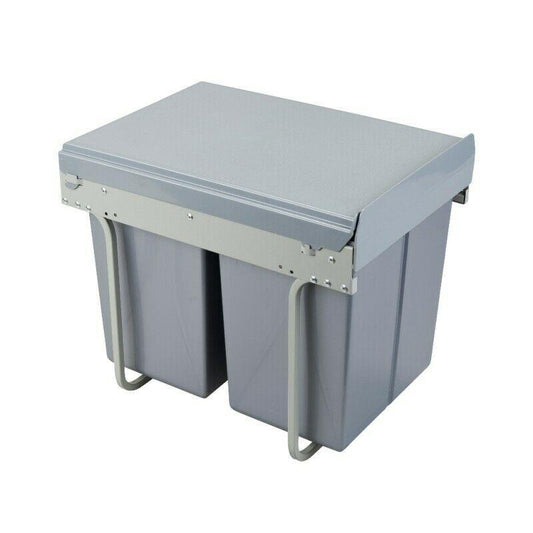

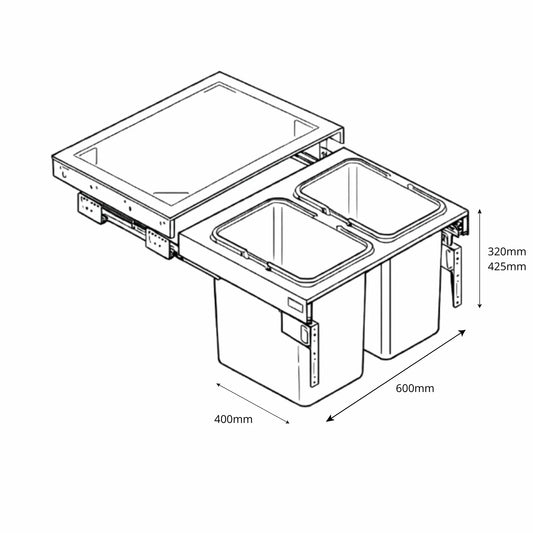

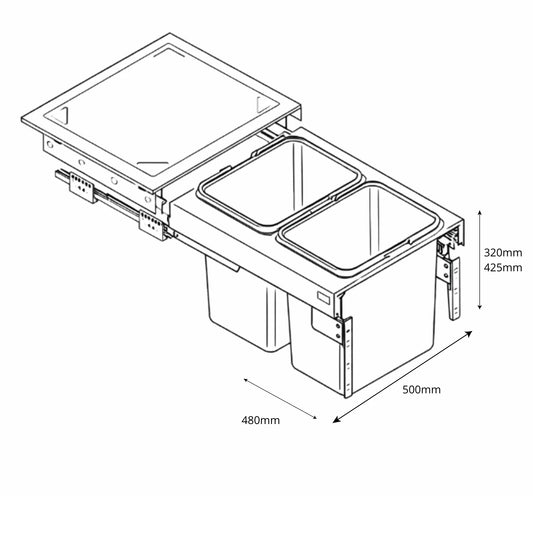

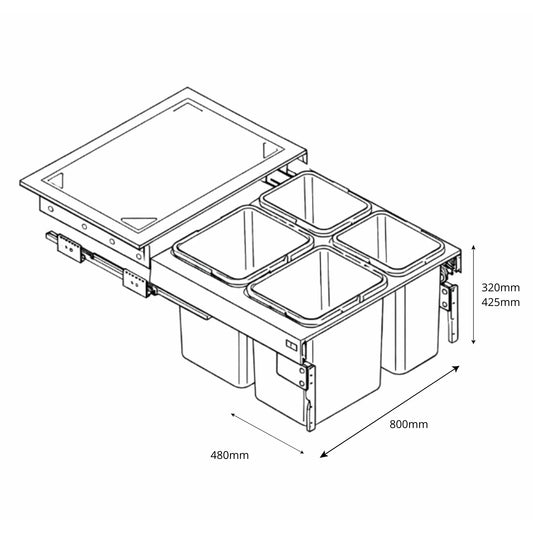

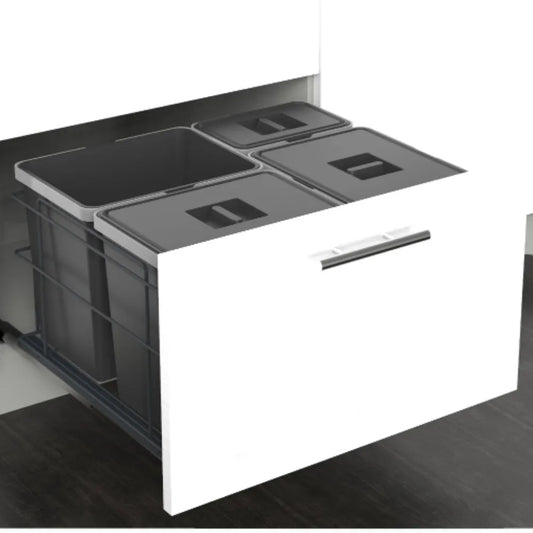

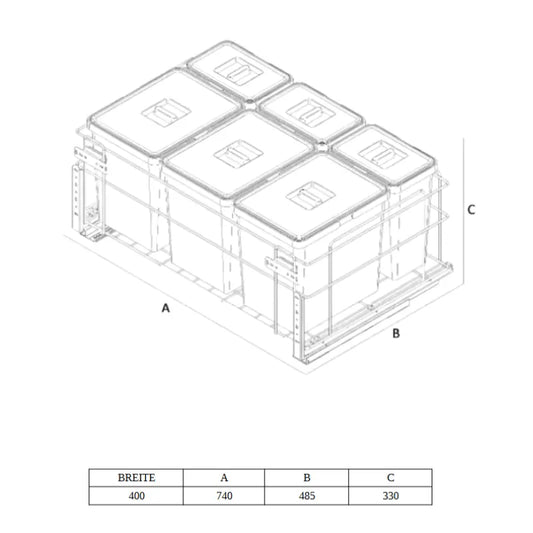

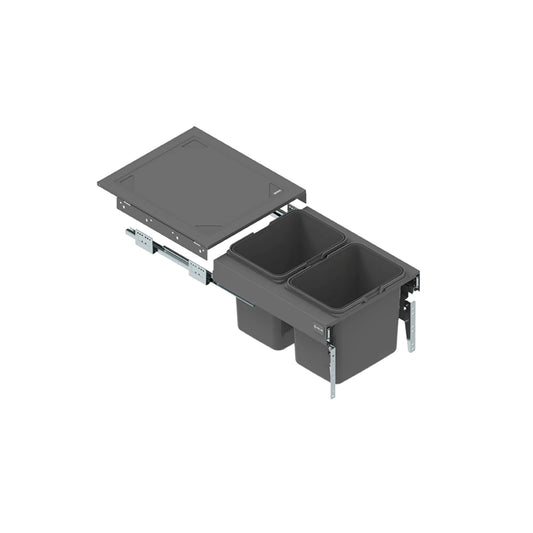
Adual trash can pull outis a built-in recycling and waste system designed for kitchen base cabinets, featuring two separate bins to sort household trash and recyclables right inside your cabinet. These systems install securely into the cabinet carcass and slide out smoothly on a rail mechanism when opened. For DIYers planning or updating a kitchen, installing a dual pull-out trash can is the most efficient way to keep floor space free of freestanding bins and maximize usable under-counter storage. A dual compartment trash can works inside a base cabinet like an organized toolbox: everything has its designated spot, and every component functions seamlessly.
Dimensions and Compatibility: Finding the Right Cabinet for Your Dual Pull-Out Bin
Selecting the right 2-compartment pull-out waste system depends primarily on the outer dimensions of your existing kitchen cabinet. In cabinet making and installation, references are always made to theexterior cabinet width. When a system is specified for a "15-3/4 in (40 cm) cabinet," it means the total width of the cabinet, including the side walls, measures 15-3/4 in (400 mm).
When planning your installation, three key dimensions must be taken into account:
1. Cabinet Width (Exterior Width)
Our line of dual trash can pull outs is designed to fit standard kitchen cabinet sizing. The interior clear width (the actual space between the two side panels) equals the exterior dimension minus the side wall thickness (typically 5/8 in to 3/4 in (16 mm or 19 mm) particle board or plywood).
- 15-3/4 in (40 cm) Exterior Width:The standard size for compact sink base cabinets. Systems with two bins positioned front-to-back or side-by-side fit well here. Find matching solutions underwaste bin kitchen pull-out 40cm.
- 17-3/4 in (45 cm) Exterior Width:Offers extra clearance for wider bin designs. Ideal forwaste bin kitchen pull-out 45cm.
- 19-11/16 in (50 cm) Exterior Width:Accommodates larger bin capacities per compartment, often 2 x 4 gal (2 x 15 L) or 2 x 5.3 gal (2 x 20 L). Seewaste bin kitchen pull-out 50cm.
- 23-5/8 in (60 cm) Exterior Width:The standard size for large sink cabinets. Generous bin capacities (e.g., 2 x 7.1 gal (2 x 27 L)) can sit side-by-side. Corresponding options are listed underwaste bin kitchen pull-out 60cm.
2. Installation Depth
Cabinet depth is critical because adual trash can pull outrequires adequate clearance toward the back of the cabinet. Standard base cabinets have an internal depth of around 22 in (560 mm). A typical 2-bin pull-out trash can requires an installation depth of15-3/4 in to 18-7/8 in (400 mm to 480 mm). Note: Measure from the inside edge of the closed cabinet door to the back wall. If plumbing lines or drain pipes run along the back wall, reduce your usable depth measurements accordingly.
3. Installation Height and P-Trap Clearance
The most common mounting location for a dual pull-out trash bin is under the kitchen sink, where the sink's P-trap (drain trap) extends down into the cabinet space. Depending on overall capacity, a dual trash can pull out stands between12-5/8 in and 17-11/16 in (320 mm to 450 mm)high. Measure the distance from the cabinet floor to the bottom edge of the P-trap. If clearance is limited, select a lower-profile model or replace the existing plumbing with a space-saving drain trap.
Hardware and Mechanics: Understanding Slide Systems
A modern pull-out cabinet trash can relies on heavy-duty drawer slides for smooth, daily operation. Understanding slide mechanics ensures long-lasting performance.
Full Extension vs. Partial Extension
When selecting a system, ensure it featuresfull-extension drawer slides. Full-extension slides allow the pull-out frame to pull out 100% from the cabinet interior. This means even the rear bin (in front-to-back configurations) is fully accessible from above without getting caught under the countertop overhang. Partial-extension slides (offering around 75% travel) are inconvenient for waste separation systems because the rear bin remains difficult to remove.
Ball-Bearing Slides and Weight Capacity
The extension system is generally built with steelball-bearing slides. Precision steel balls roll smoothly inside heavy-gauge metal channels (telescoping slides), providing excellent lateral stability and effortless glides. Because a fully loaded 2-compartment pull-out bin (filled with wet food waste or heavy recyclables) can quickly weigh 22 lbs to 33 lbs (10 kg to 15 kg), robust hardware construction is essential.
Soft-Close Mechanism
Many premium pull-out trash cans come equipped with asoft-close mechanism. A hydraulic damper absorbs closing momentum during the final few inches, pulling the trash bin smoothly and silently into its resting position. Technical note: Soft-close is the exact opposite of push-to-open mechanisms. While soft-close dampens the closing action, push-to-open is a spring-loaded system used for handleless opening. These two mechanisms cannot be combined on mechanical slides.
Installation Guide: Mounting Your Dual Pull-Out Trash Can
Installing adual trash can pull outis a straight-forward DIY project that usually takes about 20 to 30 minutes. Systems feature eitherbottom mountingorside mounting. Bottom-mounted systems are the most common and versatile, as the frame simply screws directly down onto the cabinet floor regardless of exact side-wall clearances.
Required Tools
- Tape measure or ruler
- Pencil
- Cordless drill/driver
- Wood drill bit (1/16 in or 1/8 in (Ø 2 mm or 3 mm) for pilot holes)
- Screwdriver (bit matching mounting screws, typicallyPZ2orTX20)
Step-by-Step Bottom-Mount Installation
- Positioning:Place the empty mounting frame (without bins) onto the cabinet floor. Ensure the front edge of the slide frame sits flush with the front opening without pressing against the cabinet door when closed. Leave a gap of approximately 3/16 in to 3/8 in (5 mm to 10 mm) from the door face.
- Check Alignment:Align the frame so it runs completely parallel to the cabinet side walls. If the cabinet uses concealed European door hinges, check that the pull-out frame clears the hinge arms when extended.
- Mark and Drill Pilot Holes:Mark the frame's mounting holes on the cabinet base with a pencil. Drill pilot holes about 3/8 in (10 mm) deep using a 1/16 in or 1/8 in (2 mm or 3 mm) wood bit. Pre-drilling prevents the cabinet board finish from cracking.
- Secure with Screws:Fasten the frame using includedwood screws(typically #8 x 5/8 in (Ø 4.0 x 16 mm or 4.0 x 15 mm)). Set your cordless driver to a low torque setting to avoid stripping the screws in the cabinet floor.
- Insert Bins and Test:Place the plastic bins into the mounting frame. Test the movement of the slide rails to confirm smooth operation.
Recommended Solutions for Specific Cabinet Widths
Choose the correct hardware setup based on your cabinet's exterior width. Here are targeted dual-compartment pull-out solutions:
- For 15-3/4 in (40 cm) Cabinets:For tight cabinet layouts, thewaste bin waste sorting - 2x15L - 40cm kitchen cabinetis ideal. It mounts two 4 gal (15 L) bins in a space-saving front-to-back arrangement. A similar alternative is available underwaste bin waste sorting 2x15L - 40cm kitchen cabinet.
- For 17-3/4 in (45 cm) Cabinets:Thewaste bin waste sorting 2 x 15L - 45cm, T = 480mm H = 320mm kitchen cabinet - Anthracite Grayfeatures an installation depth of 18-7/8 in (480 mm) and a low height profile of 12-5/8 in (320 mm), making it exceptionally compatible under low-hanging sink plumbing.
- For 19-11/16 in (50 cm) Cabinets:Offers higher storage capacity. Thewaste bin kitchen pull-out - 2x15L or 2x20L- 50cm kitchen cabinetlets you select between dual 4 gal (15 L) or dual 5.3 gal (20 L) bins—ideal for busier households.
- For 23-5/8 in (60 cm) Cabinets:Maximum capacity for waste separation is provided by thewaste bin waste sorting - 2x27L - 60cm kitchen cabinet. Featuring dual 7.1 gal (27 L) containers, this system is built for families. The wider layout places bins side-by-side to reduce total required depth.
If you require a system with more than two bins (for instance, to separate organic waste, general trash, and recyclables), explore ourwaste bin waste sorting 3 Fachcategory. For general pull-out options, see our mainwaste bin waste sortingcollection.
Care and Maintenance of Slide Hardware
Adual trash can pull outhandles daily kitchen duty. Over time, dust, moisture, or stray debris can enter the slide channels. The removable plastic bins feature built-in handles for easy lift-out cleaning. Wipe down the metal mounting frame regularly with a damp cloth. The telescoping ball-bearing slides come factory-lubricated for long-life performance. If slide travel becomes stiff or noisy, wipe the slide channels clean with a dry cloth and apply a small amount of non-resinous lubricant (such as silicone spray or light machine oil) directly to the ball bearings. Avoid heavy grease, as it attracts dust and can clog ball-bearing raceways.
Frequently Asked Questions (FAQ)
Will a dual pull-out trash can fit under any kitchen sink?
Not always. Clearances around the sink P-trap, water supply lines, and disposal units are limiting factors. Measure from the bottom of your cabinet interior up to the lowest point of the plumbing. If that clearance is less than 12-5/8 in (320 mm), standard waste pull-out units may not fit. Always verify specified height dimensions in inches and millimeters on product pages.
Can I install a bottom-mount system into a cabinet with a door attached to the slide?
Most bottom-mount dual pull-out trash cans are designed for cabinets with hinged doors. You swing open the cabinet door and pull out the trash unit manually by its frame handle. For cabinets where the door panel is attached directly to the pull-out system (door-mount), specialized door bracket hardware is required to connect the frame directly to the cabinet door front.
What if my cabinet has a non-standard width (e.g., 16-1/2 in / 42 cm)?
If your cabinet doesn't match standard production widths, check the internal clear width. A unit built for a 15-3/4 in (40 cm) cabinet typically requires an internal width of around 14-3/16 in to 14-1/2 in (360 mm to 368 mm). With bottom-mounted systems, extra side space on the left or right does not affect installation, provided the frame is firmly screwed into the cabinet floor.
What materials are used to make these pull-out trash bins?
The bins are made from durable, easy-to-clean polypropylene plastic. The slide frames and telescoping rails are constructed from galvanized or powder-coated steel engineered to support total loads up to 44 lbs (20 kg). For metal finish options, check ourwaste bin aus Stainless steelselection.
Are the cabinet lids odor-resistant?
Most built-in trash pull-out systems feature a stationary top cover mounted inside the cabinet. When the dual trash can pull out is pushed closed, the bins slide directly under this top cover. This helps seal in odors while offering extra shelf space inside your cabinet for lightweight items like sponges or trash bag rolls.
Related Waste Management Categories
To further upgrade your kitchen cabinetry or explore options for other cabinet dimensions, check these matching hardware collections for your next home improvement project:
- waste bin kitchen Trennung
- waste bin kitchen pull-out
- waste bin waste sorting 3 Fach
- waste bin waste sorting
- waste bin aus Stainless steel