Satin Desk Grommet

4 products

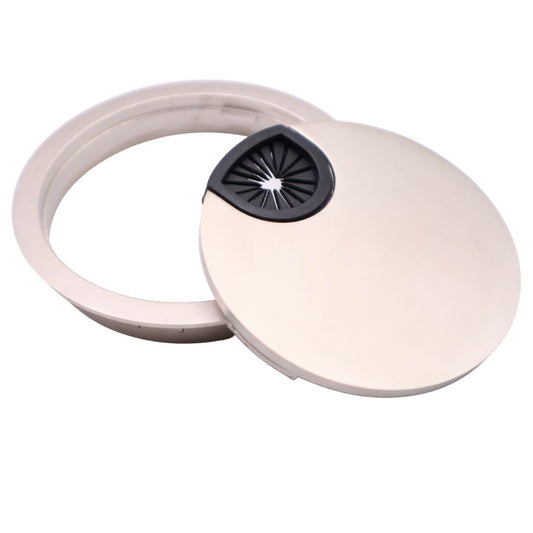
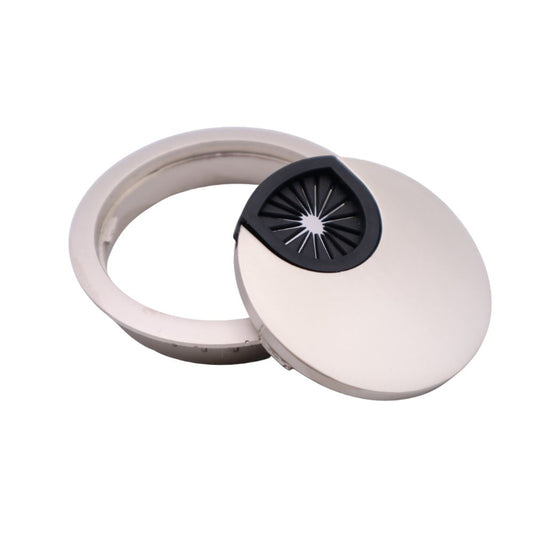
Satin desk grommetsare technical hardware fittings designed for furniture construction and interior fitting, engineered to neatly route power and data cords through desk tops, cabinet back panels, or sideboards. In this version, they are primarily manufactured from metal alloys with a specialized matted finish. This silky-matte sheen reduces light reflections, minimizes visible fingerprints, and offers a cool, neutral aesthetic that integrates seamlessly into modern office and residential environments. For cabinetmakers, installers, and ambitious DIYers, these fittings serve as the mechanical interface between a solid furniture surface and the required IT or power infrastructure.

Technical Function of a Desk Grommet

A precisely routed desk grommet acts within a piece of furniture like avalve in a piping system: it bundles the uncontrolled flow of data and power cables at a single defined pass-through point, preventing cord chaos on the work surface.

Beyond simple cable management, this fitting fulfills other essential roles in furniture construction:

  • Edge Protection:Covers the sharp or rough cut edges of the hole drilled inparticleboard,MDF, orsolid wood, protecting cable jackets from abrasion caused by mechanical friction.
  • Strain Relief:Integrated bristles or arubber grommet insertlightly secure cables, preventing plugs from accidentally sliding back underneath the desk.
  • Dust Protection:A closed cap or tight-fitting rubber lips prevent dust from entering the space underneath the desk or inside a cabinet.

Unlike plain plastic alternatives, ametal desk grommetprovides significantly higher mechanical stability. This is particularly relevant for heavy conference tables or high-traffic workstations where thick cable bundles (e.g., power strip leads) exert constant tension on the fitting.

Sizing and Formats for Cabinetry & Furniture Making

Selecting the correct diameter is the most critical step in project planning. Dimensions generally refer to thehole diameter(the cutout size), not the outer diameter of the top flange.

The Standard: 3-1/8 in (80 mm) Diameter

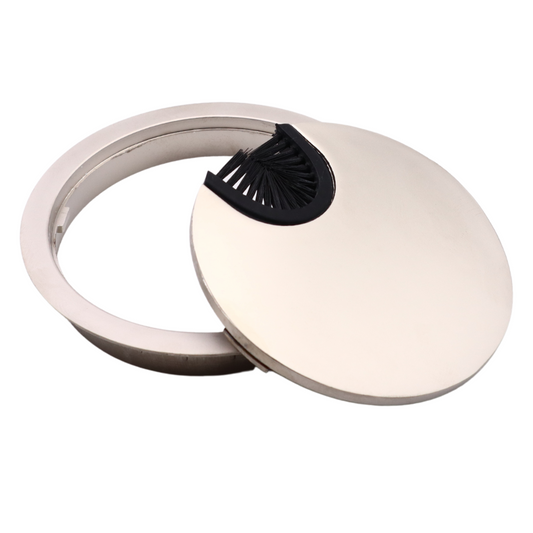
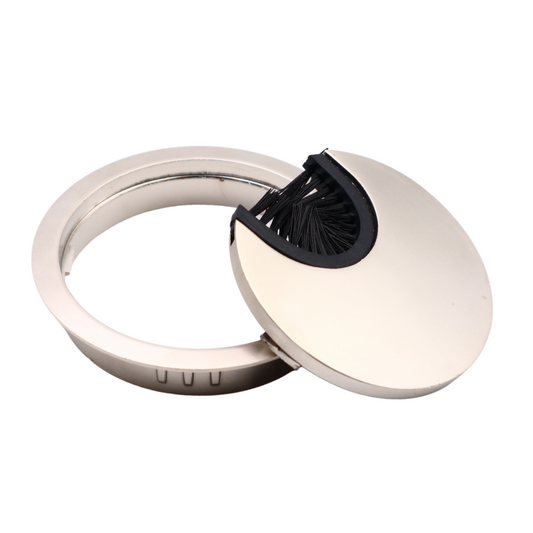
For complex workstations, an 80 mm desk grommet is the industry benchmark. A 3-1/8 in (80 mm) cutout offers ample space to pass bulkygrounded power plugs, large power adapters, or thick DVI and DisplayPort cables with wide connectors. A classic option for these requirements is theSatin Metal Desk Grommet with Rubber Pass-Through - 3-1/8 in (80 mm). It features a removable lid; when locked in place, it leaves an opening protected by a rubber membrane or brush seal. Likewise, the standard3-1/8 in (80 mm) Satin Metal Desk Grommetwithout a dedicated rubber insert provides maximum clearance when the center piece is removed.

The Compact Solution: 2-3/8 in (60 mm) Diameter

When routing thinner cables like USB lines, network cables (RJ45), or slim two-prong plugs, a 60 mm desk grommet is sufficient. A 2-3/8 in (60 mm) hole takes up less surface area on the desk and reduces structural weakening of the desktop. Fittings like the2-3/8 in (60 mm) Satin Metal Desk Grommetor theSatin Metal Desk Grommet with Rubber Pass-Through - 2-3/8 in (60 mm)are ideal for this. However, keep in mind that while a standard grounded plug (approx. 1-1/2 in to 1-5/8 in (38 mm to 42 mm) in diameter depending on design) can technically pass through a 2-3/8 in (60 mm) hole, the angling required for thick, rigid cords can be challenging.

Shapes and Profiles

While classicround cable grommetsdominate the market because they can be drilled quickly using rotating hole saws,rectangular cable grommetsor square options are available for specific design needs. Installing a rectangular grommet requires a router with a template or precise jig-sawing, which increases assembly effort. Specific profiles, such as aU-shaped cable grommet, are often placed along the rear desk edge, allowing cables to exit directly down the back wall without cutting a fully enclosed hole into the top.

Design Features and Finish: Why Choose Satin?

In furniture hardware,satinrefers to the surface finish rather than the base material. The core structure typically consists ofdie-cast zinc alloy (Zinc alloy)or sheet steel. This base material is electroplated and then given a matte finish via brushing or bead-blasting.

The main technical advantage of a satin finish lies in light refraction. Unlike high-gloss chrome, a satin desk grommet diffuses light. On an office desk, this eliminates glare from task lamps or computer monitors. Furthermore, its micro-textured surface resists fingerprints and fine scratches caused by pulling cords across the rim.

This finish blends seamlessly with other satin hardware components. For instance, when designing a moderndark walnut satin sideboard, cable pass-throughs can be perfectly matched tosatin furniture legsorsatin cabinet handles. On rich, dark woods like walnut, the cool, matte silver-gray tone of a satin desk grommet provides a crisp, modern accent. Even on a traditionalwalnut satin credenzarepurposed as a media console, these fittings blend in unobtrusively.

Installation and Processing Guidelines

Installing a desk cord grommet requires precision. An uneven hole can cause the fitting to wobble or—even worse—prevent the top rim from concealing tear-outs in the laminate coating.

Tool Selection

For round grommets, ahole sawor a largeForstner bitis the tool of choice. A Forstner bit yields the cleanest edges, but in sizes like 2-3/8 in or 3-1/8 in (60 mm or 80 mm), it requires a heavy-duty drill driver or drill press. For handheld drilling with a cordless drill, a high-quality bimetal hole saw with a pilot bit is recommended.

Drilling Melamine-Coated Particleboard

  1. Positioning:Choose a drill center that avoids under-desk crossbars, metal frames, or drawer slides. A distance of at least 2 in to 4 in (50 mm to 100 mm) from the rear edge of the top is recommended to maintain edge strength.
  2. Pilot Hole:Drill completely through the panel using the hole saw’s pilot bit.
  3. Drilling from Both Sides:To prevent chip-out on the underside of theparticleboard, cut from the top until the pilot bit breaks through the bottom. Then flip the panel (or continue from beneath) to complete the cutout from the opposite side.
  4. Inserting the Fitting:Place thedesk grommetinto the wood cutout. The friction-fit mechanism on most metal grommets accommodates top thicknesses ranging from 5/8 in to 1-1/2 in (16 mm to 38 mm).

Securing the Grommet

Generally, grommets are installed with a press fit. The ribbed outer sleeve provides sufficient grip in the wood. If the cutout ends up slightly oversized, secure the housing from the underside using a drop of clear construction adhesive or hot melt glue.

Applications and Specific Uses

Standard Office Workstations

Every moderndesk with cable pass-through grommetsbenefits from clear separation between the work surface and underlying cords.Desk wire grommetsare typically positioned in the rear corners (left and right) to route monitor cables, keyboard cords, and chargers directly into an under-desk wire tray.

Living Room & Entertainment Centers

When building a TV stand or audio rack, adesk cable pass-throughis equally essential for routing thick HDMI cables, optical audio cords, and power leads through back panels or interior shelves. Arubber grommet insertalso damps minor vibrations that speaker wires might otherwise transfer to the wood cabinetry.

Distinction from Industrial & Wall Grommets

Furniture grommets should not be confused with architectural or structural fittings. Customers frequently search for terms likewall cable grommets,exterior wall pass-throughs, orcable entry seals. A satin desk grommet isnotengineered for masonry or outdoor use and carries no IP ingress protection rating. Projects requiring awaterproof cable entryorwatertight cable grommetrequire industrial cable glands (such as NPT or PG fittings) or modular industrial entry systems (like anicotek cable entry frame). Similarly, a simplerubber hole plug grommetfor automotive or wet-location use differs significantly from two-piece decorative metal furniture grommets. Adesk cable grommetis built for interior aesthetics and smooth cord management, not weatherproofing or draft sealing.

FAQ – Frequently Asked Technical Questions

1. What exact hole size do I need to drill?

The nominal product size matches the required drill diameter. For a 2-3/8 in (60 mm) grommet, use a 2-3/8 in (60 mm) hole saw. The upper flange (lip) is always slightly wider (typically around 2-11/16 in (68 mm) for a 60 mm hole) to cleanly cover the cut edge.

2. Will standard power plugs fit through a 2-3/8 in (60 mm) opening?

Yes, a standard grounded plug measures about 1-1/2 in to 1-5/8 in (38 mm to 42 mm) in diameter and will fit through a 2-3/8 in (60 mm) cutout. However, if you need to pass multiple thick cables simultaneously or if the plug has a right-angle design, 2-3/8 in (60 mm) can be tight. In those cases, choosing a 3-1/8 in (80 mm) diameter is strongly recommended.

3. How does the lid locking mechanism work?

Most metal desk grommets feature a twist-lock or spring-tension catch. Insert the center cap and turn it slightly (about 15° to 30°) to lock it into the outer ring. This prevents stiff cables from pushing the lid up and out of place.

4. Can I install these grommets in extra-thick countertops?

Yes. Because the grommet body acts like an open cylinder, maximum top thickness does not limit functionality. In a 1-1/2 in (40 mm) thick solid wood desktop, the sleeve simply won't extend all the way through to the bottom. Minimum panel thickness should be at least 5/8 in (15 mm) to prevent the flange from protruding underneath.

5. What is the difference between a brush seal and a rubber pass-through?

A brush seal (nylon bristles) conforms flexibly around various cord shapes and seals large openings effectively against dust. A rubber pass-through (a rubber membrane with star-shaped slits) grips cables more firmly, helping prevent individual thin cords from slipping back down through the hole.

6. How do I retrofit a desk grommet into an existing table?

Retrofitting is straightforward. Clear off the desktop completely. Apply painter's tape over the target area to reduce laminate chipping. Hold the hole saw perfectly vertical and drill at medium speed with steady, moderate pressure. Vacuum away wood shavings immediately.

Related Categories and Alternatives

If a satin finish doesn't match your project, or if you need different hardware configurations for wire management, explore technical solutions in our other dedicated categories:

Plan cable paths early in the design process and choose a grommet diameter based on your largest cable connectors to ensure straightforward assembly and a clean, organized workspace.