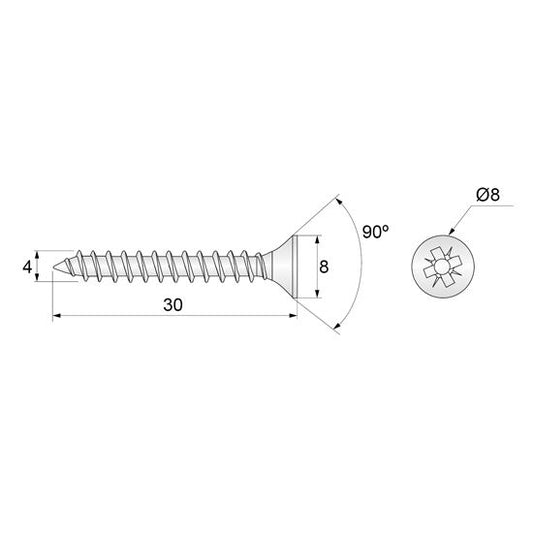
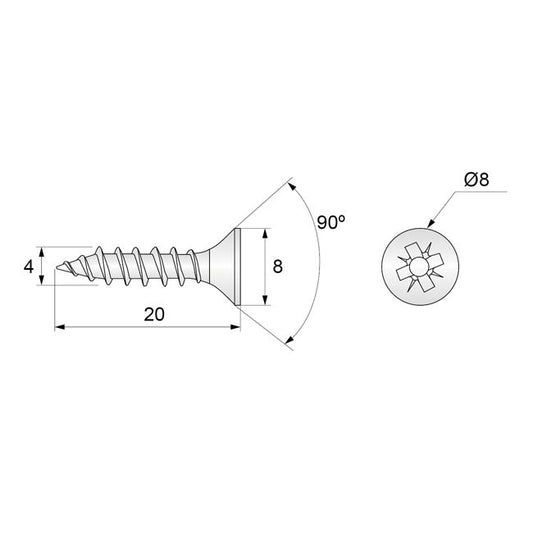
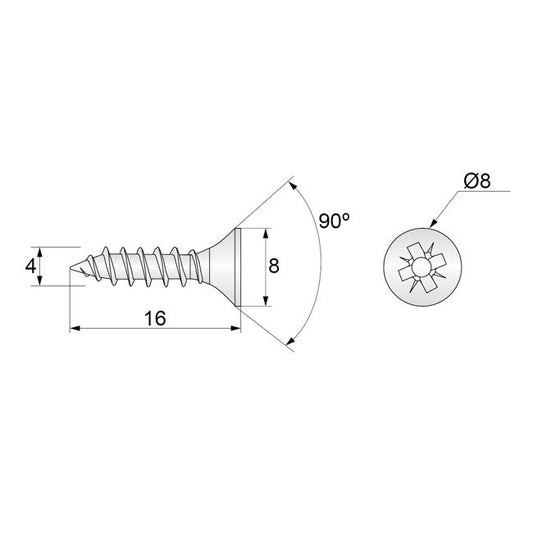
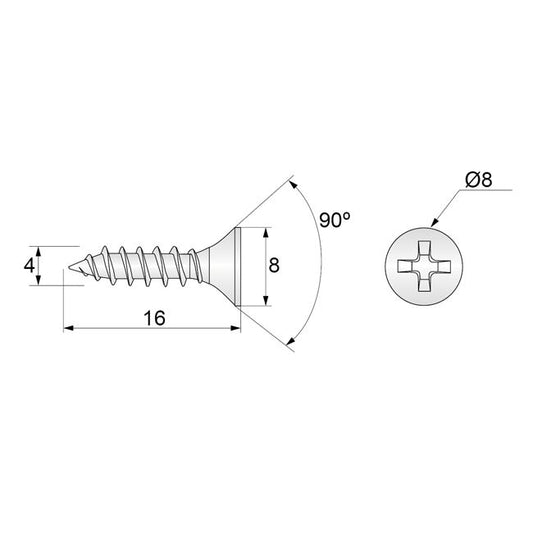
4mm Wood Screws

0 products

No products found
Use fewer filters or remove all

4mm wood screwsare versatile fasteners manufactured with an exact outer thread diameter of 4.0 mm (approx. #8 gauge). In cabinetmaking and interior fitting, they are primarily used for high-tensile connections in engineered wood materials (particle board, MDF, solid wood) and for securely mounting furniture hardware.

Technical Specifications and Drive Types

A diameter of 4.0 mm (approx. #8) represents the absolute standard for structural joints and hardware installation in modern furniture manufacturing. This dimension offers an optimal balance between material displacement and pull-out resistance. When proper edge distances are maintained, a 4 mm thick screw will not split standard particle board (from 5/8 in (16 mm) thickness), yet it provides a large enough thread flank to absorb high shear forces.

When selecting the rightwood screws and furniture screws, the drive type is a crucial factor for efficient torque transmission during assembly. Two cross-recess standards dominate this sizing category:

  • PZ (Pozidriv):Recognized by the additional fine radial lines between the main slots. The drive flanks run parallel, which drastically reduces cam-out (the bit slipping out of the screw head). This is the preferred drive system for high-volume power driving. Matching products can be found in thewood screws PZ2category.
  • PH (Phillips):The classic cross-recess drive with slightly tapered flanks. It was originally designed to let the tool cam out at a specific torque to prevent over-tightening. For specific assembly needs, correspondingwood screws PH2are available.

Nearly all standard wood screws in this segment feature a flat countersunk head. The conical head sits flush with the workpiece surface or the countersink of the metal bracket. To protect against corrosion in standard indoor humidity (living rooms, bedrooms, hallways), these fasteners are zinc-plated. Thesezinc wood screwsfeature a smooth, low-friction surface that reduces driving torque.

Mounting Drawer Slides: Screws for Drawer Runner Installation

A major technical application for the 4.0 mm diameter is installing moving hardware. When tradespeople choosescrews for drawer slides, the head geometry and thread diameter must precisely match the stamped holes in the slide runners.

While the industrial 32 mm system frequently relies on 5.0 mm Euro screws in pre-drilled hole pattern series, custom placement of telescopic slides, roller runners, or undermount slides calls for classic chipboard screws.4mm wood screwsor alternatively3.5mm wood screwsare the gold standard here.

When you install drawer slides with screws, the countersunk screw head must sit completely flush inside the mounting rail's stamped hole. If the head protrudes by even 1/64 in (0.5 mm), it will collide with the slide's moving profile, jamming the mechanism or damaging the ball bearings. Adrawer slide screwwith a 4.0 mm diameter provides just the right head size (typically around 5/16 in (8.0 mm) head diameter) to sink flush into the metal, while the thread guarantees maximum holding power in the cabinet body. For securing slides to the side panels, 5/8 in (16 mm) lengths are most commonly used so as not to pierce standard cabinet walls (approx. 23/32 in (18 mm) or 3/4 in (19 mm)).

Choosing the Right Length: From 5/8 in (16 mm) to 1-3/16 in (30 mm)

A screw's length dictates its application. For flat countersunk screws, total length is always measured including the head. A 4 mm thread inside sheet material behaves like a secure anchor in the seabed: it bites deep into the fiber structure and withstands continuous tensile loads from heavy drawers or doors without bursting the substrate.

  • 5/8 in (16 mm) Length:The absolute industry standard for mounting hardware. Whether for concealed hinges, mounting plates, or asdrawer slide screws, this length ensures the screw point will not break through the exterior side of a 23/32 in (18 mm) particle board panel.
  • 25/32 in (20 mm) Length:Frequently used to mount heavy-duty hardware to thicker materials (from 7/8 in (22 mm)) or to join two thin panels together (e.g., attaching 3/8 in (10 mm) back panels to a 5/8 in (16 mm) cabinet carcass).
  • 1 in (25 mm) and 1-3/16 in (30 mm) Lengths:These sizes are used for cabinet assembly itself, such as installing decorative trim, double-faced panels, or plinth fascia.

(Note on length sizing: While structural timber construction, such as roof framing, requires9-7/8 in (250 mm) long wood screwsor a9-7/8 in (250 mm) wood screwwith a washer head, cabinetmaking and interior millwork in a 4 mm diameter operate almost exclusively within the 1/2 in (13 mm) to 2 in (50 mm) range).

Installation Technique: Pre-Drilling for Wood Screws

A frequent technical question when working with4mm wood screwsinvolves pilot holes. Pre-drilling depends heavily on the density of the material and proximity to the edge.

  1. Particle Board and MDF:When mounting hardware in the middle of a panel face, pre-drilling for a4mm screwis usually not strictly necessary because modern chipboard screws feature a sharp point that grips immediately. However, if the screw location is less than 1-3/16 in (30 mm) from the edge, a pilot hole must be drilled to prevent edge splitting.
  2. Solid Wood (Hardwood):In oak, beech, or ash, pre-drilling for wood screws is essential. Otherwise, the wood will split or the screw head may snap off during driving.
  3. Drill Bit Diameter:The rule of thumb for pilot holes is to match the core root diameter of the screw. For a4mm wood screw, a wood drill bit measuring 3/32 in (2.5 mm) or maximum 1/8 in (3.0 mm) is recommended. Drill only as deep as the screw length.

When driving screws with a power tool, pay close attention to the clutch torque setting. Excessive torque will strip the threads in particle board, causing the connection to immediately lose 100% of its pull-out strength. When assembling drawers with screws, set your drill clutch to a low or medium torque setting.

Selected Products for Specific Applications

Depending on your project scale and required drive system, our selection includes precisely packaged quantities:

Frequently Asked Questions (FAQ)

Which bit size do I need for 4 mm wood screws?

That depends on the screw head. For a 4.0 mm diameter (#8 gauge), size #2 is the standard. You will need either a PZ2 bit (Pozidriv) or a PH2 bit (Phillips). Using the wrong bit size or drive type (such as a PZ1 bit in a PZ2 screw) will strip the screw head.

Are 4 mm screws suitable for installing European cup hinges?

Yes. For mounting cross-shaped mounting plates on cabinet interior walls and attaching the hinge cup (usually 1-3/8 in (35 mm) diameter) to the door,4mm wood screwswith a length of 5/8 in (16 mm) are ideal, provided no pre-drilled 5 mm holes for Euro screws are present.

What happens if a 4 mm screw strips out in the wood?

If the thread inside the substrate (e.g., particle board) strips out, the screw loses all holding power. The proper fix is to remove the 4.0 mm screw and replace it with a screw of a larger thread diameter (such as 4.5 mm or 5.0 mm / #9 or #10 gauge) at the same length. Alternatively, fill the hole with wood glue and a wooden dowel or toothpick, let it cure, and re-drive the screw.

Can I use 4mm wood screws with wall anchors?

Yes. For a standard 1/4 in (6 mm) nylon wall anchor (1/4 in (6.0 mm) drill hole), a screw with a diameter of 4.0 mm or 4.5 mm is technically the exact fit to properly expand the anchor inside masonry or drywall.

What screw length should I choose for 5/8 in (16 mm) thick particle board?

When screwing hardware onto a panel without drilling through the back, subtract 1/16 in to 5/64 in (1.5 mm to 2.0 mm) from the panel thickness for safety. On a 5/8 in (16 mm) panel, the maximum screw length inside the wood is about 9/16 in (14 mm). If the hardware bracket itself adds 5/64 in (2.0 mm) of thickness, a 5/8 in (16 mm) screw is an exact fit.

Related Categories and Alternatives

If your cabinet building project requires different dimensions or drive sizes, explore the technical specifications in these related categories: